
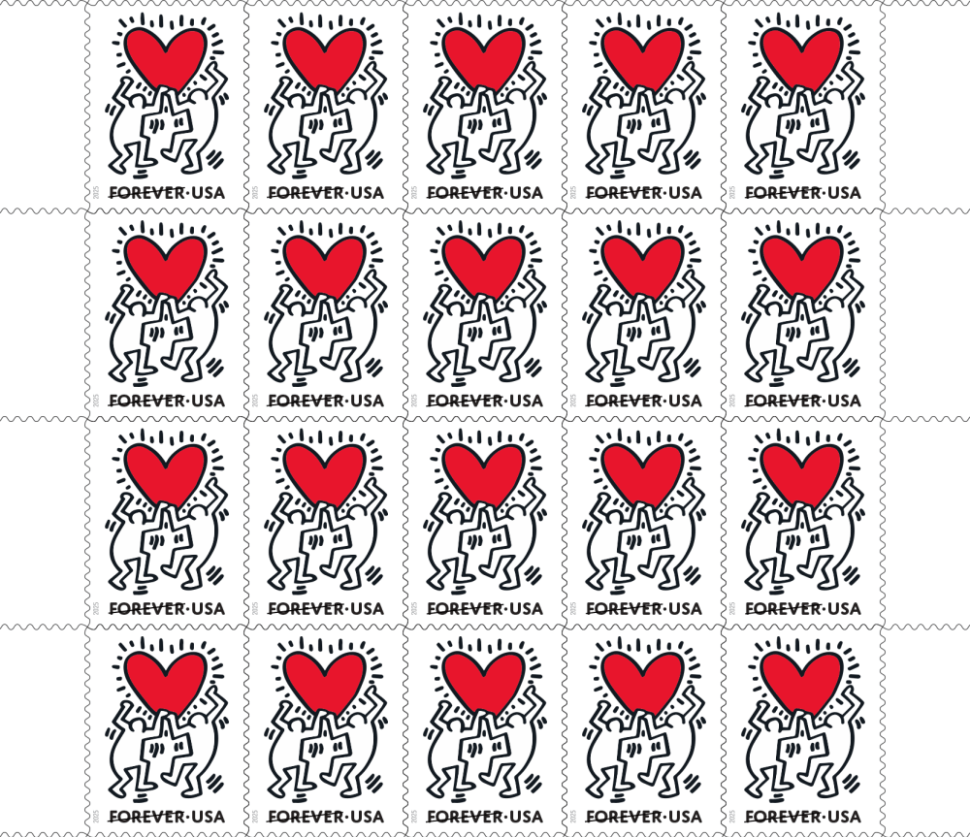
Keith Haring-style âForever USAâ stamps, each with black outlined figures holding up a red heart.” width=”970″ height=”837″ data-caption=’The Keith Haring Foundation, founded a year after the artist’s death in 1990, earned $13.2 million in 2024 through licensing, artwork sales and investment income, distributing approximately $8 million in grants that same year. <span class=”lazyload media-credit”>Courtesy USPS</span>’>
The Robert Mapplethorpe Foundation has a large mandate—in fact, it has two: to promote photography as an art form and to support medical research focused on HIV/AIDS. Knowing that he had been diagnosed with and would soon die of AIDS, Mapplethorpe (1946-89) established his foundation the year before his death, placing all his assets (including real estate) and unsold photographs (plus negatives) into it to finance his goals.
Millions of dollars have been granted by the foundation to both areas since then, with money used to create the Robert Mapplethorpe Laboratory for AIDS Research at Harvard Medical School in Boston, the Robert Mapplethorpe Residential Treatment Facility at Beth Israel Medical Center in New York and the Robert Mapplethorpe Center for HIV Research at St. Vincent’s Hospital in New York. On the photography side, the foundation awarded three multi-million-dollar grants supporting photography programs at the Whitney Museum of American Art, the Hessel Museum of Art at Bard College, the Guggenheim Museum and the National Portrait Gallery of the Smithsonian Institution, resulting in galleries or facilities permanently named for Robert Mapplethorpe.
Millions more are being granted by the foundation, according to its president, Michael Ward Stout—$1.5 million annually “in an average year.” Thirty-seven years in, where does the Mapplethorpe Foundation get all the money it keeps doling out?
Not to worry. In an average year, the foundation earns between $2.5 and $3 million from a variety of sources. The lion’s share comes through the sale of Mapplethorpe’s photographic images. At the time of the artist’s death, there were 400-500 prints signed by Mapplethorpe, another 15,000-20,000 that were unsigned but have received an estate stamp (Stout noted that the average price for 16″ x 20″ or 20″ x 24″ signed and unsigned prints is $15,000), and a growing number of posthumously printed images that are larger (50″ x 60″) and sell for more.
There’s more. The Mapplethorpe Foundation earns a quarter of a million dollars annually from merchandising and licensing, as companies lease the right to use the artist’s images on a variety of products, and another $200,000-$250,000 per year in exhibition fees, as museums borrowing prints from the foundation pay $1,000 per image.
“When the foundation was started,” Stout told Observer, “I thought it would last 20 years, during which time we would turn the inventory into cash. Our obligation is to maximize the assets and make a lot of money.” Closing in on 40 years, the foundation shows no sign of running out of assets any time soon.
Most foundations that artists set up, referred to as artist-endowed foundations, exist to promote the legacy of those particular creators—encouraging research into the artists’ lives and work, underwriting publications that inform the public about the artists, creating catalogue raisonnés and authentication committees to identify all known works, making grants to institutions that display that artwork and inventorying, conserving and storing objects in their possession. Their goals are focused squarely on keeping these artists relevant and in the public eye. The Henry Moore Foundation in England, for instance, was set up in 1977 to “advance the education of the public by promoting their appreciation of the fine arts, particularly the work of Henry Moore.” A bit more wordy is the foundation created by Salvador Dalí in 1983 in Spain, which aims to “promote, boost, divulge, lend prestige to, protect and defend in Spain and in any other country the artistic, cultural and intellectual oeuvre of the painter… and the universal recognition of his contribution to the Fine Arts, culture and contemporary thought.”
Other artist-endowed foundations look beyond their own creators to help living artists who have their own needs. The foundation established through the will of painter Joan Mitchell (1925-92) both “cultivates the study and appreciation of artist Joan Mitchell’s life and work” and seeks “to aid and assist working artists,” which it has accomplished with annual fellowships of $60,000 to 15 artists and six- or 10-week residencies at the Joan Mitchell Center in New Orleans that include private studio space, weekday meals and a $150 per week stipend. The foundation set up two years after the death of painter Adolph Gottlieb (1903-74) exists exclusively to provide money to artists in financial need, through individual support grants and emergency assistance grants.
Whatever the purposes of individual artist-endowed foundations, they all need money to fulfill their missions, and coming up with it requires ingenuity. Their initial and perhaps only real assets are the artworks created by the artists, which can be sold to fund their goals. “The sale of works of art from our collection is our major source of income,” said Sanford Hirsch, executive director of the New York City-based Adolph and Esther Gottlieb Foundation and chairman of the board of directors of the Nancy Graves Foundation, which both promotes the legacy of painter and sculptor Nancy Graves (1939-1995) and offers grants to individual visual artists. That foundation also raises money through sales of the artist’s work. “The Gottlieb Foundation annual budget is around $2,000,000. The Nancy Graves Foundation annual budget is around $700,000.”
The Joan Mitchell Foundation’s budget is considerably higher, just over $10 million, according to its executive director, Christa Blatchford, who noted that “the foundation’s annual budget is covered through investment returns and strategic artwork sales, which further build the foundation’s investment portfolio to support our mission-based work.”
There are other ways of generating income for artist-endowed foundations, as the Robert Mapplethorpe Foundation has made clear. “Product licensing by artist-endowed foundations is not an uncommon activity,” said Christine J. Vincent, managing director of the Aspen Institute’s Artist-Endowed Foundations Initiative. She noted that licensing copyrighted images “generally serves multidimensional purposes, including increasing the public’s access to and knowledge about the artist’s creative achievements and principles, even as it may also represent an important source of income to support operation of a foundation’s charitable programs.”
Royalties and licensing fees may range widely, from $10,000 a year at the Woodman Family Foundation to $6,227,894, which the Andy Warhol Foundation for the Visual Arts reported in 2024. As a point of comparison, the Dedalus Foundation (Robert Motherwell) reported royalty income in 2024 of $18,227, while the Irving Penn Foundation earned $131,032 and the Easton Foundation (Louise Bourgeois) brought in $256,639. The Josef & Anni Albers Foundation earned royalties of $182,188, as well as authentication fees of $7,690 and “reproduction fees” of $51,124. The Calder Foundation earned $529,250 from “exhibition income,” charging museums that borrowed the artist’s work for displays and another $26,938 from conservation work on Calder artworks owners brought in for repairs.
The Keith Haring Foundation and the estates of Jean-Michel Basquiat and Roy Lichtenstein are among the leaders in licensing and merchandising, with revenues used to support the larger goals of promoting the individual artists and their stated missions. The Keith Haring Foundation, founded in 1991, a year after the artist’s death, looks to promote Haring’s artistic legacy by funding exhibitions, arts organization programming and publications on the artist, as well as “philanthropics, such as AIDS research and youth services,” according to its executive director Simon Castets. In 2024, that grantmaking added up to approximately $8 million, and the foundation itself earned $13.2 million that year through licensing, the sale of Haring artworks and investment income. “We do better than break even every year,” Castets said.
Some artists’ profitability can last for many decades. “We do not share information about our annual revenue,” Frank Avila-Goldman, executive director of arts and intellectual property for the estate of Roy Lichtenstein, told Observer, “but the estate has managed the copyrights of Roy Lichtenstein for many decades.” He noted that “we license internationally, year-round,” citing “recent projects such as Uniqlo, PUMA/BMW, Skateroom, Supply Stickers, Commes des Garcon/Junya Watanabe, USPS stamps, as well as various movies, streaming services and TV licensing.”
Licensing generally involves permitting a company to create products based on an artist’s work, but some artist-endowed foundations have taken it upon themselves to make reproductions and other items for sale to the public. Celia Bertoia, the daughter of sculptor Harry Bertoia and founder and director of the Harry Bertoia Foundation, has authorized the production of an edition of 300 tabletop sculptures based on a sketch by her father. The Isamu Noguchi Foundation offers a line of Noguchi Coffee Tables based on a design the artist realized in 1944, available in various colors at $2,913, including in-home delivery but not assembly. The Louise Nevelson Foundation established its own separate entity, NevelsonLLC, offering a small but growing number of products. “NevelsonLLC is a way to generate revenues,” said Marie Nevelson, the artist’s granddaughter.
Single-artist museums also need ways to generate revenue, turning in many instances to creating and selling their own editions. Both the Musée Rodin in Paris and the Frederic Remington Art Museum in Ogdensburg, New York earn a third of their annual revenues through the sale of reproductions and original castings of the respective artists’ work. “Rodin bequeathed to the museum his works and possessions including his intellectual property rights and the right to cast original bronze editions of his works beyond his lifetime,” said Amélie Simier, director of the Musée Rodin, told Observer. “We are a self-supporting museum.”
A company that licenses images from a number of European single-artist museums, Boutiques des Musées, offers reproductions of painted images and sculptures, including from the Van Gogh Museum in Amsterdam, the Marc Chagall Museum in Nice, the Fernand Léger Museum in Cannes and the Musée National Picasso-Paris. Among the Picasso-themed items are head scarves and cushion covers.
The Adolph & Esther Gottlieb Foundation has been in operation for half a century, but keeping an artist-endowed foundation in business is not a sure thing. Magda Salvesen, director of the Jon Schueler Foundation, formed in 2024, told Observer that “nothing is very solid in the art world. The appreciation of artists’ works is totally unpredictable, with excellent years of demand and then a fizzling out. Prices can totally depend on the reputation of the gallery, increasing by 150 percent or much more when picked up by a blue chip very wealthy gallery or dropping when the artist’s work is let go or discarded.”
At present, the foundation earns what she called a “minimal” amount of money from the sale of postcards, posters, catalogs and DVDs featuring the artist’s (1916-92) work. A “modest” endowment helps the organization pay the bills but, she said, “the foundation will inherit when I die the shares of the co-op where the paintings are mostly stored, where the office is located and where I still live,” as well as “some private money.” Then, “the foundation will be in better shape, and at that point my co-directors can have a broader idea of how long the foundation can run for and they can determine more easily what the average income may be from sales of paintings.” Artists, the saying goes, only become famous after they die—or, in this case, after the director of their foundation does.
