
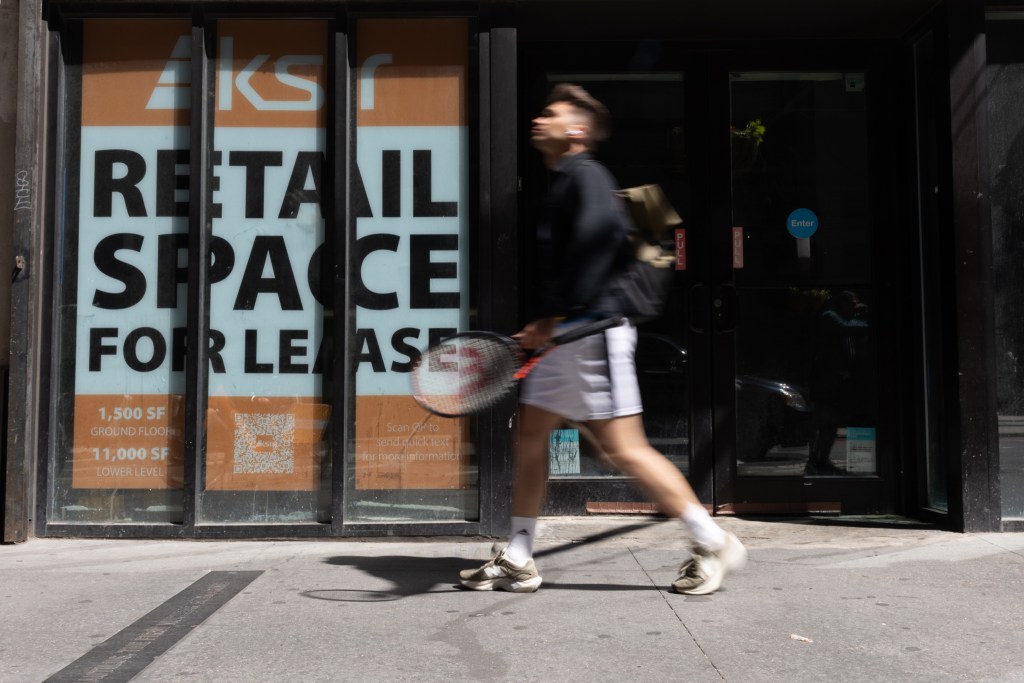
Six years after the pandemic shuttered businesses across New York, the city’s commercial corridors have not quite recovered, reflected in persistent storefront vacancies.
That’s according to a new report by the city comptroller’s office, which for the first time tracked ground-level data — indexing every visible storefront in New York City — and found that the citywide vacancy rate stands at 11.0% as of April 2026, up from 10.5% at the start of 2020.
This new report complicates Mayor Zohran Mamdani’s recent celebration of a new post-pandemic low in storefront vacancies in New York, and the opening of 27 new businesses in the Financial District. While storefront vacancy rate is trending down generally, it varies greatly by neighborhood.
“Storefront vacancies are at a post-pandemic low, and we’re continuing to unlock opportunities for more small businesses to open and existing small businesses to thrive,” Mamdani said on social media on Tuesday.
Responding to the comptroller’s report, the mayor’s office said that 340 commercial spaces that had been vacant for at least two years were filled in the first quarter of 2026.
A Lower Manhattan building advertised vacant retail space, June 2, 2026. Credit: Ben Fractenberg/The City Reporter
The report found that empty stores are mostly concentrated in Lower Manhattan, north Brooklyn and western Queens.
The Financial District and Battery Park City lead the city with a vacancy rate of 21.1% — meaning nearly one storefront in four is empty. Old Astoria–Hallets Point in Queens nearly matches it at 20.1%. And a band of central Brooklyn — Ocean Hill, East New York, the eastern and western flanks of Bedford-Stuyvesant and the north end of Crown Heights — runs above 15%.
The report also found that once a storefront becomes vacant, it tends to stay that way for a long while. In many of the hardest-hit neighborhoods, 80% to 90% of currently vacant storefronts had already been empty for at least nine months.
The persistent vacancies reflected the calculus of individual landlords more than any deliberate warehousing of space, said Demetri Ganiaris, who chairs the Tribeca Alliance and runs a small commercial real estate brokerage.
Most landlords want to rent, he said. But asking rents downtown have fallen roughly 20% to 25% from 2019 levels, Ganiaris said, and the tenants who do come looking often do not have enough funds — offering, for example, $12,000 a month for a 2,000-square-foot space that typically rented for at least $20,000, and bringing business plans that wouldn’t support even the lower figure.
“Landlords don’t want to rent to a business that struggles to pay that rent,” Ganiaris said. “Because then in this legal world that we live in New York City, it can take quite a while to kick out a delinquent tenant.”
Within the disproportionately impacted neighborhoods, the vacancies tend to cluster together.
While the report does not directly offer any explanations for why vacancy rates are higher in some neighborhoods than others, a spokesperson for the comptroller’s office said that gentrification, rising rents, and office vacancy rates downtown can all contribute to the pattern.
Wall Street Slump
On Pine Street in the Financial District, the owner of Wall Street Wine Merchants, Mishal Kamdar, has operated his family store in the same block since the early 1990s — surviving Sept. 11, the 2008 recession, Superstorm Sandy, and then COVID.
“Each time there brought changes, and there was a period of kind of sloping down, but it came back,” he said. “It’s a change, so we just had to adapt.”
This time, Kamdar is changing his business to keep up with the Financial District morphing from a corporate hub to a more residential neighborhood, which has upended the daily foot traffic his business has depended on.
An example of the trend is right across the street. The building directly across from his shop, 80 Pine St., was once entirely corporate offices. Now it is being converted into a mostly residential building.
“Prior to COVID, throughout the day we had a steady stream of traffic from morning to lunchtime, and then leaving,” he said. Now, business only picks up in the evening hours when local residents return home from work in other parts of the city, he said.
The vacancies in Lower Manhattan are due to the drainage of office workers in the area, said Jessica Walker, president of the Manhattan Chamber of Commerce.
“It’s all about weakened demand,” she said. “It was a district before COVID that was very heavy with workers, and after COVID, we are seeing a significant decrease in the number of workers coming into the office five days a week.”
The office vacancy rate in the Financial District was approximately 26% in the first quarter of 2026, according to a recent commercial real estate report from Cushman and Wakefield, a stark contrast to 16.5% in the last quarter of 2019.
Costs Climbing
The comptroller’s report compares New York with the rest of the nation, and it’s not a flattering view. The disparity in vacancy rates between New York neighborhoods was the widest of nine largest metropolitan areas in the country, with some neighborhoods showing 30% vacancy rates when measured by square footage of retail space available.
In SoHo and on Fifth Avenue, brokers are reporting record asking rents and the tightest prime-corridor availability since they began tracking it in 2019. Eight of Manhattan’s 12 community districts have recovered to or lower than their pre-pandemic levels. The four that haven’t — Lower Manhattan, The East Side, Midtown and Hell’s Kitchen and Chelsea — are all office-dominated neighborhoods.
However, for storefront owners who have survived, the wider economic recovery has not brought much relief.
The Manhattan Chamber of Commerce’s survey of 117 storefront owners — heavily weighted toward food and beverage businesses — found that 16% are considering permanently closing within the next year. Only 8% described their business health as “very good.”
“The recovery is still very fragile,” Walker said. “Cost pressures, in particular, are weighing our businesses down.”
At Wall Street Wine Merchants, owner Kamdar pays $17,000 a month in rent and he finds it hard to make a profit when the overheads — between rent, utilities, and the costs of three employees — are so high.
The story is the same among members of the Chamber. Owners told the trade group that rent is their single largest cost pressure, with 47% citing rent and occupancy as the top burden.
But the Chamber’s survey found that commercial rent is the slowest-growing cost for businesses in the city, up just 2% year over year. The faster-rising costs include health insurance, up 12.9%; utilities, up 8.5%; business insurance, up 7%; and tariff-exposed goods and materials, up 5.5%.
Walker said the Chamber’s top policy request is for the city to assess the economic impact of every new piece of legislation before it is passed. The Chamber’s survey found 68% of Manhattan’s storefront operators rate the city government ineffective at supporting them.
A realtor advertised vacant retail space in the Financial District, June 2, 2026. Credit: Ben Fractenberg/The City Reporter
“Many small businesses are spending more of their time dealing with regulations and complying with different laws,” she said. “That is time taken away from dealing with customers, learning new skills, marketing their business.”
The city is now betting on what officials hope will be the busiest tourism summer in its history with the FIFA World Cup kicking off in two weeks and the celebration of America’s 250th birthday. The Chamber’s report projects 7 million visitors and more than $6 billion in economic impact in the broader New York area through the summer.
For Kamdar, the question is whether the soccer fans and tourists who do come reach the Financial District or whether they cluster in the corridors that are already doing fine, like Midtown West and the Upper East Side.
“We’ll see what happens this summer with the World Cup,” he said. “But it’s tough.”
Our nonprofit newsroom relies on donations from readers to sustain our local reporting and keep it free for all New Yorkers. Donate to THE CITY today.
The post 15,700 Zombie Storefronts Sit Empty Across NYC, New Report Says appeared first on The City Reporter.
