
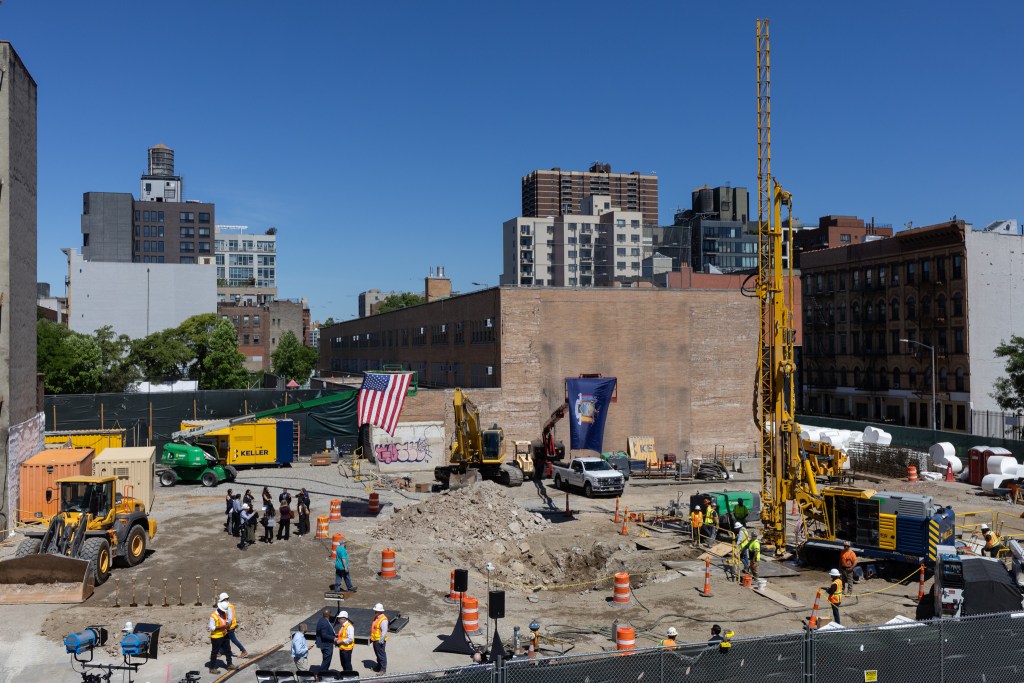
New York officials dropped ceremonial shovels into a Second Avenue lot Monday ahead of a much deeper dig to eventually stretch the Q line into East Harlem, then potentially further west beneath 125th Street.
Gov. Kathy Hochul, elected leaders and the head of the MTA dug into the East 119th Street construction site — where massive tunnel boring machines will soon begin carving north on the nearly $7 billion next phase of the Second Avenue Subway. The groundbreaking marks the latest step forward for a project that has been repeatedly derailed since it was proposed in the late 1920s.
“When I became governor, I promised that I would be the leader to finally get this done and by breaking ground on the major construction phase of this project, we are one giant step closer to realizing a dream nearly a century in the making,” Hochul said.
Machines that tip the scales at more than 1.5 million lbs. will arrive in early 2027 to begin drilling through rock, soil and sand en route to 125th Street and Malcolm X Boulevard, the potential starting point for yet another three-station extension, one that could someday move the line west to Broadway.
The milestone came after the Trump administration agreed in April to release nearly $60 million it withheld from the MTA on work to stretch the subway north from the Q line’s 96th Street terminal, one of three Upper East Side stations that opened beneath Second Avenue on New Year’s Day 2017.
Small businesses along Second Avenue near East 116th Street were blocked from view by construction sites for the Second Avenue Subway expansion, June 8, 2026. Credit: Ben Fractenberg/The City Reporter
The funding holdup led the MTA to take legal action against the federal government, even as the transportation authority moved ahead in awarding a contract to excavate and construct the 106th Street station. That part of the project would connect the “tail tracks” just north of the end of the line’s first phase with an existing 1970s-era tunnel whose construction was halted during the city’s financial crisis.
The three new stations at 106th, 116th and 125th street are supposed to open by 2032.
The contract for the tunnel boring will also include controlled blasting for future stations, as well as asbestos and lead abatement in the tunnel that then-Gov. Nelson Rockefeller and then-Mayor John Lindsay broke ground on in 1972. The project was shelved just three years later with the city teetered on the brink of financial collapse.
That 70s-era stretch of the Second Avenue line has remained largely off-limits for decades, with MTA crews regularly checking on its structural integrity while also keeping it in play for a long-planned line extension. The project is designed to make up for the demolition in the 1940s and 1950s of elevated lines that ran above Second and Third avenues.
“It was 80 years ago that they started knocking down the Second Avenue El — an entire lifetime,” said Janno Lieber, MTA chairperson and chief executive. “Today’s groundbreaking is another major step toward transit justice for East Harlem, the city’s most transit-dependent community.”
To get to the closest train stations, East Harlem locals walk to the Lexington Avenue line, whose congestion is a driving factor in building a new segment of the Second Avenue line.
“The 6 line is annoying, it’s overcrowded and there is always some issue,” said Hana Rubenstein, who lives across from where the tunnel boring machine will proceed north at 119th Street. “We need the Q line because the green line is just over-capacity.”
Or they rely on the M15 buses to move up and down on First and Second avenues.
As she waited Monday morning at a Second Avenue and 115th Street bus stop for an M15 to take her to work, Jeanette Scott, 52, said the project will be a game-changer for East Harlem residents.
“It will make a huge difference, especially for me, because I’m right at the corner where [the 116th Street station] is supposed to be,” said Scott, who works in Alphabet City. “It will be beneficial for a lot of people in this area.”
The MTA is, in some cases, using eminent domain to acquire properties that are in the path of the project to build the new stops.
Some businesses are getting set to shutter or relocate because of ongoing or future work to relocate utilities.
East Harlem businesses owner Lou Nicat said he will have to close the shop that opened in 1993 because it is behind a construction fence near the future 116th Street stop on the Second Avenue Subway, June 8, 2026. Credit: Jose Martinez/The City Reporter
At Eagle Tile, owner Lou Nicat said some customers aren’t aware that his Second Avenue shop between 115th and 116th streets remains open because it is obscured by fencing that lists the names of businesses behind the barriers.
“There is no way of anybody knowing that I exist,” he told The City Reporter. “The contractors wouldn’t know I exist or are too aggravated to stop here and get material because they have to park two blocks down and carry the material over there.”
Nicat estimated that Eagle Tile’s business has dropped by more than 80% since the fencing went up last winter in front of his storefront, adding that relocating the shop that opened in 1993 will cost at least $300,000.
Nicat, who lives near the 86th Street stop on the Q line, said he saw how construction on the line’s first phase reshaped the community in ways good and not-so-good.
“I’m a believer in progress because at the end of the day, it is to make the city a better place,” he said. “But there’s a lot of people who get hurt through the process.”
Our nonprofit newsroom relies on donations from readers to sustain our local reporting and keep it free for all New Yorkers. Donate to THE CITY today.
The post Second Avenue Subway Breaks Ground Ahead of Big Tunnel Dig Next Year appeared first on The City Reporter.
