
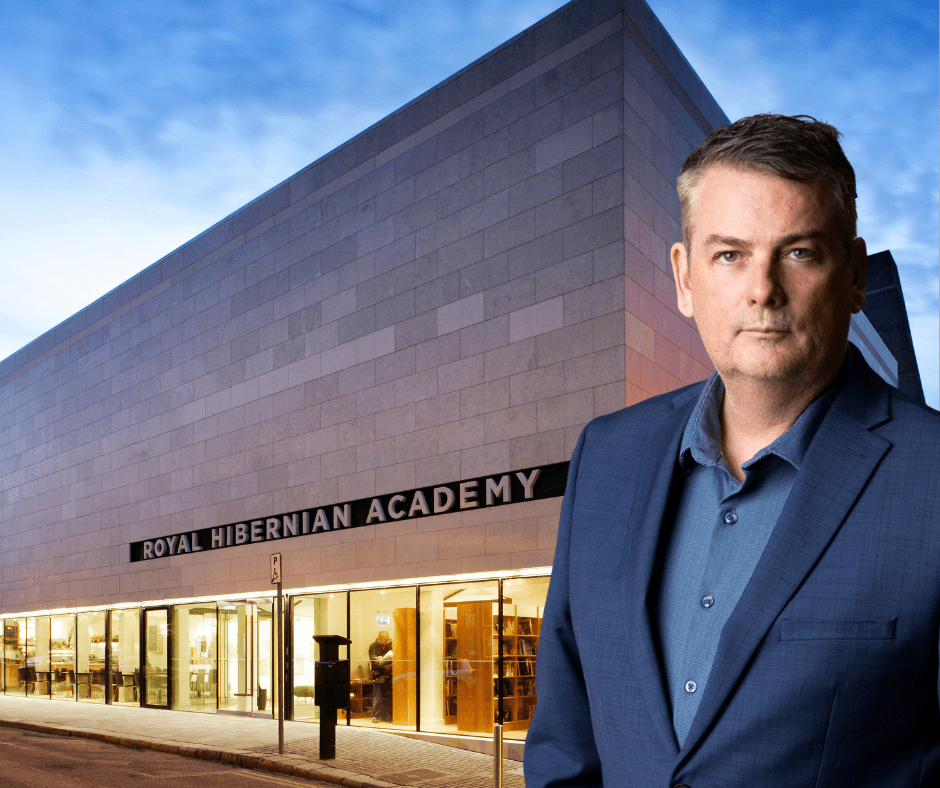
Earlier this month, the Royal Hibernian Academy of Arts announced that museum director, curator, artist and writer Séamus Kealy would serve as its new director. Kealy comes to the institution from Oakville Galleries in Ontario, where he served as executive director since 2023. Kealy’s diverse career has led to a unique perspective on many of the questions facing heads of institutions these days. We caught up with him to hear his thoughts on these and the RHA’s future.
Congratulations on the new gig. This appointment marks a return to Ireland after more than a decade abroad, most recently leading Oakville Galleries and the Salzburger Kunstverein before that. What changes have there been in the Irish contemporary art landscape since then?
Thank you, it is a thrilling moment for me. It has been my desire to return to Ireland for some time, and yes, I have kept an eye on the Irish art scene these last years. I have also returned to Ireland regularly to visit family and friends—as well as artists and colleagues working in the arts. You are right, so much has changed. A significant challenge is the lack of artist studios in Ireland, and the housing strain as well, which we are observing ourselves as we search for a new home. I believe much more is to be done to ensure that artists living in Ireland can produce their work and simply get by. The closing of The Complex in Dublin is an unwelcome change. On the other hand, almost every week, I am asked about Ireland’s Basic Income Scheme for Artists. This is naturally very inspiring for artists around the world, and it could very well be that this progressive venture by Ireland will influence other regions to emulate its intentions and obvious positive impact, and not only for artists.
I continue to follow the careers of many Irish artists, and I have seen how their work has evolved. Some of these artists I have invited to exhibit or collaborate with since my last time in Ireland. I have observed some institutional changes in Ireland these last years, where notable shifts have happened with Annie Fletcher taking up the helm at IMMA (Irish Museum of Modern Art), and with the Crawford Gallery in Cork undergoing a major development presently. Smaller institutions such as EVA in Limerick, the Kunstverein Aughrim or the Douglas Hyde Gallery are punching above their weight, and I keep a close eye on their programming.
I have also heard great things about the new Visiting Curators program in Ireland, and I see the good work that Culture Ireland continues to achieve internationally. I have heard that matters of governance for arts organizations have become more prominent and I am happy to observe this. Overall, Ireland’s contemporary art landscape is rich, diverse and evolving. I see my work at the RHA as deeply involved in advocating for artists and providing a strong platform to showcase contemporary art and its discourses.
The RHA was founded in 1823. What is it like to inherit a place with two centuries of identity? How do you balance that with the demands of new audiences?
I was fortunate enough to direct the Salzburger Kunstverein for over nine years. It was founded in 1844, so in that case, I had to negotiate a long and complex history. One can imagine the different permutations in that context, too, where the institution was initially founded by a prince with the local bourgeoisie, and then later housed in the historic Künstlerhaus in 1885, where it still resides to this day. It is a beautiful and iconic building—painted all in red, quite a visual statement—and at a central point of the city. The Salzburger Kunstverein has a deep and meaningful relationship to the local population. Over its two centuries, it went through dramatic changes that reflected the cultural and political context. The most dramatic of course was during the Nazi era, where the institution was usurped for Nazi propaganda and Nazi-approved art. To this day, you cannot escape this history; it is palpable in the urban geography and informs all aspects of society, from education to language to social policy to art production.
Following that dark period, the Salzburger Kunstverein eventually returned to its roots as a site for exhibiting contemporary art and celebrating artists. It later also became an exciting locus of discourse and progressive ideas—hence the red color. When I arrived in 2014, it seemed to be at a turning point. The public’s desire for the Salzburger Kunstverein’s transformation—for something different to take effect—was real. Many people there were curious that a non-German-speaking Irish-Canadian was appointed, but I was warmly welcomed nonetheless. And it was important to integrate. I learned German fluently, many friendships were made, and we became embedded in the local community. Both our children were born there. The program and atmosphere I then developed there was international but also reflected local and national tendencies in contemporary art. I felt I had to balance a very long tradition—one with some unimaginable histories and then later very politicized programming—with new impulses that were received positively by audiences and stakeholders alike. The board, which was made up mostly of artists, was very supportive. Artists came to hang out there.
The Salzburger Kunstverein’s activities grew significantly during my time, as did partnerships, new programming and new visitors. It was thrilling. Indeed, during my tenure it became more of a nexus point for immigrants, newcomers to Austria, refugees, university students and youth, the L.G.B.T.Q. community as well as artists and arts enthusiasts. We had performances, concerts, artist residencies, a new film festival I founded, art awards and at the heart of it all was an exhibition program that resonated locally, nationally and internationally. I spoke about these experiences with the RHA Council before I was offered the directorship. I found there to be compelling parallels—not only in terms of admiring long, important traditions, but also in balancing these traditions with a spirit of transformation and internationalism. These tendencies should complement, not contradict, one another.
Your tenure at Oakville Galleries involved leading a major capital project. Did you enjoy that part of the job? What lessons about fundraising will travel with you to Dublin?
This is certainly an intense part of the job, but equally also very rewarding. I was lucky enough to also lead a capital development at The Model in Sligo previously, where I was able to apply some of that experience to the ambitions in Oakville. You are right in connecting the fundraising responsibility here, as a capital project is heavily involved with patronage and building relationships with stakeholders. I do enjoy it immensely, as you find so much good will out there, and when individuals share excitement about the future vision of an art institution with a world-class ambition, friendships are made in tandem with commitments. The joy of collaboration simply leads the way. I think I will bring that along with me back to Ireland: a deeper understanding of how meaningful it is to have many people involved in building an institution’s potential and believing in the good it brings to a city and its people.
You studied photography under Jeff Wall at UBC and have continued working as an artist alongside your curatorial career. How does maintaining your own practice shape the way you build exhibitions and relate to the artists you program?
I had earlier paused my artistic career to focus completely on directing institutions and curating. When COVID happened, as with many people, I found myself picking up something new, or in this case, painting again. I was lucky enough to be invited for a few exhibitions after that. These days, I don’t find enough time to make paintings on a regular basis, but to answer your question, yes, maintaining my practice does shape how I work with artists. But it always did, even when I wasn’t actively painting. I think artists can have a different approach to running an art institution, such as the RHA, which is fundamentally artist-centric. Having empathy for artists is important, but it goes well beyond that. Artists know that my way of working with them flows with their practice and their needs, and that I respect their work inherently. It was flattering, for example, that when the RHA announced its search for a director, artists reached out to me and asked me to apply for the job. Perhaps they trusted me to take on this role. I would attribute my artist background to being a large part of that sense of trust.
Your appointment release describes your approach as “artist-centered,” a phrase institutional leaders often use. What does it actually mean in practice for you, in terms of how a program gets built and how artists are treated through the process?
Yes, as you suggest, sometimes one hears platitudes about being “artist-centered” without much effort behind this. I think what I was touching upon earlier is leaning into this question, though. I feel that my directorship of institutions is artistic—just as an artist works in a studio, I work in an office. In a similar way, my curatorship is also artistic but moreover artist-focused, meaning that when I work with artists, I am at their service. Curating, for me, is actually a modest role. The word “curate” is from Latin, meaning “to care,” as we know. This is in part the care for the artwork during its exhibition, as well as encouraging the audience’s reception and conversation around the artwork. But for me, it is also really about caring for the artist. This is simply an attentiveness towards their work and their way of working. I don’t think this can be taught—one has to learn it by being around artists and working with them. Sometimes the children of artists understand this sentiment straight away. Many of my dearest friends are artists, and neither do I think this is a coincidence nor do I think it unimportant to running an art institution. I think artists who know me know that I am always in their corner.
The RHA offers free admission at a moment when many institutions are consolidating revenue around memberships and timed tickets. How central is free access to your vision for the place, and how do you plan to defend it as operating costs keep climbing?
As an art student and even as an artist, I would often not enter museums because I felt the ticket entry was expensive. Free access to art and culture for everyone has long been an integral part of my approach to directing institutions. As with every role, one finds means of bringing in stakeholders, relevant funding, patronage, partnerships and new forms of income into the mix. In my three previous roles, I was able to do that according to each context. Admission costs to the programming were never a question for me. I know that public museums with ticketing often find creative ways—such as free Thursday evenings—and this is a positive step. However, I feel that an institution such as the RHA would not be the RHA anymore if it were to commence ticketing.
What do you want the RHA to look like in 10 years?
When I travel to certain cities, there are essential places to drop in to. But moreover, there are essential places that are meeting points and where I want to hang out and get to know what is going on. This is what I wish the RHA to be. I remember as an art student standing in front of a contemporary art museum and feeling intimidated by its architecture. I felt this was not a place for me. Eventually, I entered, and I loved it, of course. I have taken this initial sentiment with me, though—this memory of feeling estranged from the “museum”—and I have always applied everything in my power to help ensure people feel welcome by the programming and the atmosphere of the institutions that I direct. This is already tangible with the RHA, because it is loved and admired, and it has a meaningful and beautiful history. When the former director, Patrick Murphy, reached out to me to congratulate me, I told him that there are big shoes to fill and that I always admired his program and his style. So in many ways this is about continuity, and it will be about new impulses.
Ten years from now, the RHA should have a vibe of being the place to be. When someone asks where artists, art students and those curious about ideas and people gather in Dublin, one definitive answer will be the RHA. As much as a place for people to gather, I like the idea of the RHA being a haven for sharing and developing ideas of making the world a better place. The exhibitions will be an enormous draw that way, showcasing international and Irish artists and thematic exhibitions from the zeitgeist. The RHA will have meaningful links with other cultural energies in Ireland and abroad—both institutional and grassroots—which can put it further on the global map as well. Central to this vision is the work of and the relationship with artists, providing them support and resources at all stages of their careers. All programming and operations of the RHA are to be achieved with a standard of excellence, with a collaborative and hospitable culture. It is my hope that people of all backgrounds will want to hang out there.
