
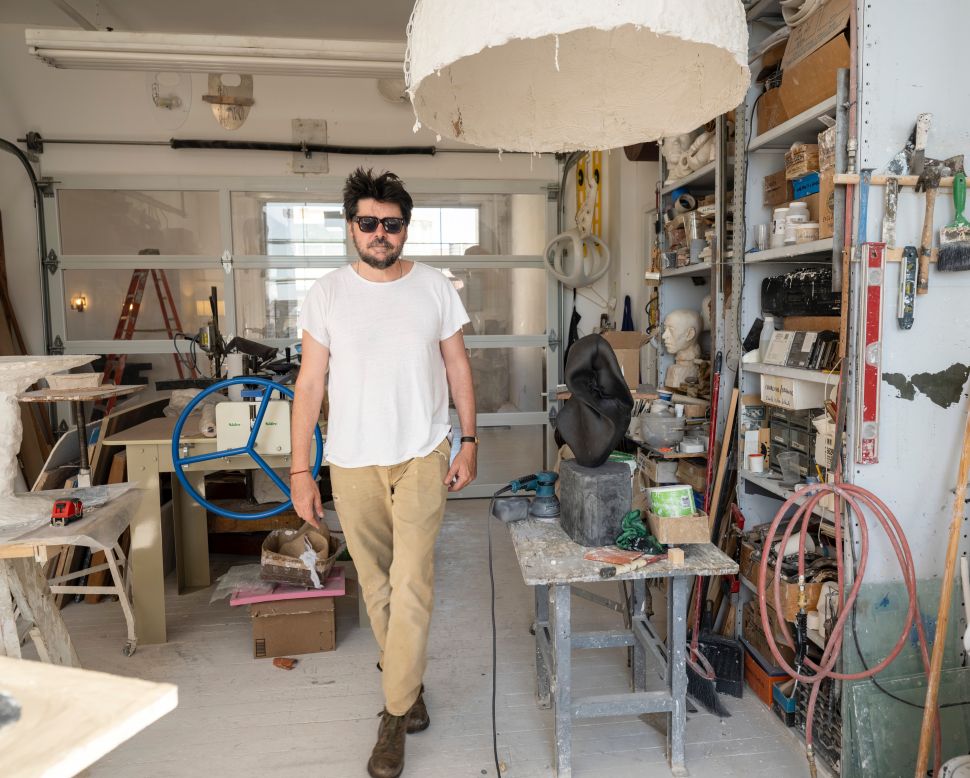
Sébastien Léon doesn’t think in categories, nor does he fit into them. He’s a multi-hyphenate creator whose practice takes mediums, materials and forms at their most familiar and finds in them something fundamentally other. “Each creation operates as an act of revelation: an object that reveals itself through transformation,” reads his bio, and in his hands, resin might become leather or stone and glass can metamorphasize into fog or folds of cloth or lava. So, too, has the French-born, New York-based artist transformed himself, from creative director to designer and artist. He is variously described as a sculptor, a musician, a furniture designer and an installation artist.
Léon first experimented with blown glass in 2019 when working on a collection of lighting shown at Design Miami, and he describes the medium as one of transmutation—sand mutated by fire, then shaped by air into something solid. That arc, from one state of matter to another, is a useful description of his general approach to his work, which encompasses not only physical objects but also soundworks. He has collaborated on projects with the Dallas Symphony Orchestra, released three solo records, built a permanent sonic sculpture for the Orange County Museum of Art and created immersive sound environments around the world.
(Later this month, he’ll be debuting a new soundwork for NOMAD Hamptons—the first in a coming series of interconnected pieces. Titled The Echoes of Our Dreams, it blends sculpture, sound and technology to explore the boundaries between natural and artificial forms of communication.)
His work has been shown at the Palais de Tokyo, the New Museum, the Palazzo della Triennale and UCCA in Beijing, and his commercial collaborations have extended to Audi, Samsung, Audemars Piguet and Krug, among others. More recently, he completed an 18-month residency at the Ralph Pucci sculpture studio in Manhattan, resulting in a new body of work, “Inca City.”
The series of otherworldly lighting and furnishings takes its name from the Angustus Labyrinthus on Mars—a networked complex of geological ridges so geometrically precise that it looked like the ruins of a lost civilization in the images sent back to Earth by the Mariner 9 probe. Alas, the resemblance was an obvious coincidence, but for Léon, that potential misreading opened a doorway into what he calls speculative archaeology—the fabrication of relics from a civilization that never was.
The works in “Inca City” are the output of the material philosophy Léon has been refining throughout his career and the experimentation that has driven that career forward. During the residency, he built and refined the pieces in the show at the Ralph Pucci workshops, where he had access to master artisans and the tools to work with materials ranging from clay and resin to metal. Observer connected with Léon after the opening of the show to discuss what it means to excavate a civilization that never existed, why function can be its own kind of illusion and what sound has to do with sculpture.
Your work spans a wide range of materials and techniques. Is that multiplicity driven by a search for the right medium, or is the movement between materials itself the point?
More than anything, I think it’s because each idea demands its own medium. Glass, steel, resin, sound, etc., each carries very specific behaviors and symbolic weight. What interests me is how far I can push those behaviors until the material starts to contradict itself: resin that reads like leather, mirrors that dissolve into transparency, wool rugs that feel like hairy terrains. My exploration between materials is really a way of staying in that unstable perception-shifting territory.
Your sound works are incredibly immersive. How does your engagement with sound relate to your work with physical materials?
Sound is probably the most direct way I think about presence. It’s invisible, and yet it completely shapes how we experience space. It suggests a memory, an emotion, a place, even a form of materiality. Any sculpture, for me, is something that emits: light, reflection, tension, or even a kind of silent aura. I approach a light sculpture in the same way as I approach a sound sculpture. They all have a voice, something to say, a role to fulfill.
“Inca City” at Ralph Pucci International feels suspended between abstraction and something almost geological, like artifacts from a civilization that might have existed elsewhere. There’s a strong sci fi undertone. Was that intentional?
“Inca City” is a real geological formation on Mars, resembling the ruins of a lost city. It became the starting point for the exhibition, which I developed as a kind of speculative archaeology, creating artifacts from a civilization that never existed. The sci-fi aspect is definitely there, but not in a futuristic sense; it’s more about displacing time and location altogether. I’m interested in imagining a different physical world, almost a parallel set of conditions where matter follows a slightly altered logic. Glass might behave like stone, surfaces might shift between opacity and reflection and materials might be grown into their final forms instead of cut to fit.
When you create functional pieces, do you approach them differently from your more speculative works?
What interests me is when a piece fulfills a use, but at the same time destabilizes your perception of what it is. A table that appears to float, or a mirror that behaves in unexpected ways. I integrate function as a magic trick, as an illusion. So I see my work as a continuum where function becomes a kind of entry point into a more ambiguous experience. I often get asked whether my work belongs to the design or art worlds, but I don’t really think in those terms.
On your website, you pose the question “Design or Transmutation?” What are you trying to prompt with that idea?
‘Design’ broadly implies solving a problem through the creation of an object, but I’m more interested in transforming the nature of the material itself. Transmutation suggests a deeper shift, almost alchemical. What I hope it prompts is a moment where the viewer is no longer sure if they’re looking at something familiar or something that’s been fundamentally altered. In the word “transmutation”, there is a notion of magic, of transformation from lead into gold, and invention, and all these resonate with me.
There seems to be an element of world-building in your work. Is there a throughline connecting these pieces?
There is definitely a form of world-building, but it’s not narrative in a literal sense. It’s more like fragments of a larger system that keeps on growing in order to reveal itself. Each creation, each exhibition, becomes a way of introducing new elements, whether sculptural, sonic, or even olfactory. Over time, the idea is that this environment is slowly unveiled as a set of conditions for us to discover. “Inca City” is slowly revealing itself to me and to everyone.
More in Artists
Manuel Mathieu’s Venice Biennale Debut Asks How We Carry the Past
The Temporal and Geographical Ambiguity of Mark Manders
Roberto Lugo On Thinking Larger Than Life in Madison Square Park
Kunstmuseum Basel Puts Helen Frankenthaler Front and Center
Nick Doyle’s “Mirror, Mirror” Turns the American Dream Inside Out
