
Few cities embody China’s past, present and future as vividly as Shanghai. On one side of the Huangpu River, colonial-era buildings line the Bund, their grand façades recalling the city’s days as an international trading port. Across the water, Pudong’s futuristic skyline rises like a forest of glass and steel, anchored by the soaring Shanghai Tower, the tallest building in China. There aren’t many cities that offer such a dramatic visual—or symbolic—contrast.
For many first-time visitors, Shanghai serves as a window into modern China, a country that balances tradition and innovation with ease. To understand both sides of Shanghai, begin by heading to the former French Concession, a historic neighborhood of tree-lined streets, hidden cafés and one of the largest concentrations of 1930s Art Deco architecture outside of Miami, before ending the day with a sunset stroll along the Bund as Pudong’s skyscrapers light up at dusk.
With a population of more than 25 million, Shanghai is one of the world’s great urban centers, yet it’s easy to discover pockets of calm while you explore. “Visitors expect old China, but find a city that is utterly contemporary, confident and forward-looking—without ever forgetting its roots,” Cecilia Yang, director of marketing and communications at Mandarin Oriental Pudong, Shanghai, tells Observer.
Unlike Beijing, with its checklist of must-see monuments, Shanghai rewards wandering, says Jamie Barys, founder of UnTour Food Tours. “Shanghai is a blank slate for any first-time visitor.” Rent one of the city’s shared bikes to cover more ground and stop wherever curiosity leads—a tiny noodle shop, a family-run dumpling stall or an independent design boutique tucked inside a restored shikumen townhouse.
That spirit of discovery extends to Shanghai’s thriving cultural scene. World-class institutions such as the Power Station of Art and West Bund Museum sit alongside a growing network of independent galleries, studios and creative spaces that have helped establish Shanghai as one of Asia’s leading centers for contemporary art and design. “Shanghai has never stopped looking outward,” says Yang. “The city attracts global curators, collectors and artists—and more importantly, it has a local audience with the curiosity and sophistication to engage with them.”
Then there’s the food. As China’s financial capital, Shanghai has attracted migrants from every corner of the country, creating one of the world’s most exciting dining scenes. “This diversity of flavors makes it one of the best cities in the world to eat in,” says Barys. “You can slurp Shanghainese xiaolongbao stuffed with pork and hairy crab for breakfast, tuck into a bowl of halal hand-pulled noodles from Lanzhou topped with lamb and cumin for lunch and sit down to a mouth-numbing meal of Sichuan’s famous peppercorn-laced dishes for dinner, all within a single block.”
Whether you’re visiting for a long weekend or using Shanghai as a gateway to the rest of China, these recommendations will help you navigate the city’s neighborhoods and make the most of your first trip.
The First-Timer’s Shanghai Travel Guide
Where to Stay
Mandarin Oriental Pudong, Shanghai
111 Pudong Road (S), Pudong, Shanghai, 200120
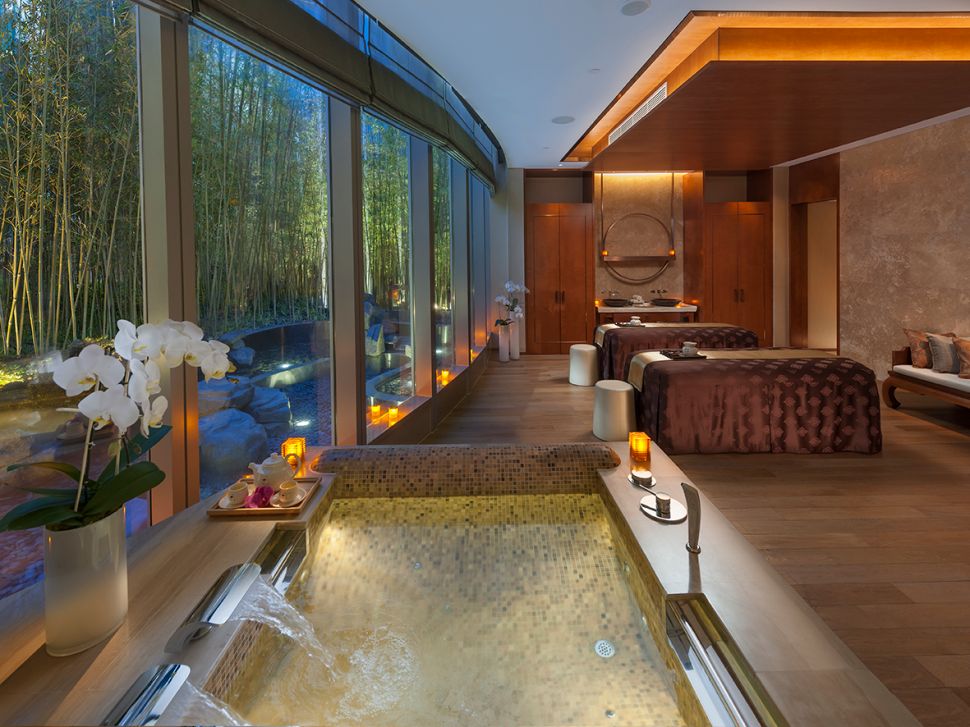
Set on the east bank of the Huangpu River in Shanghai’s futuristic financial district, Mandarin Oriental Pudong provides a blissful respite from the city center’s relentless energy. In its 362 rooms, floor-to-ceiling windows frame cinematic skyline views that are best enjoyed from the circular, standalone soaking tub. Guests can walk the nearby riverfront promenade, savor Michelin-starred Hangzhou food at Yong Yi Ting and relax in private spa suites equipped with vitality pools that feel worlds away from downtown Shanghai’s bustle.
Mandarin Oriental Pudong, Shanghai.
Mandarin Oriental Pudong, Shanghai
Capella Shanghai, Jian Ye Li
480 West Jianguo Road, Xuhui, Shanghai, 200031
Here, you can step back into 1930s Shanghai, when the city was known as “the Paris of the East” for its glamorous nightlife. Tucked in the former French Concession, the hotel occupies 55 restored shikumen villas from the era, blending historic architecture, classic Chinese accents and 19th-century French style. Dine at one-Michelin-starred Le Comptoir de Pierre Gagnaire, the only restaurant in mainland China from the much-awarded chef, and balance your qi at Auriga Spa, where the treatment menu is inspired by Chinese holistic healing, with services mincluding gua sha and cupping.
Capella Shanghai, Jian Ye Li.
Capella Shanghai, Jian Ye Li
Bulgari Hotel Shanghai
Lane 108 North Shanxi Road, Shanghai, 200085
Bulgari Hotel Shanghai brings the Italian jeweler’s signature understated luxury to one of the city’s most convenient addresses, with some of its 82 rooms overlooking the glittering Bund and Pudong’s dramatic skyline. The property’s rooftop bar and acclaimed Il Ristorante Niko Romito draw a stylish local crowd, while guests enjoy personalized amenities including private in-room check-in, packing and unpacking service and 24-hour personal butlers for suites.
Bulgari Hotel Shanghai.
Bulgari Hotel Shanghai
Amanyangyun
6161 Yuanjiang Road, Minhang, Shanghai, 201111
Set on the outskirts of Shanghai, Amanyangyun resulted from an ambitious conservation project that relocated 10,000 ancient camphor trees and dozens of historic homes threatened by a reservoir development in 2002. At the 47-room property’s heart, you’ll discover authentic Ming and Qing dynasty villas, transported from Jiangxi Province and reconstructed stone by stone. Guests can explore the tranquil forest, join cultural workshops or retreat to the spa, equipped with a Russian banya and Moroccan hammam.
Amanyangyun.
AMAN
What to Do
Yu Garden
218 Anren Street, Huangpu, Shanghai, 200000
Dating back to the Ming dynasty, Yu Garden is one of Shanghai’s most beloved historical landmarks and a rare oasis in the heart of the old city. Intricately designed pavilions, koi-filled ponds, rockeries and bridges showcase the principles of Chinese garden design, creating a landscape intended for contemplation and harmony. Arrive early to avoid the crowds and stroll the garden’s winding paths, where centuries of history feel remarkably preserved.
Yu Garden.
Me!
The Shanghai Museum
201 Ren Min Da Dao, Huangpu, Shanghai, 200000
Few places offer a better introduction to China’s artistic and cultural heritage than the Shanghai Museum. Renowned for its world-class collection of ancient bronzes, ceramics, jade, calligraphy and classical painting, the museum traces thousands of years of Chinese civilization through beautifully curated galleries. Its newer location in Pudong, Shanghai Museum East, features more contemporary architecture meant to evoke a traditional Chinese courtyard.
Shanghai Museum.
Zhang Xia
Go Shopping
Arguably China’s most cosmopolitan city, Shanghai has no shortage of places to splurge, from mega-malls and international labels on China’s premier retail strip Nanjing Road to charming, homegrown concept stores like Labelhood and In the Park. Vintage shops like Déjà Vu Recycle Store—which treads the line between a secondhand shop, bookstore and gallery—have become especially popular with Gen Z and millennial tastemakers looking for sustainable and unique clothing. For a deal on designer goods like Chanel purses and Rolex watches, head to the ZZER consignment warehouse.
Déjà Vu Recycle Store.
Hu Yanyun
Tianzifang
A maze of narrow alleyways tucked within the former French Concession, Tianzifang reveals a glimpse of old Shanghai. Set within a network of preserved shikumen lane houses, the district is home to independent boutiques, cafés and galleries, including the former studio of artist Chen Yifei, hidden behind weathered brick facades. While it has become a popular stop for visitors, wandering its winding passages still showcases pockets of local life, as laundry hangs in back alleys and old friends play mahjong over tea.
Tianzifang.
Me!
Go on a Cultural Culinary Walking Tour
For travelers who believe a city is best understood through its food, UnTour Shanghai offers one of the city’s most illuminating introductions. Led by knowledgeable local guides, the company’s walking tours venture beyond the city’s headline attractions into neighborhoods where family-run eateries, bustling markets and beloved street-food stalls reveal everyday life. On the Streets Eats Breakfast tour, sample jianbing (Chinese crepe), freshly made sesame noodles and other specialties.
UnTour Shanghai.
UnTour Food Tours
Where to Eat
Fu He Hui
1037 Yuyuan Road, Changning, Shanghai, 200031
At Fu He Hui, a Zen, temple-like dining room sets the stage for meticulously crafted dishes that draw on Buddhist culinary traditions. Vegetables, mushrooms and tofu are treated with the same care often reserved for luxury proteins, resulting in a two-Michelin-starred meal that feels both deeply tied to Chinese culture and strikingly contemporary through the fusion of Western cooking methods. Don’t leave without ordering the off-menu mapo tofu.
Fu He Hui.
Me!
Mi Shang Prada Rong Zhai
186 North Shaan Xi Road, Jing’an, Shanghai, 200041
Set within a 1918 mansion, Mi Shang Prada Rong Zhai is as much a cultural destination as it is a café. Created by Prada in collaboration with acclaimed filmmaker Wong Kar Wai, the space blends Milanese elegance with Chinese heritage through richly detailed interiors and cinematic flourishes. Stop by for refined Italian-inspired dishes, afternoon tea and coffee, but linger to admire one of the city’s most beautiful historic buildings, where fashion, design and gastronomy intersect.
Mi Shang Prada Rong Zhai.
Mi Shang Prada Rong Zhai
Chai Men Hui
2/F, N3 Block, BFC, 588 Zhongshan North 2nd Road, Shanghai, 200120
China has eight official culinary traditions among many other styles of cooking, but Americans tend to be most familiar with Sichuan and Cantonese. To try one of Shanghai’s best examples of Sichuan, head to Chai Men Hui, where Sichuan peppercorns and chiles are used in nuanced and elegant recipes like “strange flavor” short ribs bathed in a sauce that’s at once spicy, salty, sweet, sour and numbing.
Chai Men Hui.
Me!
Where to Drink
Paal
94 Nanchang Road, Huangpu, Shanghai, 200025
Paal reinterprets Southern Chinese ingredients through a minimalist Nordic lens. Order China’s answer to the Moscow Mule—with Pu’er tea, ginger beer, gin and dried tangerine peel—or an ode to sticky rice dumplings made from 12-year-oldpi malt whisky, vanilla ice cream, malt powder, maple syrup-infused butter and salted egg yolk. It’s a bar that’s thoughtful, inventive and reflective of Shanghai’s increasingly sophisticated cocktail culture.
Paal.
Paal
Bar Leone Shanghai
527 Middle Fuxing Road, Huangpu, Shanghai, 200025
Bar Leone brings the spirit of a convivial Roman neighborhood hangout to Shanghai’s former French Concession. An offshoot of Hong Kong’s Bar Leone—ranked the best bar in the world in 2025—the space favors warmth and hospitality over theatrics, making it feel less like a trendy hotspot and more like a beloved local institution. Italian aperitivi and impeccably executed classics, such as the Olive Oil Sour and house Negroni, draw devoted regulars and cocktail aficionados alike.
Bar Leone Shanghai.
Bar Leone Shanghai
Pony Up
230 Jinxian Road, Huangpu, Shanghai, 200041
Specializing in inventive twists on familiar tipples, Pony Up has earned a loyal following for its playful approach to cocktails and unfussy atmosphere. Favorites like a baijiu-based piña colada balance technical precision with a sense of fun that keeps the experience approachable. Another highlight is the food menu, which offers elevated American bar food like patty melts, corn dogs and “tailgate chips” with Sichuan-spiked beef chili.
Pony Up.
Pony Up
Root Down
145 Nanchang Road, Huangpu, Shanghai, 200025
Founded by a DJ, Root Down provides a more relaxed take on the silent Japanese listening bar trend. Sip ingredient-driven cocktails made from seasonal produce while grooving to expertly selected vinyl records played through a high-fidelity sound system. The carefully curated soundtrack—spanning jazz, soul and funk—is as much a draw as the drinks, creating an intimate atmosphere where music takes center stage without overshadowing conversation.
Root Down.
Root Down
