
The union that represents Central Park carriage horse drivers charged Tuesday that a horse who dropped dead last week may have been doomed after chomping on toxic plants in the park.
But the Central Park Conservancy quickly countered that a park rule bars horses from causing “any damage” to shrubbery and eating any vegetation in the park — adding that the owner of 16-year-old Deniz should have been paying more attention.
The Transport Workers Union cited the preliminary diagnosis of a gross necropsy by a Cornell University College of Veterinary Medicine pathologist that said Deniz’s stomach and intestine had a “substantial amount” of needles from Japanese yew, a plant that is “highly toxic to horses.”
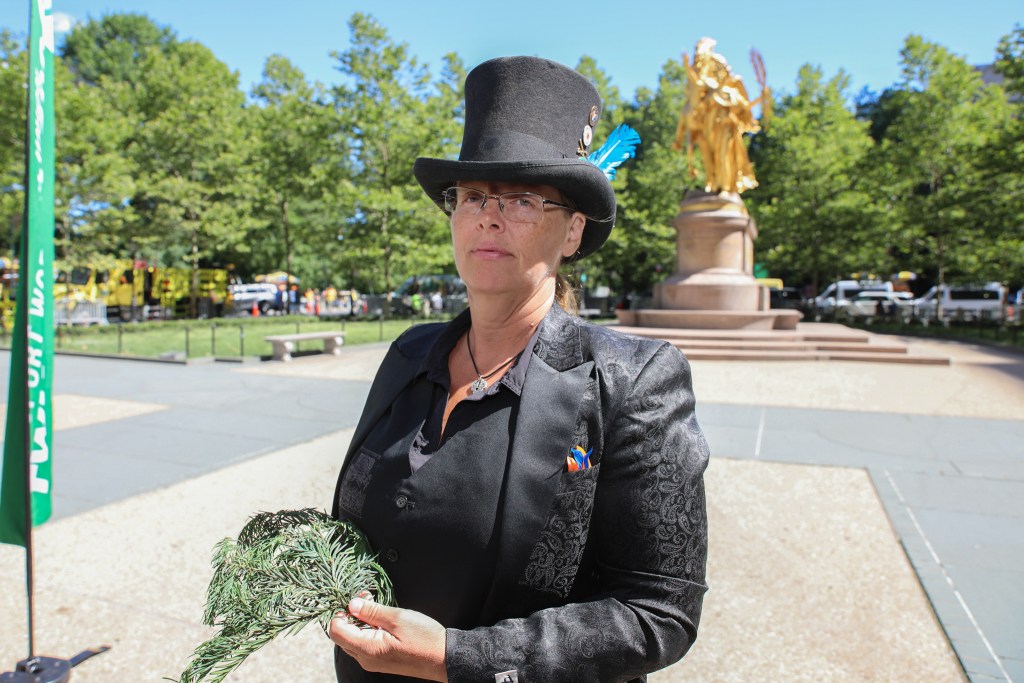
A carriage driver holds up a poisonous yew plant, June 16, 2026. Credit: Alex Krales/The City Reporter
Common on Christmas wreaths, yew is also harmful to dogs and some other animals, according to the ASPCA.
“It was highly interpreted to be lethal,” a summary of the gross pathology said.
Final results are pending.
The union said the 1,433 lb. brown-and-white horse had been found to be in good health following a March examination by a veterinarian for the NYPD Mounted Unit.
Nurettin Kirbiyik is seen with his carriage horse, Deniz, before the animal passed away after eating a poisonous plant in Central Park. Credit: Courtesy of TWU
“It’s obvious gross negligence by the gazillionaires who run Central Park,” said John Samuelsen, international president of TWU. “They planted poison shrubs, successfully killing a horse and then blame the worker — absolutely shameful.”
The union said the horse chomped the yew near 90th Street on the east side of the park. The Central Park Conservancy said the horse was carrying two tourists when it collapsed near 72nd Street and West Drive.
Owner Nurettin Kirbiyik, a carriage driver for more than 20 years, said the horse’s June 9 death has hit him as hard as losing a family member.
“Deniz was with us for 10 years,” Kirbiyik, 52, said at a news conference just outside the park. “He was not just a horse to us, he worked with us to help us earn our living, he had become part of our family.”
Carriage driver Nurettin Kirbiyik says his horse, Deniz, died after eating a poisonous plant in Central Park, June 16, 2026. Credit: Alex Krales/The City Reporter
According to the Central Park Conservancy, which oversees the 843-acre park, Deniz’s death marked the seventh time in the last 13 months that working horses have been involved in on-the-job incidents.
The death came weeks after a startled horse struck another carriage at the south end of the park, toppling the carriage and injuring its driver.
The latest incident set off another round of fingerpointing among TWU, the conservancy and activists who have long pushed for horse carriages to be banned from Central Park. In a statement, the conservancy said New York City must join other cities in enacting a ban on horse carriages.
“Today’s park is busier and more crowded than ever,” the Central Park Conservancy said in a statement. “For the safety of visitors, other animals and the horses themselves, we continue to support a ban on carriage horse rides in the park.”
The conservancy accused TWU of negligence in what it termed an “unfortunate incident,” saying the carriage drivers and operators must tend to their horses “at all times.”
“Perhaps if they had, Deniz would not have suffered as he did, and died,” the statement said.
The horse’s death renewed calls from critics of the horse-carriage industry for the City Council to pass Ryder’s Law, which would prohibit new licenses to operate horse-drawn cabs from being issued.
Edita Birnkrant, executive director of New Yorkers for Clean, Livable and Safe Streets, said the proposal should be made into law to phase out horse-drawn carriages in the city.
“The City Council and Speaker Julie Menin should fast-track Ryder’s Law before another horse suffers or dies or another runaway crash puts more lives at risk,” she said in a statement.
Veteran carriage-horse driver Christina Hansen, TWU shop steward, said that generations of carriage drivers had “no idea” about the presence of potentially deadly plants in the park. She added that “there is nothing to indicate that this danger is out there.”
“This was Deniz’s last bite,” she said, holding up a clear bag with needles from the plant. “He pulled it off the plant — this would be enough to kill a horse, it’s certainly enough to kill a dog.”
Kirbiyik said he and other carriage drivers have felt “unsafe” and taunted as “horse killers” in the park and online since Deniz died.
“Now the report has shown the real cause,” he said. “But I ask people to remember that the world can hurt people and families.”
“We will never forget Deniz.”
Our nonprofit newsroom relies on donations from readers to sustain our local reporting and keep it free for all New Yorkers. Donate to THE CITY today.
The post Who Killed Deniz? Yew’s to Blame, Union Sez After Central Park Horse Drops Dead appeared first on The City Reporter.
