
A small crowd gathered on the harbor at Kello, a fishing village in the municipality of Haukipudas, the anticipation building as the top of the hour drew near. At 10 o’clock sharp, a recording of the local fisherwoman Elina Halonen spoke a single word into the morning air: “Miehiään”—of their men. It was the latest installment of a reading of Pentti Saarikoski’s Finnish translation of Homer’s The Odyssey, broadcast from a sculpture on the harbor wall at a rate of one word an hour, a pace at which the whole epic will take 10 years to tell. It is a fitting way into “Climate Clock,” a permanent art trail spread across the Oulu region as part of Oulu’s year as European Capital of Culture 2026, which asks us to tune in to a slower, deeper sense of time than the one most of us carry around in our pockets.
That same day, we sat down to a lunch of spinach soup and Karelian-style pies filled with rice porridge in a church hall in Ylikiiminki, a few hundred yards from one of the trail’s other works. It was a minor moment in a packed two-day itinerary, but it has stayed with me as a kind of encapsulation of the whole project: down-to-earth, made with and for the people who live there, and entirely uninterested in performing for an audience that might not even be paying attention (yet).
“Climate Clock” is among the flagship projects of Oulu2026, the year-long program marking Oulu’s status as European Capital of Culture. Oulu, a city of just over 200,000 people a little south of the Arctic Circle, is the urban heart of a region of 40 municipalities spanning roughly 30 percent of Finland’s land area—an area warming, according to the scientists involved, at around four times the global average. Curated by Alice Sharp, artistic director of the U.K. organization Invisible Dust, and produced by Claudia Woolgar, the project paired six Finnish and international artists with scientists working on the environmental questions most pressing to their assigned corner of the region, their works found at sites ranging from a Stone Age settlement to a highway underpass. A seventh work, made in collaboration with local communities, embraces the whole region.
A trail shaped by ice, clay and lichen
In Oulu’s central square, Rana Begum has installed No. 1574 Stone, a series of granite and marble shards—spectrolite blue, Baltic brown, pale green Lapland marble—cut to resemble fragments of breaking sea ice. One face of each piece is painted in silver metallic, evoking the sheen of melting glaciers; the other is polished smooth enough to reflect the sky and the people walking past. Begum developed the work with the University of Oulu glaciologist Alun Hubbard, whose footage of collapsing Greenland ice she has described as scary and yet beautiful. Sharp points out that the Arctic could be ice-free in summer by 2040—a fact that gives Begum’s glittering, fractured forms an unsettling undertone even on a bright June afternoon.
“Climate Clock“
Artists: Rana Begum, Ranti Bam, Antti Laitine and others
Venue: Oulu, Finland
Address: Various locations
An hour or so north, at the Kierikki Stone Age Centre in Yli-Ii, Ranti Bam’sIlé-Ìlá sits beside the still water of a lake: a family of large clay vessels, shaped by the pressure of the artist’s own body, set on a Douglas fir platform. Bam, who has British and Nigerian heritage and lives in Paris, was struck by the Stone Age pottery shards held in the museum’s collection, some still bearing the fingerprints of the people who made them thousands of years ago. Working with the physical geographer Jan Hjort, who showed her how this stretch of land has been slowly rising out of the sea since the last ice age, Bam arrived at the idea that clay and landscape are doing the same thing, on different timescales. How we hold the earth, she has said, shapes what remains.
Where Bam’s vessels sit beside calm water, at the Koiteli rapids in Kiiminki the river (outside of winter, at least) runs fast and loud, and Antti Laitinen’s Olet Tässä (You Are Here) responds with something playful and almost delicate rather than monumental: circular viewing windows woven from twisted branches frame views of the water, while two large spheres—juniper, seeded with a “cocktail” of local lichen—turn slowly in the wind like miniature planets. Laitinen, who is Finnish and grew up nearby, worked with the botanist Jouko Rikkinen on the lichen, a notoriously slow-growing organism and a reliable indicator of air quality. Some of it will die; some will spread and eventually cover the spheres completely. The artist said simply that he doesn’t know what will happen to the work—”nature will decide.”
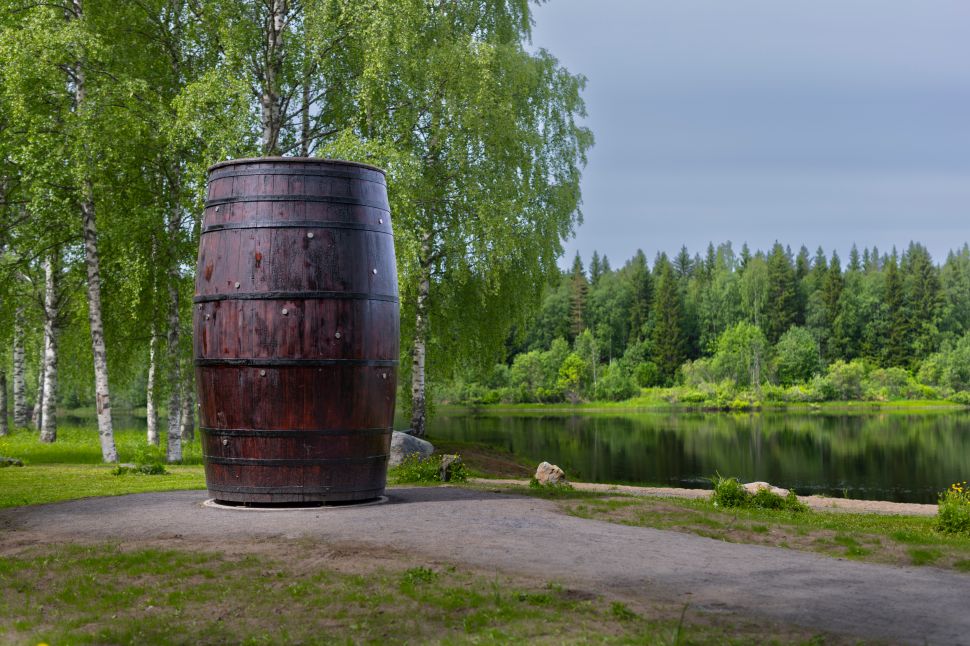
Back in Ylikiiminki, a few steps from our lunch table, Takahiro Iwasaki’s giant tar barrel is full of snowflakes. Built with local carpenters using traditional methods, it nods to the area’s history of tar-making and to the symmetrical, neoclassical church next door, designed by the Finnish architect Jacob Rijf—a building whose drawings, Iwasaki noticed, share something of the geometry of a snow crystal. Inside, he has carved his own snowflakes, meant to be viewed through peepholes as though magnified under a microscope. The peepholes themselves are set at different heights to track hanki kanto, the hard crust that can form on top of deep snow and is strong enough to walk on; when it’s thick enough, in winter, visitors will be able to look down into the barrel from above and peer through the upper peepholes. There are 112 snowflakes inside—112 being, as Iwasaki likes to point out, the number Finns dial in an emergency. His hope is straightforward: take care of the environment, and nobody will ever need to call it.
Over in Oulunsalo, on a stretch of road leading to the airport, Gabriel Kuri has transformed an underpass and roadside, placing sliced and reassembled boulders amid the relatively urban landscape and painting lampposts in the green-to-red gradient of a standard risk-assessment chart, developed with the climate scientist Kevin Anderson. It is, on the face of it, the most legible of the six works: many of us have filled in a form using these colors, and we all know what red means. But Kuri framed it as an example of a working method he returns to again and again—taking something intangible, an experience or an idea and compressing it into something concrete, a number or a color or a chart. “Some kind of circular motion,” though, he suggested, is built into the work’s very title: Risk Assessing Risk Assessment loops back on itself the same way a risk chart does, with its colors running from cool greens at the bottom up through yellow and orange to a hot red at the top, only to be quietly disregarded by the people making the decisions.
“Climate Clock’s” works all foster a slowing down and deep reflection, but, the truth be told, Superflex’s Super Kello isn’t even really for us. Developed with the behavioral ecologist Alex Jordan, its blocks—cut from a single piece of pink-veined stone—are shaped using an algorithm that maximizes surface area: good for humans to sit on, but designed, as Superflex’s Rasmus Nielsen explained, with another audience in mind. Fish, he said, are the group’s new collaborators, and the sculpture’s pink color was chosen because, in a few hundred years, coral polyps drifting north as the Baltic warms might be drawn to it. It is the same sculpture that broadcasts the recording of Halonen reading The Odyssey, one word an hour: a piece of art made, in part, for an audience of fish, and addressed to a future 10 years, or a few hundred years, away.
A clock of moments
If the six permanent works each anchor “Climate Clock” to a single place, the seventh element—The Most Valuable Clock in the World, by the longtime collaborators Tellervo Kalleinen and Oliver Kochta-Kalleinen, both Finnish—is the thread running through all of them. Over several years, the duo held a series of “Dinners for Twelve” in local communities, asking residents what they valued about their daily lives and their local environment. The results were built, together with a team of eight local volunteers with no prior clockmaking experience, into a large mechanical-electronic clock: an hour hand made up of 12 short films about threatened local species and habitats, produced with regional scientists; a minute hand of 60 “valuable moments” donated by residents, from a family’s tradition of walking in the snow in wool socks to an ice-dancing team’s practice; and a second hand of more than 100 fleeting clips sent in from people’s phones. The clock is now touring all six “Climate Clock” sites before heading on to museums in Tornio and Hämeenlinna. It will become a “time capsule,” Kalleinen said, capturing what life in Oulu looked like in 2025 and what people valued.
It is worth pausing on how unusual all this is. Several of these artists have represented their countries at the Venice Biennale—known as much for its spectacle as its prestige. Yet here their works are, embedded in Finnish suburbia or wild nature, working alongside snow hydrologists and lichen specialists most of the art world will never meet. Sharp has described the project as an attempt to step outside the ordinary tyranny of clock time and into something else: a space, as she put it, “between the tick and the tock,” where entire new worlds can be imagined. That is more or less what each of these seven works asks visitors to do, whether it’s standing in front of a giant ceramic vessel, peering into a barrel of carved snowflakes, or waiting on a harbor wall for the next word of an epic poem. Whether a pause like that is enough to change how a region this remote and this rapidly warming is seen, by its own residents or by the rest of the world, is another question. But for a couple of days in June, in a church hall with spinach soup, or on a harbor wall waiting for one word an hour, Oulu felt like exactly the right place to ask it.
