
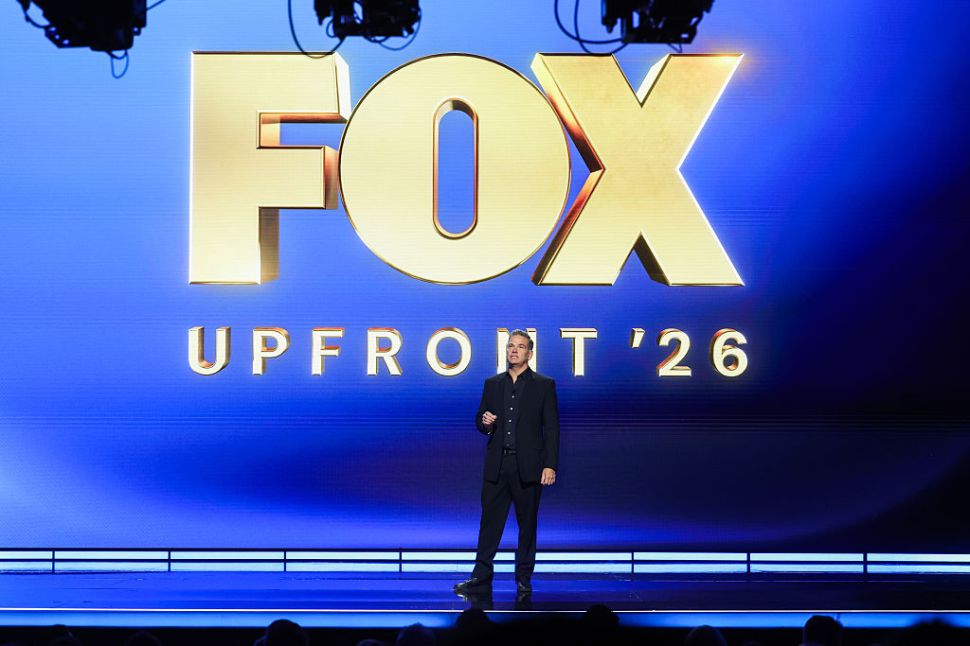
Lachlan Murdoch, Executive Chair and CEO of FOX Corporation speaks onstage during the Fox Upfront 2026 at New York City Center on May 11, 2026 in New York” width=”970″ height=”647″ data-caption=’Murdoch’s Fox is betting that the next phase of streaming won’t be won by making more shows, but by controlling how viewers find them. <span class=”lazyload media-credit”>Frank Micelotta/FOX via Getty Images</span>’>
When you turn on your television, how do you decide what to watch first? YouTube, Netflix and Disney+ are among the most popular individual video platforms. But the growing answer dictating your TV selections may very well be Roku, Amazon Fire and Apple TV. Why? Because these companies are controlling distribution, not just content programming. All three operating systems house the streaming services and apps we use daily. That’s what makes Fox’s acquisition of Roku so compelling. It’s a bet one level up from the streaming wars. Rather than competing directly with Netflix, Disney+ and HBO Max, Lachlan Murdoch is moving to own the monetizable distribution layer of entertainment alongside Amazon and Apple.
Earlier in the streaming wars, individual services fought over content. Everyone wanted the biggest shows that built the largest subscriber bases. Netflix’s Stranger Things, Hulu’s The Handmaid’s Tale, and Amazon Prime Video’s The Boys—breakout originals that attracted new customers en masse. The all-consuming cultural maw of HBO’s Game of Thrones spurred rivals to throw tens of millions of dollars at splashy IP. Marvel, Star Wars, DC and Lord of the Rings.
These programming skirmishes are still ongoing, but on a smaller scale. As the industry matures, focus has somewhat shifted away from individual content lineups and towards controlling discovery, recommendations and placement. That’s where real power and value lie. Roku, Amazon Fire TV, Apple TV, Walmart’s Vizio are all operating systems that house the YouTubes, Netflixes and Disney+s of the world. Those watching Paramount+’s Landman or HBO Max’s The Pitt are likely doing so via one of those companies’ devices.
Imagine the TV operating systems are like properties in Monopoly, and the individual streamers and apps that consume our attention are the houses and hotels built atop them. It’s easy to see where leverage is hoarded in that dynamic. (Investors remain more wary as Fox shares fell 18 percent in the first hour after the deal was announced, and Roku stock slipped 1 percent).
How Fox is leveling up
The further we move away from the 2010s, the clearer it becomes that Fox slimmed down in order to beef up. This Roku acquisition is the loudest evidence yet.
On the micro side, it gives the company a strong foothold in the small but growing world of free ad-supported streaming TV (FAST). Combined, Fox’s Tubi (2.2 percent) and Roku’s The Roku Channel (3.0 percent) account for monthly U.S. TV screen viewing time that’s within spitting distance of Disney+ (5.3 percent), according to Nielsen’s The Gauge. (However, the one-third overlap between the two audiences, or viewers who use both, would reduce the combined total somewhat.) One quarter of Roku Channel viewing comes from home-screen tile placement, while the other 75 percent comes from search and discovery. The combination of all of Fox’s distribution, Roku and Tubi positions the company as the third-largest connected TV distributor in the U.S., per Nielsen.
But Roku isn’t just another streaming service. At the macro level, it’s a front door to all of streaming. Transactional video on demand (one-time rental or purchase of titles) and third-party subscription marketplaces (signing up for streamers available on these apps) are lucrative businesses. “Amazon Channels is, by all accounts, the largest distributor of streaming services with close to 100 million subscriptions globally, from which they take a commission,” Owl & Co founder Hernan Lopez wrote in his Streamonomics newsletter. Fox is clearly chasing a similar quarry.
As I previously covered, Fox sold its entertainment assets to hyper-focus on sports, news, Tubi and the growing creator economy. In what may or may not be a sign of the fragmented future, abandoning blockbusters for passionate niches has worked. The stock is up 33 percent over the last five years. But the model was heavily reliant on the rapid decline of linear TV. This move takes a unique angle on streaming that’s more meaningful than Fox One and Fox Nation.
Is there now an argument to be made that Fox is the best-positioned legacy media company thanks to a slimmed-down content focus and owning highly valuable consumer on-ramps? Roku, Amazon, Apple and Vizio have figured out how to let programming from rival companies deliver money into their own coffers.
Quietly winning the streaming wars
I previously argued Sony won the streaming wars by sitting it out. Fox largely did too, saving itself billions in the process. The biggest differentiator now? After assuming control of Roku, Fox is poised to take a bite out of its competitor’s subscription and advertising revenue.
Roku typically takes around 20 percent of every third-party subscription sold or in-app purchase made through its OS, and an advertising cut of roughly 30 percent. (Apple famously collects 15-30 percent from TVOD). So the company makes money every time, say, a Dove ad pops up on Hulu or you subscribe to HBO Max through its system. With more than 100 million global households using Roku, few rivals, if any, can afford to abandon the service.
As we’ve seen across the industry in recent years, subscriber growth is harder to come by. That’s partly because the streaming audience is becoming more homogenous, according to data from Greenlight Analytics, where I work as Director of Insights & Content Strategy. Since 2024, streaming-exclusive viewers who don’t use linear TV have grown older, more female, less diverse and less engaged. That makes content discovery more important than ever.
Hollywood has spent a decade trying to catch and beat Netflix on the assumption that becoming the default destination is the only way to survive. Fox is betting that it might be more lucrative to own the bridge that gets you there.
