
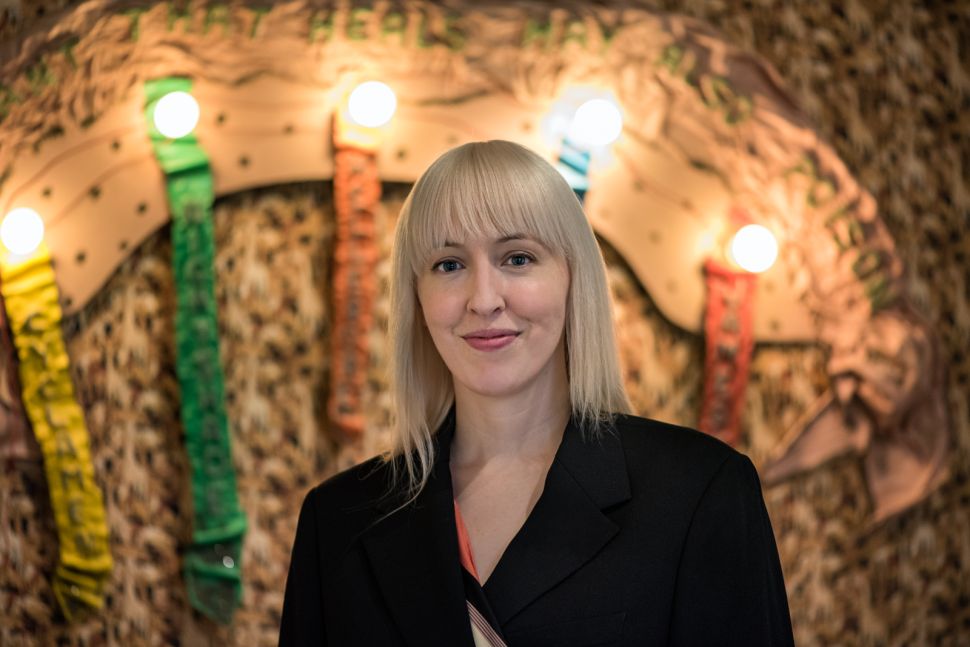
Next week, Kate Kraczon begins her new job as chief curator of the Montclair Art Museum. Founded in 1914, the New Jersey institution was among the first in the country to organize itself around American art, an area of study that now affords many opportunities. Kraczon, who arrives from the David Winton Bell Gallery at Brown University, takes over a post held since 1994 by Gail Stavitsky, and joins incoming director Todd Caissie at a moment of big transition for the museum. We caught up with her to hear about her plans for the next chapter.
Congratulations on the new job. What excited you most about this role when you first heard about it?
Beyond its incredible collection and exhibition history, MAM has a devoted audience and is a leader in accessibility and education programming. I was also intrigued by the unique history of the Montclair Art Museum School of Art (Yard School of Art), which merged with MAM in 1999, and how that can be a provocation for both curators and artists.
You’re succeeding Gail Stavitsky, who held the chief curator post since 1994. What’s it like stepping into a role someone shaped for three decades?
Gail shaped a strong collection and exhibition history that I hope to build on, a program and acquisition strategy that is inspired by and honors that history. I have always loved the idea of revisiting thematic exhibitions and curatorial propositions decades later as a generative form of exhibition making and a way to extend a museum’s unique curatorial and scholarly legacy.
You’ll be working closely with incoming director Todd Caissie, and you’ve said his vision resonates with your own. What are some dynamics of that partnership that you’d like to establish in these early months?
Todd and I share a truly joyful approach to what we do. We simply love spending time with artists, and with people who also love artists, and want to share this passion for the arts with the widest audience possible. Coming in as a new chief curator to a museum is also a moment to think radically and ambitiously about how your exhibition program can live within the already thriving institutional ecosystem at MAM and the arts ecosystems of northern New Jersey and the wider region. I believe Todd feels similarly that this moment is an opportunity to envision the future of MAM.
Your appointment announcement describes your practice as “deeply collaborative,” as seen in your ambitious commissions, such as Alex da Corte and Jayson Musson’s Easternsports (2014) at ICA Philadelphia. Can you tell me more about that project? What do you enjoy about working with living artists?
Easternsports was an example of how a curator can amplify the strengths of an artist’s practice, particularly strengths that may not be object-based (and therefore as market-friendly). I loved Jayson’s writing and Alex’s videos, and I knew they wanted to collaborate. What contemporary museum commissions allow are spaces for artists to experiment without the pressure of sales. The majority of the projects I have commissioned have been long-term conversations over time. Elisabeth Subrin and I began the conversation about what would eventually become The Listening Takes (2023) nearly a decade before the installation opened at The Bell.
Montclair was founded in 1914 as one of the first American museums to focus on American art, and it built a serious collection of works by Native Americans early on. Works by Jeffrey Gibson, Wendy Red Star and Edgar Heap of Birds sit alongside John Singleton Copley, Winslow Homer and John Singer Sargent. How does a contemporary, artist-focused curator like you approach a collection with that kind of range? Are you looking to create dialogues there?
Absolutely! That MAM has a curator of Native American art—the brilliant Laura Allen—devoted to Native and Indigenous works in the collection, as well as commissioning new artist projects and curating exhibitions, was a significant factor in my decision to join the museum. I’m looking forward to developing a program alongside Laura that centers Native and Indigenous practices while allowing the tensions within a historical collection to be responsive to our contemporary moment.
At ICA Philadelphia, you organized Ree Morton’s first major U.S. retrospective in over three decades. Was it gratifying to bring an artist like that back into focus? Might you like to tackle similar projects in Montclair?
As someone who often focuses on platforming underrecognized artists, most recently a survey of Bay Area octogenarian Franklin Williams, projects like the Morton retrospective are meaningful in both honoring the artist and in bringing that work to a more expansive audience. Gallery size was a limitation at Brown University, and I am thrilled to be able to develop survey and retrospective exhibitions with ample gallery space. I am already in conversations about major retrospectives in development with curators who work similarly!
You were a founding board member of artist-run spaces like RAIR in Philadelphia and FR MOCA in Fall River. What lessons have you learned from your experiences with these organizations that you might bring to a larger institution?
Working directly with artists to found an arts organization, whether a residency program like RAIR or an exhibition and education space like FR MOCA, has been transformative for me. It offers access to and understanding of what artists need and value when they are able to set priorities, and unsettles your own understanding of how museums and larger arts institutions can better support artists.
At the Bell, you built collaborations with international institutions like Performa, Nottingham Contemporary and MACBA in Barcelona. Do you intend to pioneer similar collaborations at Montclair?
Absolutely! The Bell was a true kunsthalle program in both spirit and size: there was just over 3,000 square feet of gallery space. MAM’s galleries are exponentially larger and quite lovely in proportion, with high ceilings and an excellent architectural flow. This will allow me to curate and collaborate on much larger exhibitions than I was able to at Brown, as well as bring touring exhibitions organized by other museums to the New York Metro region that otherwise wouldn’t find a home on the East Coast or even within the United States.
Last question: Pork roll or Taylor ham?
Scrapple! I grew up in Pittsburgh but have spent more of my adult life in Philadelphia than any other city. The only aspect of Philadelphia culture I refuse to embrace is the Flyers. Let’s Go Pens.
