
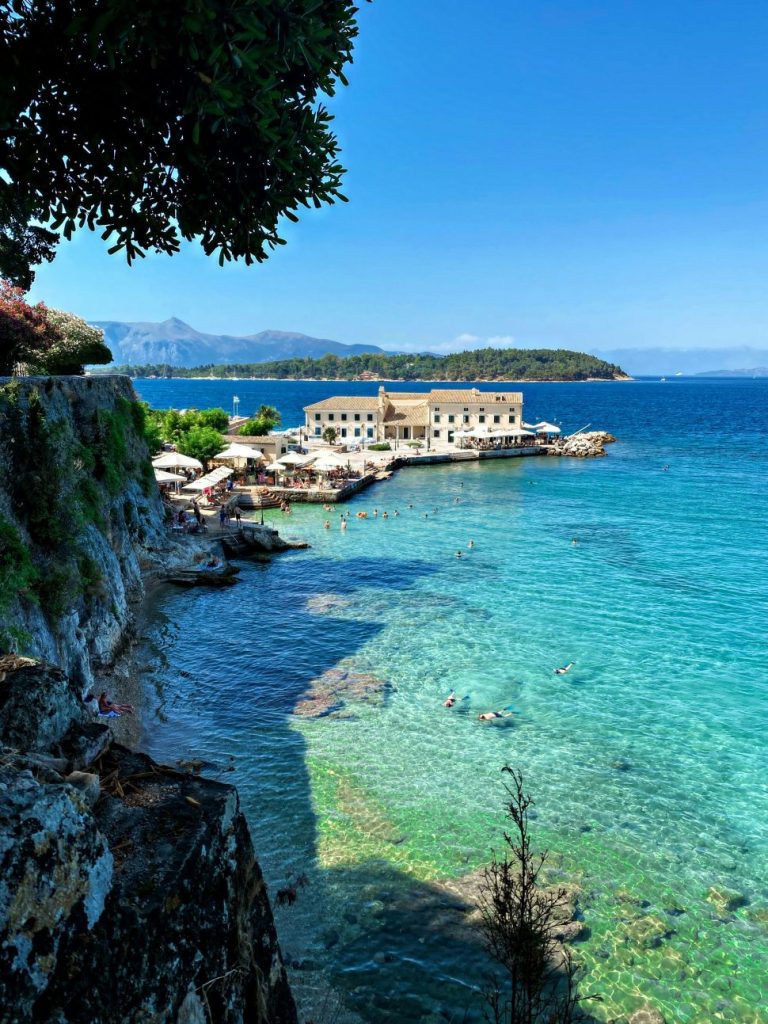
Picture hills of cypress and olive trees tumbling toward water the color of sea glass, harbors lined with faded Venetian palazzi in sherbet pinks and sun-softened ochres. Welcome to the Ionian Islands, the green archipelago strung along Greece’s western coast, where the Mediterranean feels less Aegean and more Adriatic, and where centuries of foreign rule left behind one of Europe’s most distinctive island cultures. Their beauty is largely an accident of empire. While the Cyclades spent centuries baking beneath the Aegean sun, the Ionians passed through Venetian, French and British hands before joining modern Greece in 1864. Four centuries under Venice left an imprint that remains impossible to miss. Church bell towers rise above red-tiled roofs. Arcaded squares feel lifted from northern Italy. That inheritance extends to the kitchen. The signature dish, pastitsada, is beef braised for hours with cinnamon and red wine and served over thick pasta, a preparation that would not seem out of place in Bologna. It is visible, too, in the islands’ improbable greenery, more Tuscany than Cyclades, thanks to more than 40 inches of annual rainfall.
The pull is as much cultural as scenic. Homer made Ithaca the most storied island in the Western canon, and Corfu gave the English language one of its happiest memoirs: the naturalist Gerald Durrell and his novelist brother, Lawrence, spent a 1930s childhood here, and Gerald’s My Family and Other Animals—and more recently, the series The Durrells—fixed the island in the imagination as a sunlit Eden.
Getting around, however, requires abandoning the fantasy of effortless island-hopping. Unlike the Cyclades, where ferries shuttle between islands with near-metronomic frequency, the Ionian chain was never designed as a neat progression. The islands stretch more than 220 miles from north to south, and most ferry routes still prioritize connections to the mainland rather than one another. Reaching Kefalonia from Corfu often means returning to shore first. Lefkada alone is connected by road. Paxos, Ithaca and Meganisi have no airports at all. Their relative inconvenience remains one of their greatest luxuries. For travelers willing to slow down, the reward is a version of Greece that feels richer, greener and considerably less predictable than the postcard clichés of whitewashed villages and blue domes. These are the eight Ionian islands most worthy of your attention.
Corfu
Corfu is the island that best explains the Ionian obsession. Larger, wealthier and historically more layered than its siblings, it has spent centuries attracting aristocrats, artists, shipping dynasties and anyone else inclined toward beautiful scenery with a side of social theater. Long before luxury travel became an industry, European royalty was already arriving here, drawn by the restorative sea air and strategic displays of leisure. The atmosphere feels distinctly un-Greek in the best possible way. The UNESCO-listed Old Town packs the densest stretch of Venetian fortification in the eastern Mediterranean—two fortresses, the French-built Liston colonnade, the cricket green—while the Achilleion broods above Gastouri, an Austrian empress’s marble shrine to Achilles. The green northeast coast, Barbati through Nissaki, Kalami, Agni and Kerasia, is where Britain’s moneyed set has summered for half a century.
Literary pilgrims still arrive in search of traces of Gerald and Lawrence Durrell, whose writings transformed Corfu into a sun-drenched fantasy for generations of readers. Spend mornings swimming beneath the limestone cliffs of Paleokastritsa or hiking down from Afionas to the twin turquoise bays of Porto Timoni. Evenings belong in the Old Town, where Venetian facades glow amber beneath the fading light, and the entire island seems to gather for a slow promenade. For accommodations, few addresses rival Corfu Imperial, A Grecotel Resort to Live, occupying its own private peninsula at Kommeno Bay. Domes Miramare offers a more contemporary adults-only alternative on land once owned by Greek shipping magnate Aristotle Onassis, while Angsana Corfu Resort & Spa delivers sweeping views across the Ionian Sea from its hillside perch above Benitses.
Corfu island.
Julia Leqiz via Unsplash
Paxos
If Corfu is the grande dame of the Ionians, Paxos is the private members’ club—all 12 square miles of it. A house here is shorthand among a certain set for having found the island before the rest of the room caught on, and for preferring to keep the address vague. The appeal is mostly a matter of what’s missing: no airport, no cruise berth, no resort sprawl. Arrival still demands effort—a hydrofoil from Corfu, a ferry from mainland Epirus or a private boat—and the effort does the vetting. The Greek drama Maestro in Blue, the first Greek television series acquired by Netflix, introduced Paxos to a global audience. Locals would probably prefer viewers forget they noticed.
Three harbors define daily life. Gaios serves as the island’s social center, tucked behind a protective islet that creates one of the Mediterranean’s most picturesque natural harbors. Loggos offers postcard perfection in miniature, while Lakka attracts a devoted sailing crowd, thanks to its sheltered horseshoe bay and crystalline water.
The island’s western coast presents an entirely different personality. Here, sheer limestone cliffs plunge into deep blue water, interrupted only by sea caves and hidden swimming spots accessible primarily by boat. Renting one is less a recommendation than a requirement. No visit is complete without crossing to Antipaxos, the tiny island just 15 minutes south. Its beaches, particularly Voutoumi and Vrika, possess Caribbean-blue water. The vineyards climbing above the shoreline only add to the illusion.
Accommodation remains intentionally limited. Torri e Merli Hotel, a restored Venetian manor surrounded by olive groves near Lakka, anchors the boutique hotel scene. Most visitors, however, choose private villas hidden among centuries-old olive trees, often arriving with a skipper, a chef or enough provisions to disappear entirely for a week.
Paxos Island.
Dimitris Kiriakakis via Unsplash
Lefkada
Lefkada occupies an unusual position in the Ionian hierarchy. It is the only major island you can drive to, a fact that makes it more accessible and more useful. While neighboring islands demand ferry schedules, luggage logistics and varying degrees of patience, Lefkada begins the moment your tires roll across the floating bridge linking it to mainland Greece. Convenience, however, should not be mistaken for compromise. The island’s western coast rivals anything in the Mediterranean. Here, white limestone cliffs rise hundreds of feet above an electric-blue sea, creating beaches so visually improbable they often appear digitally enhanced. Porto Katsiki remains the headline act, a dramatic crescent of sand and pebbles tucked beneath towering cliffs, while nearby Egremni feels even more remote, now accessible primarily by boat after safety concerns permanently altered access from land.
Kathisma provides the social scene, with beach clubs and loungers spread across a broad stretch of shoreline, while Vassiliki attracts a different crowd entirely. Thanks to a reliable afternoon wind known locally as Eric, the bay has become one of Europe’s premier destinations for windsurfing and wing foiling. Lefkada’s deeper appeal lies offshore. From the harbor town of Nydri, boats weave through a constellation of private islets once controlled by Greek shipping titan Aristotle Onassis. His purchase of Skorpios in 1963 transformed this sedate corner of the Ionian into one of the 20th century’s most famous playgrounds, hosting everyone from Maria Callas to Winston Churchill and serving as the site of Jacqueline Kennedy’s marriage to Onassis. Today, Skorpios belongs to the daughter of Russian billionaire Dmitry Rybolovlev, who has spent years developing one of Europe’s most secretive ultra-luxury resorts. For accommodations, Porto Galini Seaside Resort & Spa offers one of the island’s strongest waterfront positions, while Crystal Waters Lefkada delivers a more contemporary resort experience near Nikiana. Increasingly, though, luxury travelers favor private villas tucked into the hills above the coast, where sunset views stretch uninterrupted toward Kefalonia and Ithaca.
Lefkada Island.
Stock Birken via Unsplash
Meganisi
Meganisi earns the upgrade from Lefkada if the logistics allow—a short ferry from Nydri lands on barely eight square miles of three villages: harbor-front Vathy, hilltop Katomeri and cliff-top Spartochori, the prettiest of them all. Life here moves slowly. Very slowly. There are no major resorts, no organized beach clubs and virtually no nightlife beyond a long dinner that somehow becomes midnight. The clientele reflects that reality. Superyachts anchor quietly offshore. Their owners tend not to advertise their whereabouts.
The landscape rewards exploration by boat. Hidden coves punctuate the coastline, while sea caves carve into the island’s limestone edges. Most famous is the vast Cave of Papanikolis, named for the legendary Greek submarine reportedly concealed here during the Second World War. Keromoussi Seaside Villas, perched above a private peninsula, provides one of the island’s rare hotel-style experiences. Beyond that, Meganisi belongs almost entirely to private villas and chartered yachts. The result is one of the few islands in Greece where silence still functions as a luxury amenity.
Meganisi Island.
Michelangelo Amoruso Manzari via Unsplash
Kefalonia
The largest of the Ionian Islands unfolds as a landscape of mountains, forests and dramatic geological contrasts, where roads twist through alpine scenery before plunging toward impossibly blue coves. At its center rises Mount Ainos, whose slopes shelter a species of fir tree found nowhere else on earth and one of Greece’s last populations of semi-wild horses. The island’s defining event remains the catastrophic earthquake of 1953, which destroyed nearly every major settlement. Only Fiskardo, tucked into the northern tip of Kefalonia (or Cephalonia), emerged largely intact. Today, its Venetian townhouses, waterfront restaurants and polished marina offer a glimpse of the Kefalonia that once existed everywhere. Argostoli, the rebuilt capital, carries its own appeal. Loggerhead sea turtles patrol the harbor. The remarkable De Bosset Bridge, constructed by British engineers in 1813, stretches across the bay as the longest stone bridge built over seawater anywhere in the world.
The beaches are among Greece’s most spectacular. Myrtos Beach, framed by soaring marble cliffs, remains one of the country’s most photographed landscapes. Antisamos gained international fame through the film adaptation of Captain Corelli’s Mandolin, based on the novel by British author Louis de Bernières, while Petani delivers similar beauty with a fraction of the crowds. Then there are the geological wonders. Melissani Cave, where sunlight pours through a collapsed roof onto a luminous underground lake, remains one of Greece’s most extraordinary natural attractions despite its popularity. For accommodations, F Zeen Kefalonia continues to set the standard for barefoot luxury, pairing minimalist design with a wellness-focused ethos near Lourdata Beach. Further north, Emelisse Nature Resort occupies a privileged perch above the sea near Fiskardo, while Petani Bay Hotel offers an intimate alternative overlooking one of the island’s most beautiful stretches of coastline.
Kefalonia Island.
Mac McDade via Unsplash
Ithaca
While every Greek island sells a story, Ithaca inherited the original one. For nearly three millennia, Homer’s Odyssey has transformed this small island into a symbol of longing, perseverance and homecoming. Whether modern Ithaca actually corresponds to the kingdom ruled by Odysseus remains a favorite topic among archaeologists, classicists and ambitious tour guides. Still, the myth hangs over everything. Separated from Kefalonia by a narrow channel and reachable only by ferry, Ithaca feels noticeably less buzzy than neighboring islands. Vathy, the island’s capital, curves gracefully around one of the Mediterranean’s largest natural harbors. Rebuilt after the 1953 earthquake in traditional style, it possesses a calm elegance that feels increasingly rare in modern Greece. Further north, Kioni and Frikes provide the sort of picture-perfect waterfront scenes that inspire extended lunches and abandoned itineraries.
Inland, the village of Stavros serves as the gateway to Ithaca’s Homeric mythology. Excavations continue around sites associated with Odysseus, including the so-called School of Homer, where archaeologists and dreamers alike continue searching for evidence that myth and history might overlap. Yet the island’s greatest luxury is neither archaeological nor literary—it is the stuck-in-time atmosphere. The island’s finest hotel remains Perantzada 1811 Art Hotel, housed within a restored 19th-century mansion overlooking Vathy. Interiors combine contemporary design with pieces by Philippe Starck, Tom Dixon and Verner Panton, creating an aesthetic that feels unexpectedly cosmopolitan for such a small island. For a more secluded stay, Levendis Estate offers a collection of eco-conscious cottages set among terraced gardens and organic farmland near Stavros.
Ithaca Island.
Apostolos Zafeiriou via Unsplash
Zakynthos
Zakynthos suffers from a public relations problem largely of its own making. For years, the island sold itself through two images: the neon excess of Laganas and the near-mythical perfection of Navagio Beach. Both became so successful that they obscured almost everything else. To much of Europe, Zakynthos is either a spring break destination or desktop wallpaper. The island receives more visitors than any other Ionian destination, a remarkable statistic for a place with barely 40,000 permanent residents. During peak summer, entire sections of the south coast can feel less like Greece and more like a sociological experiment involving cheap cocktails, rental scooters and very little sleep. Most sophisticated travelers make the same decision: skip it entirely. That would be a mistake. Move north beyond the party zones, and Zakynthos reveals itself as one of the Mediterranean’s most visually spectacular landscapes, possessing a scale and drama that rivals Capri, while retaining stretches of coastline that still feel surprisingly wild.
Spend a day exploring the Blue Caves at the island’s northern tip, where reflected light transforms the sea into liquid sapphire. Swim at Porto Limnionas, a dramatic inlet carved into the cliffs, or visit Gerakas Beach, one of the most important nesting sites in the Mediterranean for endangered loggerhead sea turtles. The hospitality scene offers a welcome counterpoint to the island’s rowdier reputation. Porto Zante Villas & Spa remains one of Greece’s most exclusive addresses, pairing private beachfront villas with Armani/Casa interiors, personal chefs and direct access to a sheltered stretch of sand. Nearby, Lesante Cape Resort & Villas channels the architecture of a traditional Ionian village, while adults-only Lesante Blu Exclusive Beach Resort delivers a more contemporary experience overlooking the open sea.
Lesante Cape.
Lesante Cape
Kythira
Kythira drifts apart from the rest—officially Ionian, geographically marooned off the southern Peloponnese, where three seas collide. The island has occupied an outsized place in the European imagination for centuries. According to the poet Hesiod, this was where Aphrodite first emerged from sea foam before continuing on to Cyprus. The myth transformed Kythira into a symbol of romance and longing for generations of artists and writers. French Rococo painter Jean-Antoine Watteau immortalized it in The Embarkation for Cythera, while Charles Baudelaire later recast it in darker, more melancholy terms. Expect a landscape of Venetian fortresses, waterfalls, secluded coves and whitewashed villages scattered across an unexpectedly rugged interior. Chora, the island’s capital, rises beneath a 13th-century Venetian castle whose ramparts command sweeping views across all three surrounding seas. Below, Kapsali curves around twin bays lined with waterfront tavernas and sailing boats.
Further inland, the village of Mylopotamos introduces a completely different side of the island. Plane trees shade walking trails that lead to waterfalls, abandoned mills and the atmospheric remains of Kato Chora, a deserted settlement where the Lion of Saint Mark still stands watch centuries after Venice’s departure. Then there is the island’s curious Australian connection. More than 80,000 Australians claim Kytherian ancestry, the result of significant migration during the 20th century. In summer, conversations in village squares often shift effortlessly between Greek and accents imported from Melbourne and Sydney. Nostos Guesthouse, housed within a restored 19th-century mansion in Chora, offers one of the island’s most refined stays, while Kythea Resort and Pelagia Aphrodite Hotel provide understated alternatives near the coast.
Kythira Island.
Amy Jolly via Unsplash
