
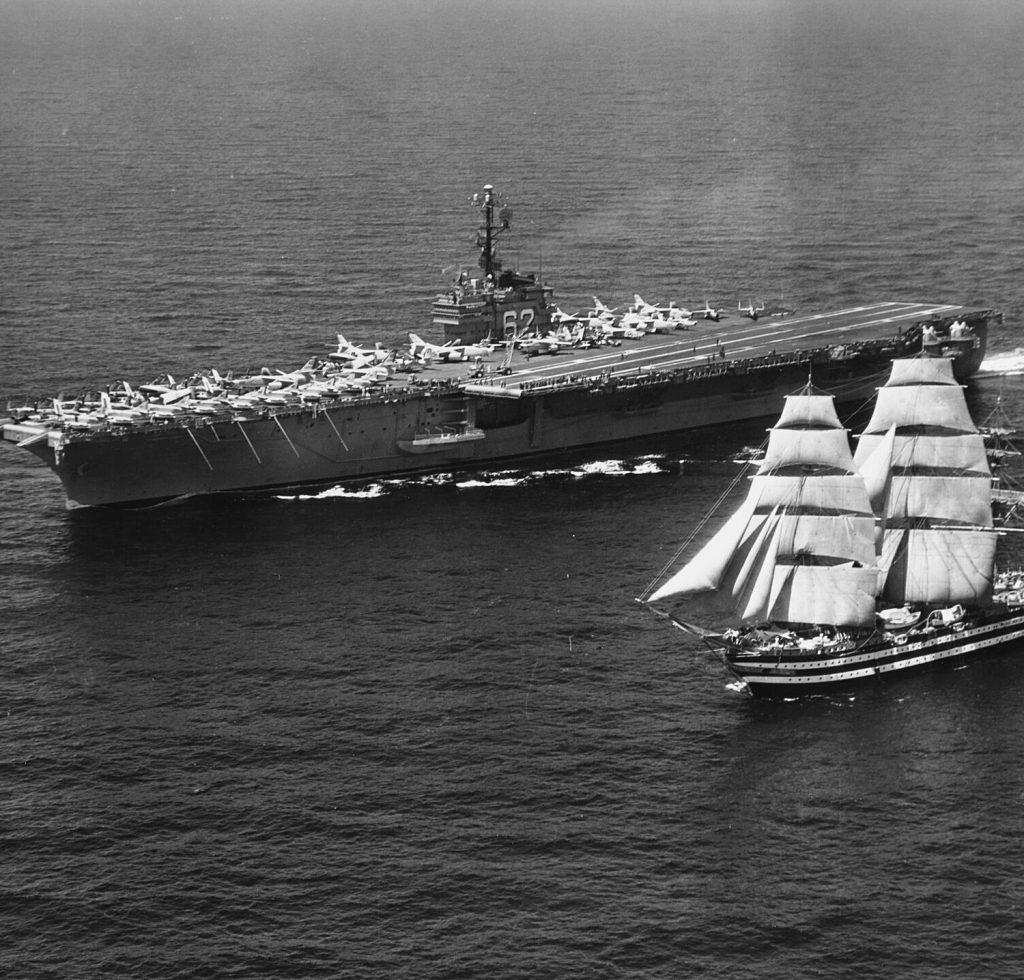
In 1962, more precisely on July 12, the American carrier USS Independence crossed the Amerigo Vespucci school ship into the Mediterranean. On the one hand there was a carrier of the Forrestal class, built to represent the new post-war American naval power. On the other hand there was an Italian sailor who entered service in 1931, with three trees, four sails and a form that seemed to belong to another century. According to the reconstruction of the Italian Navy and the US Sixth Fleet, Independence asked Vespucci to identify. The answer was: «Nave scuola Amerigo Vespucci, Marina Militare Italiana». The carrier responded with a phrase destined to remain in history, and then it would become the fastest way to tell the Amerigo Vespucci: «You are the most beautiful ship in the world».
The strength of that phrase is not only in the compliment: the Independence was a modern military machine, which is more than three hundred meters long, designed to bring planes, men and technology to the open sea. The Vespucci, instead, was already a timeless ship, at least in appearance. It was built in the Regio Cantiere Navale di Castellammare di Stabia, set in 1930, launched in 1931 and delivered a few months later to Regia Marina. Its white and black line recalls the nineteenth century vessels, with the two clear bands reminiscent of the battery bridges of the guns. But it is not a historical reconstruction, nor a museum piece: it is a military ship in service with a very precise function.
That function is training. On board the Vespucci the students of the Naval Academy still learn things that on a modern ship might seem marginal, but which serve to understand the sea before the instruments: the manoeuvres, the wind, the sender, the life on board, the discipline of a crew. Vespucci is the oldest unit in service in the Italian Navy, and the latter recalls that, from its entry into service, it has carried out training activities almost every year, with some interruptions due to war or extraordinary works.
Sixty years later, on 1 September 2022, the scene was resumed almost as a quote. In the lower Adriatic, while Vespucci was in transit from Manfredonia to Taranto, he crossed the American carrier USS George H.W. Bush, class Nimitz. The carrier commander, David-Tavis Pollard, asked by radio whether that was the ship Amerigo Vespucci of the Italian Navy. After the affirmative response of Commander Massimiliano Siragusa, a new version of the 1962 phrase came from the Americans: “After 60 years you’re still the most beautiful ship in the world”. The US Sixth Fleet, in short, wanted to rebuild that sympathetic encounter with the USS Independence.
Even in that case, the point was not just nostalgia. An American carrier who greets an Italian sailor says something about how the marines use the ships even outside the war: they also serve to represent a country, confirm relationships, make tangible an alliance. The Vespucci simply does so with its presence, its form of past times, its long history and the emotion that arouses in every landing that turns into a public event. This is why the ship has also become an instrument of naval diplomacy.
Today this story has returned to North America with the “World Tour Vespucci – Campaign in North America 2026”, started from Genoa and also included in the celebrations for the 250 years of Independence of the United States. The “World Tour Vespucci – Campaign in North America 2026” is an initiative of the Ministry of Defense and Navy produced by Defense Services S.p.A. The project is developed in collaboration with the Ministry of Foreign Affairs and International Cooperation, the Ministry of Enterprises and Made in Italy, the Ministry of Agriculture, Food and Forestry, the Ministry of Culture, the Ministry of Tourism, the Minister for Sport and Youth and the Minister for Disability. In this sense the Vespucci continues to do two works together: he trains the official students and, when he enters the port, becomes a form of Italian diplomacy abroad.
L’articolo The most beautiful ship in the world is Italian, say Americans proviene da IlNewyorkese.
