
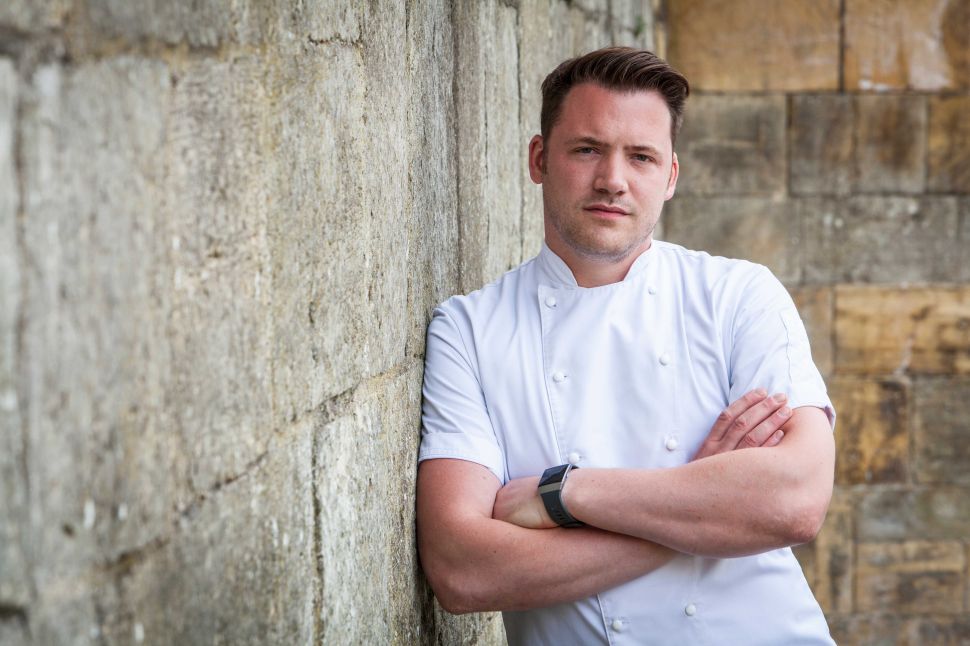
While some chefs fly ingredients in from all over the world, Tommy Banks is interested in what’s in his backyard. The chef grew up in Oldstead, a village in the northeast of England, and he’s built an entire career in the area, dedicating himself to cultivating the best possible products from the region. His Michelin-starred restaurant, The Black Swan, celebrates its 20th anniversary in August—a milestone that showcases just how much the destination has evolved.
“It’s night and day,” Banks tells Observer. “When we first opened, I was a 17-year-old kid, and it was a local pub. For the last decade, my focus has been on creating something unique and something that’s solely of the area.”
Banks, 37, grew up on his parents’ small farm, where they also ran a bed and breakfast. It was hard to make ends meet solely by farming wheat, barley and rapeseed, so when Banks was a teenager, his parents took on the local pub, The Black Swan. “I had no interest in it whatsoever,” he says. “I worked there because I’d left school and needed a job. I waited tables, I washed pots.”
At the time, Banks didn’t consider becoming a chef. He dreamed of pursuing a career as a cricket player. But when he was 18, his grandfather died, and the grief was so intense he developed an aggressive autoimmune disease called ulcerative colitis. He had part of his bowel removed and was bedridden for months.
“That put to bed any ideas of being a professional sportsman,” he says. “I had three operations, and it was very sobering and very tough. I had left school, I didn’t have my health, and the only work experience I had was at The Black Swan. But I was very determined and also a bit frustrated, so I threw myself into cooking. The amazing thing was that you could get all of the things that you could get through sport. You could win accolades, and you could be acclaimed.”
For the first few years, The Black Swan struggled. Banks worked under head chef Adam Jackson, an ambitious chef who helped guide the restaurant to a Michelin star in 2012 by elevating the restaurant’s standards and tightening the kitchen—a huge surprise. Jackson left the following year, putting Banks in charge of the kitchen at only 23 years old. “I was aware we had this Michelin star, and I needed to keep it,” he recalls. “I used to work seven days a week and cooked every plate of food. I thought if I did it all myself, it would be fine. And I retained the star.”
At 24, Banks became the youngest chef in the U.K. to earn a star. But he was also overwhelmed by imposter syndrome. He hadn’t gone to culinary school, and he had never trained with a prestigious chef. He once spent two days working at Le Manoir aux Quat’Saisons, but otherwise, Banks taught himself. He read a lot of cookbooks, drawing inspiration from chefs like Heston Blumenthal and Sat Bains, but Banks felt he lacked the worldview of his peers.
“I’d never traveled, I’ve never been trained,” he says. “I didn’t have any of these things to draw on. So what could I draw from? But I realized I had grown up on a farm, so maybe it could be farming and the land we lived on. I was like, ‘Right, I want to only cook with things we’ve grown ourselves or forage.’ My parents were hugely on board, and we really flew into it. Some of the dishes in the early days were very experimental, but over the last 13 years, we’ve really refined it to a point where we have a whole palette of ingredients.”
Today, Banks and his team create The Black Swan’s signature tasting menu (£195 for dinner and £135 for lunch) using products grown in the restaurant’s expansive garden or reared on the regenerative farm, including their own Dexter cows. There is a three-person foraging and preservation team who focus solely on keeping the larder fully stocked. Banks estimates that at least 90 percent of the ingredients served at The Black Swan are picked or foraged from their own land.
“For me, it’s all driven towards flavor, so if it’s delicious, we’ll pick it,” Banks says. “We can create really exotic flavors from things that are on the ground. I love sweet woodruff because it tastes like vanilla. There’s wild grass that tastes like vanilla, and yet you import vanilla from the other side of the world. We found we could create all of the flavors of the world, but using things that were already there in front of us.”
A few products, like asparagus and lion’s mane mushrooms, come from nearby farms, but Banks is primarily interested in how things taste in Oldstead. He no longer serves fish at The Black Swan because it has to come from too far afield. (It is on the menu at his other restaurants, Roots in York and The Abbey Inn in Byland.)
“The more restrictions you put in place, the more it promotes creativity,” Banks says. “It’s really difficult to be creative if you can use anything you want. If I make a dessert in February and can use anything in the world, I’d go for Alfonso mangoes from India or chocolate. In North Yorkshire in February, there is rhubarb and anything that you had the foresight to preserve. Restrictions are the ultimate catalyst for creativity.”
One of the desserts at The Black Swan, for example, is created with koji, an ingredient made by fermenting grains. It has a rich flavor that tastes—and looks—like chocolate, offering a familiar sensation for the diner, even though it’s an entirely new creation. Banks is interested in how a process of preservation can change or enhance how something tastes. Time, he says, is the biggest gift you can have as a chef.
“A fermented turnip sounds like the least glamorous thing you could think of,” he explains. “But if you do it over a long enough period of time, the depth of flavor is insane. It’s a case of having the patience to do it and to want to do it in the right way. You end up with something way more unique.”
The foraging team collects everything from sweet cicely to wild garlic to elderflower, depending on the time of year. There are multiple shipping containers filled with preserves. It requires a lot of planning ahead, but Banks says it pays off. The restaurant’s Negroni, for instance, uses a homemade vermouth made of 18 botanicals they either forage or grow, including wormwood and tangerine marigolds. Banks has spent so much time collecting, tasting and preserving ingredients that he can tell exactly where they grew on the land.
“I like the word terroir in French, especially when it refers to wine because it refers to a very specific flavor of a very specific location,” he explains. “It sounds really pompous when you say it as an English person, but it does explain what I mean. It’s to a point where I only like to pick the sweet woodruff from a certain bank because it tastes way better than on the other side of the farm. That’s down to a geographic place.”
He adds, “It’s not food miles because it all comes from here. It’s actually down to the idea of what’s within that mile.”
After finding success with The Black Swan, Banks debuted Roots in York in 2018. It received a Michelin star in 2021. Between the farm and his three restaurants, Banks has built a mini-empire in an area of England that is less prosperous than the south. He wants to continue investing in the area, an important part of The Black Swan’s two-decade legacy. Today, The Black Swan has nine bedrooms, which only adds to its destination-like appeal, and visitors can also pop by the more casual Abbey Inn.
“Restaurants in the middle of nowhere really struggle to exist, so you have to build something that people are willing to travel for,” he says. “But the upshot of that is we’ve now got around 170 people employed within the business. We’ve created a community of young professional people in a really rural area. And over the next 20 years, it’s about how we can deepen that impact.”
Banks tries to be in the kitchen as often as possible, but often finds himself dealing with the administrative side of the business. He’s become a vocal campaigner for fairer tax regulations on restaurants in the U.K. Currently, the British government puts a 10 percent VAT on food. Banks, along with many other chefs here, are attempting to get it lowered. Banks was forced to start a side business catering at sports stadiums to earn enough to pay off the VAT increase in 2025.
“It’s mentally really tough,” he says. “And what breaks my heart is that so many people aren’t surviving it. Since I’ve started campaigning for lower VAT, my DMs are full of heartbroken people who’ve lost their businesses. I find it very frustrating, and I really want to try and keep pushing to effect change. But it also keeps you so honest because it is a real fear that everything you’ve built over 20 years could vanish.”
On July 17, Banks will debut a one-man stage show, Spinning Plates: Live!, at the York Theatre Royal to reflect on these challenges, as well as his journey as a chef. It will incorporate documentary footage he’s been shooting over the last year with a filmmaker pal, and it covers everything “from the loveliness of it to the grim reality.” Banks wrote the show himself and hopes there might be additional live dates. The documentary, also titled Spinning Plates, will follow.
“It’s a test for me,” he says. “Everything points towards this north star of wanting to put my area on the map and really invest in it. We can do that for a couple of hours with people at The Black Swan when they come for dinner. But if I create media and content and tell them stories, that would be even better.”
The Black Swan will hold several special events in August around the anniversary, and guests can also expect to find a 20-ingredient Negroni temporarily on the drinks menu. Banks is also planning a party with all of his fellow chefs from the northeast, where more and more Michelin-starred dining has emerged over the years, including House of Tides’ Kenny Atkinson and Forge’s Jake Jones. Banks is proud to be celebrating 20 years, but he also sees the moment as an opportunity to reflect on how hard it is to maintain a restaurant in the U.K. today.
“It’s an interesting juxtaposition because on one hand you’re incredibly grateful,” he says. “My career has taken me to amazing places. I’m very privileged in some respects. But at the same time, it is really tough. We should look after small businesses. They make the lifeblood of what is great about not just this country, but any country.”
The Black Swan, certainly, is now part of what makes Oldstead great.
