
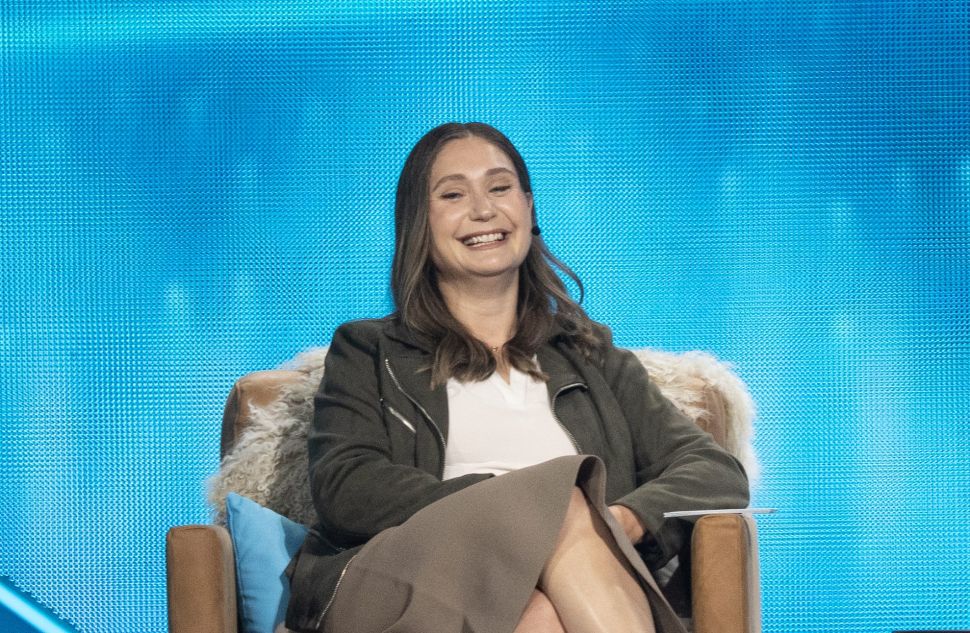
Daniela Amodei smiles during the Snowflake Summit 26″ width=”970″ height=”634″ data-caption=’Daniela Amodei contrasts Anthropic’s disciplined growth and enterprise focus with OpenAI’s scale-driven approach. <span class=”lazyload media-credit”>Minh Connors/Getty Images</span>’>
Days after Anthropic confidentially filed to go public, edging ahead of OpenAI in a closely watched IPO race among A.I. giants, Daniela Amodei, the company’s co-founder and president, sought to draw a sharper distinction between the two rivals. Anthropic is currently valued at $965 billion, with expectations it could climb past $1 trillion on the public markets, compared with OpenAI’s roughly $900 billion valuation. But as Amodei framed it, the competition is not just about numbers, but about how the technology itself is built and used.
“The whole reason we started Anthropic is to be able to build and develop this technology in a way that is ethical, responsible, fair, and I think it’s really incumbent upon everybody at the company, but especially leadership, to say, all of these numbers, they’re actually not the point,” Amodei said at this year’s Bloomberg Tech Summit in San Francisco yesterday (June 4).
Anthropic was founded by seven former OpenAI employees, including Daniela and her brother, Dario, who is the company’s CEO, aiming to build a more transparent and safety-focused A.I. firm. Its divergence from OpenAI extends beyond positioning to how it plans to grow.
The company has emphasized securing compute capacity, including a deal with Elon Musk’s SpaceX (which absorbed xAI earlier this year) to access its data centers in Memphis that will cost $1.25 billion per month. But Amodei said Anthropic is deliberately avoiding the aggressive spending levels seen elsewhere. OpenAI has projected as much as $600 billion in compute spending by 2030; Anthropic expects to spend roughly one-third of that.
“The structure of these deals is you have to commit to a certain amount of compute reasonably far in advance, and [we don’t want to] overextend ourselves such that we’re buying more compute than we could productively use,” Amodei explained. “We would much prefer to be on the side of having a little bit more demand for the product than we’re able to serve than the inverse, where you overshoot and then you’re not in a great situation, because you’ve bought something you can’t pay for down the road.”
While Anthropic has also expressed interest in more speculative infrastructure, such as SpaceX’s proposed orbital data centers, Amodei said there are “no immediate plans for working with astronauts to get space data centers going.” “But you never know,” she added.
Product strategy marks another key split. Anthropic has prioritized enterprise and coding use cases over mass-market consumer engagement. That contrasts with OpenAI, where more than 70 percent of ChatGPT usage is tied to personal tasks such as search, tutoring and life advice.
“We have always felt that enterprise and business are the best spiritual fit for Anthropic and our values,” Amodei said. “The difference in our consumer product compared to competitors is that we’re not an entertainment tool. It’s really for productive activities, whether those are at work or at home.”
Both companies, however, are investing heavily in advanced cybersecurity A.I. Anthropic’s Claude Mythos has raised concerns about its ability to exploit vulnerabilities. OpenAI’s Daybreak targets similar risks but takes a different approach to deployment.
Daybreak is integrated into existing GPT workflows and offered in tiered access based on user verification. Mythos operates as a closed consortium limited to vetted organizations across roughly 15 countries, including the U.S. government, NATO, ENISA, Samsung and Okta.
“You have to give the defenders a head start,” said Amodei. “A.I. models are going to keep advancing. If it’s not us one day releasing a Mythos-level model [to the public], another A.I. company will.”
Anthropic has also taken a more cautious stance on government work. The company withdrew from a Pentagon contract involving domestic surveillance and autonomous weapons, which OpenAI later assumed. Still, Amodei described broader collaboration with the U.S. government as positive.
“Every company is going to have its own principles about what its red lines and values are,” she said. “It’s important that, whatever those values are for you as a company, you are true to them, you feel like you can explain them to employees and to the world more broadly.”
