
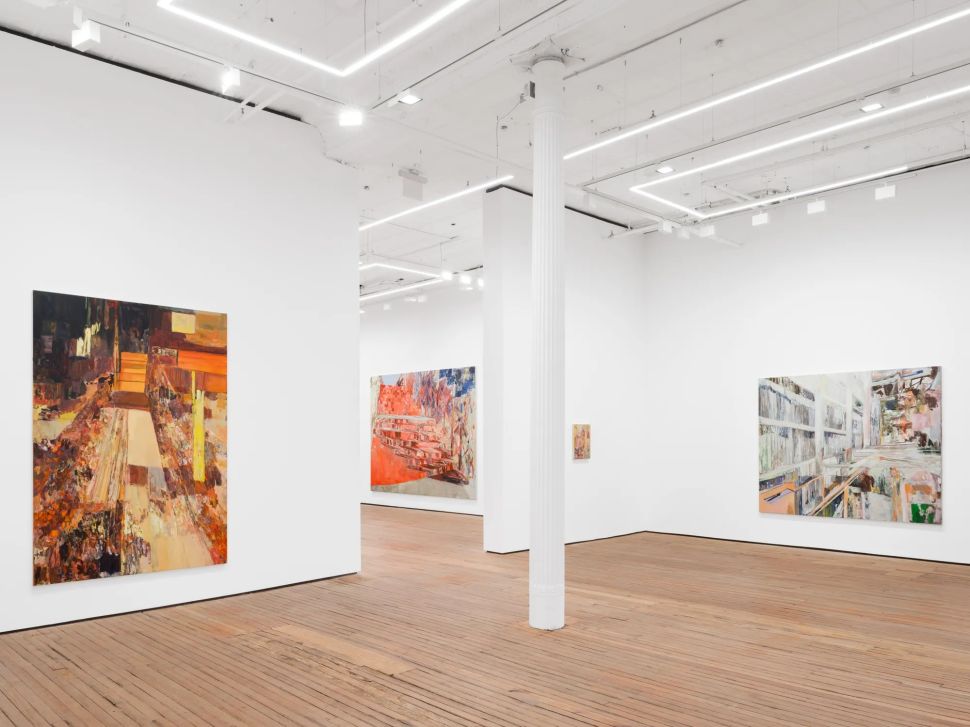
Francesca Mollett swiftly captured the attention of curators and collectors with her magmatic abstractions, which evoke and embrace the pure alchemical magic of painting to mimic the perpetual flow of matter and energy—the origins of everything. Her canvases create sensory and poetic, almost whimsical spaces, exploring how purely abstract landscapes and mindscapes can still evoke and provoke subtle sensations, hallucinations and visions tied to our relationship with the physical world.
We met as she was finishing the installation of her latest show at GRIMM in New York, where Mollett described her process as beginning with structure but remaining open to accident, sensation and revision. Her first decisions are often formal: areas of density and the dynamic between different spatial fronts. From there, works develop through layering, interruptions and adjustments, as she moves in and out of the work mentally as much as physically. Light becomes an important indicator in establishing the composition. “There might be an idea of light, then a shift and then a very deep darkness. That becomes the starting structure,” she explained. “I’m quite interested in the relation to space, and in how the body is involved.”
“Buried Shadow“
Artist: Francesca Mollett
Venue: GRIMM
Address: 54 White Street, New York City
Through: June 20, 2026
Although abstract, her paintings, through their almost architectural accumulation of layers, eventually suggest natural or urban landscapes in which the body is implied and invited. Mollett’s physical involvement, particularly in the larger formats, is a vital part of the process. Large canvases may begin on the wall but are often leaned or repositioned so that she can reach them differently, building them up layer by layer, their dense surfaces retaining traces that feel almost fossilized. “I quite like this idea of entanglement with painting,” she said. “With a palette knife, you can take parts off and smooth them, so the material is always changing.”
She intentionally treats paint as active matter, exploring how colors emerge as pigments blend, are removed and pulled across the surface, alternating between excavation and addition: “Colors emerge through sensation. One color suggests another, or I try to introduce something unexpected.”
Mollett’s lines and charcoal marks are often still visible because they preserve a provisional quality, bringing “lightness into contrast with the density of the painted surface.” Hers is an almost collage-like technique, a continuous problem-solving during which she breaks open the space, introducing pauses within fields of gestural, tactile color.
While some of her works suggest interiors, landscapes or figures, she does not begin with a literal image in mind. On the contrary, the paintings themselves seem to generate images after the fact—forms that surface from the subconscious. Each painting is a series of thresholds, moments and places that exist to give matter to form: transitory sensations that find shape only within the space of mental elaboration and identification. In this way, Mollett’s work is a continuous interrogation of how to move between what is perceived and imagined, which then resolves into a symbolic form or concept or world.
She admits this might be related to memory and the subconscious. “When you are painting, you can remember different versions of the painting before it changed. You are aware of the past painting and how it might still be present,” she reflected. “I find the composition in the process. I might have a strong idea for some parts, but then the painting changes.”
One work in the GRIMM show, Arrow to Arrow (2026), is connected to a real place near her house: a bridge over a buried canal. Yet through light, the surrounding structure has disappeared. “There is a kind of tension in erasing everything and restarting,” explained Mollett. “I like to let things emerge. Sometimes I keep something because it has appeared almost accidentally, like a sample or fragment that opens onto something else.”
In her smaller paintings, changes in register occur more dramatically, as she often works in intervals, adding a layer and then leaving the painting alone for a long time. In larger works, the space can expand into something more atmospheric or architectural. Growing up in the countryside outside London, nature also is an important undercurrent in Mollett’s work—an image and atmosphere she has simply internalized and tries to find through the process. Yet she clarified that her paintings do not depict nature literally, but instead find a kind of radiance in the light, shadow, atmosphere and a sense of spatial pressure.
For the exhibition at GRIMM, she wanted each painting to feel distinct, which made the installation especially challenging. The works can certainly be taken in individually, but they also form a path or sequence when placed together. There is a continuous tension between light and shadow, the abstract and the recognizable, between the indecipherability of more undefined layered surfaces and images that offer stronger hints of landscape, interior or figure. Light, Mollett pointed out, is the only connective element and the most important one.
Throughout our conversation, she emphasized that she approaches painting as a record of perception, mimicking the way we encounter the world. It is an exercise of embodied sensation through painting that connects with French philosopher Maurice Merleau-Ponty’s phenomenology: perception as a fluid negotiation between the eye, the body and the world. In Mollett’s work, vision is never stable or purely optical; instead, she depicts the world as it comes into our senses, before it hardens into knowledge. The painting surface becomes a threshold where matter and consciousness meet and where color, memory, body, sensation and the mind’s impulse to make meaning out of unstable forms and transitory sensations converge: magmatic mindscapes of how we navigate the world.
