
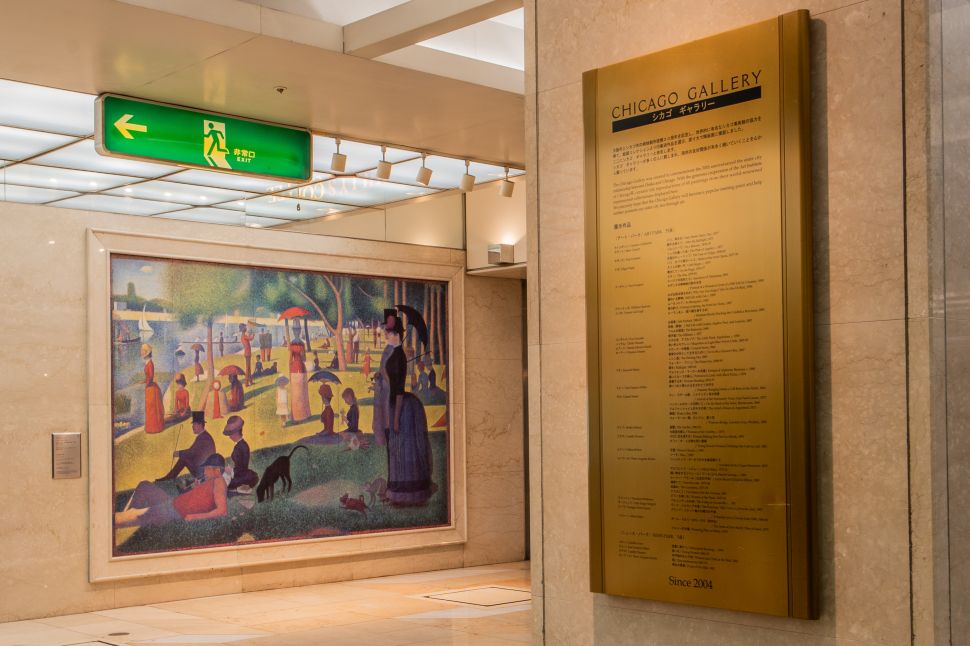
If you are standing inside the Art Institute of Chicago, a trip to the Impressionist galleries usually involves climbing the grand staircase and navigating the quiet, sunlit rooms of the upper floors. A completely different route is available to anyone willing to push a Ferris Bueller-style day off just a bit further. Take the Blue Line to O’Hare, hop a flight to Tokyo, board the Shinkansen bullet train to Osaka and head down into Namba Station, where you will find yourself standing in what feels like the Osaka subway wing of the Art Institute of Chicago.
Located in the subterranean Namba Walk transit hub, a sprawling underground network not unlike Chicago’s own Pedway, the space operates as a permanent cultural bridge between two sister cities. Founded in 1994, the gallery features 60 ceramic-tile reproductions of Impressionist masterpieces pulled directly from the Art Institute’s collection. You wouldn’t guess their age looking at the walls today. Many of the tiles are as bold and vibrant as the original works. The Japanese firm Otsuka Ohmi Ceramics collaborated closely to recreate these pieces, utilizing a specialized high-heat firing process to produce an essentially indestructible art exhibit built for the daily rush of commuters. The sheer volume of the installation is remarkable. Spread out over a mile, the works are split between 5 initial pieces at the News Park and 55 further west at the Art Park. Finding them all requires the kind of deliberate afternoon effort you would dedicate to a rainy day at a traditional museum. You could easily spend hours down here wandering like Ferris Bueller, getting lost among the world-class art while millions of people commute past you.
Chicago and Osaka share a deeply rooted second-city mentality, though the moniker carries a different historical weight in each. For Chicago, the title represents a literal rebirth from the ashes of the 1871 Great Fire, highlighting a legacy of grit and architectural reinvention. For Osaka, it is a proud cultural identity forged in defiance of Tokyo’s bureaucratic dominance. Each metropolis possesses an unmistakable character; their larger, more famous counterparts feel almost sterile by comparison. This localized pride manifests in distinct dialects. Osaka’s quick-witted, comedic flourishes contrast beautifully with the distinctly flattened vowels of the classic Chicago brogue. Second City comedy was born in the Midwest, yet the punchlines land with the exact same timing across the Pacific.
The parallels map directly onto the food scenes, where locals champion brash, heavy comfort foods over delicate presentation. Osaka is fiercely proud of its savory okonomiyaki pancakes, a dish born from post-war scarcity when citizens had to mix whatever ingredients they could scavenge into a simple batter. This perfectly mirrors Chicago’s stubborn devotion to deep-dish pizza, a massive, filling creation that originated as a cheap, hearty way to feed hungry immigrant communities stretching their dollars to the limit. Both meals began out of absolute necessity and sheer convenience, yet they evolved into incredibly proud cultural staples. There is a raw, unpretentious hospitality running through these culinary spaces. You can practically hear the legendary Billy Goat Tavern chant of “cheezeborger, cheezeborger” echoing the exact same energy as an enthusiastic shout of “Maido!,” the traditional Osaka merchant greeting ringing out from a neon-soaked izakaya. These are cities containing multitudes of personality and a cosmopolitan worldliness always saddled next to a deep local insider shorthand. We put on a good face for visitors, yet there is a deeper language only a local will truly comprehend. Flash a finger gun at a passerby in Osaka, and the unwritten comedic code dictates they must dramatically pretend to be shot dead. In Chicago, a similar unspoken understanding governs the streets through the sacred tradition of “dibs,” where the absolute, unquestioned authority of a rusted folding chair saves a shoveled parking spot in the dead of winter.
This shared local loyalty perfectly extends to their sporting miseries. Both cities boast passionate baseball fanbases long plagued by bizarre hexes. The Chicago Cubs suffered the Curse of the Billy Goat after a pet was barred from Wrigley Field in 1945, while the Hanshin Tigers endured the Curse of the Colonel after fans tossed a Colonel Sanders statue into the Dotonbori River to celebrate a 1985 championship. Both loyal fanbases weathered generations of heartbreak before finally breaking their curses, with the Cubs winning the 2016 World Series and the Tigers capturing the 2023 Japan Series.
This municipal connection extends to the surface streets. Midosuji Boulevard serves as Osaka’s own Magnificent Mile, a parallel so striking that the two thoroughfares are officially designated as sister streets. They function as high-end shopping meccas sharing international mainstays like Chanel, Louis Vuitton and Apple. Each retains a distinct, hyper-local anchor. Michigan Avenue relies on the intoxicating scent of Garrett Popcorn to keep it grounded, while Midosuji Boulevard eventually gives way to the chaotic, multi-story retail wonder of Don Quijote before feeding pedestrians directly into the subterranean Namba Walk.
Directly adjacent to these shopping districts, the waterways of both cities tell a story of human engineering. The Chicago Riverwalk winds through a wide, breathtaking canyon of towering skyscrapers, defined by the historic, industrial feat of reversing the river’s flow. The Dotonbori River canal in Osaka offers a tighter, neon-drenched corridor geared toward sensory overload and vibrant excess. Despite their different aesthetics, both rivers utilize architectural boat cruises to showcase their industrial histories, proving that a working city’s central arteries can be repurposed into highly functional public spaces.
The deep bond between the two cities dates back to the 1893 World’s Columbian Exposition, a massive event that put Chicago on the international map. Japan gifted the Phoenix Pavilion to the fair, a historic wooden structure built on Wooded Island in Jackson Park. Today, that legacy lives on through the mature cherry blossoms that frame the Osaka Garden pavilion. Chicago has planted even more blossom trees in the park in recent years, ensuring the colorful grove flourishes directly in the shadow of the highly anticipated, newly rising Obama Presidential Center. This physical intersection of history and modern development tightens the sister-city bond, creating a central point of reflection for future visitors.
If Ferris Bueller had stretched his famous day off across the Pacific, he would have found the ultimate artistic payoff waiting in the Namba subway. Because these works are built into the walls of a transit hub, the underground gallery invites you to break the fourth wall. You are entirely free to walk right up to the pieces. Running your fingers across the ceramic reveals a cool, heavy touch and an ever-so-slight physical relief that gives the brushstrokes a tangible depth. The crown jewel of the exhibit is a massive, meticulously detailed reproduction of Georges Seurat’s A Sunday Afternoon on the Island of La Grande Jatte. In the classic film, Ferris’s best friend, Cameron Frye, stands inches away from the original painting, intently studying the pointillist dots until his own identity seems to dissolve into the canvas.
Standing in the pristine, brightly lit corridor of Namba Walk, you can re-enact that exact cinematic moment. You can get right eye-to-eye with the ceramic recreation to examine the textures without a single pane of museum glass separating you from the art. The surrounding transit hub is incredibly clean, safe and beautifully maintained. Strolling past these brilliant Impressionist displays while trains hum in the distance requires a brief moment of mental recalibration. Not until you look up and see transit signs pointing toward the Midosuji, Yotsubashi and Sennichimae lines instead of Chicago’s Red or Blue do you truly realize you aren’t wandering a lost basement of the Art Institute’s Modern Wing.
Additional reporting by Tsuyoshi Kizu.
