
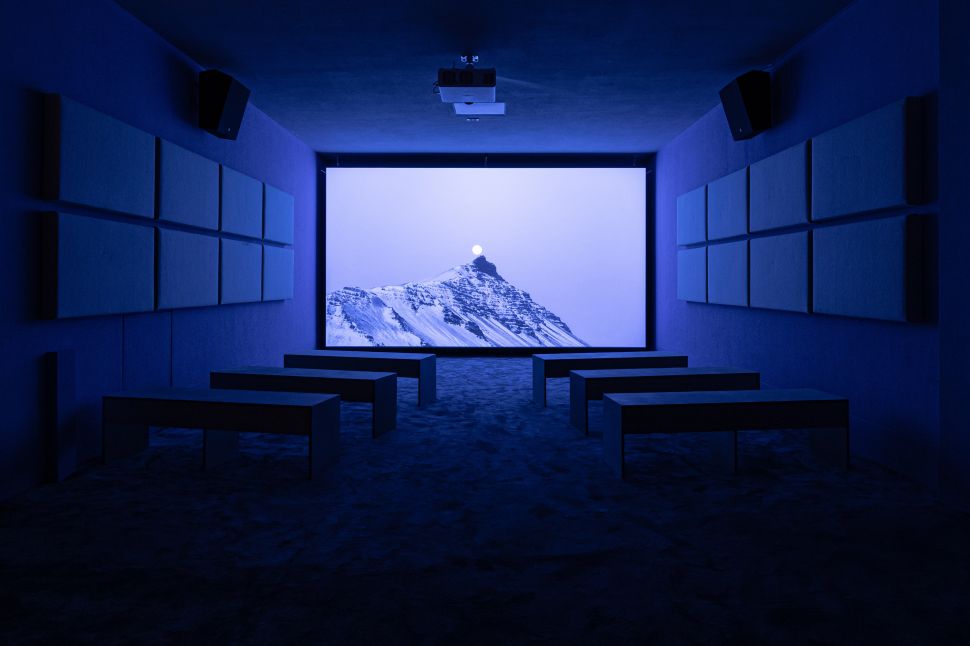
The Icelandic Pavilion offers one of the most ethereal, poetic experiences currently on in Venice—a fluid exercise in mythmaking and imagination. Titled “Pocket Universe,” the exhibition conceived by Ásta Fanney Sigurðardóttir is an expansive storytelling environment in which visitors drift through a sequence of gestures, whispering presences and sensory associations dispersed across the space. Rather than beginning with a closed concept, she created the conditions to call forth a “fixed framework” within which creative improvisation and imagination take place.
A distinctly Icelandic attitude characterizes the entire exhibition: a heightened awareness of the most minimal multisensory presences and a quiet indulgence in the temporal flow of events, suspended in time and space until they find their final resolution. Something anchors this sensibility—likely the result of an ancestral animistic spirituality that endured even after the imposition of Christianity. Observer first encountered Sigurðardóttir during Sequences, the country’s biannual festival of durational art, when the pavilion’s concept was still solidifying in the artist’s mind. In that moment, she spoke about her notion of art as a gesture of imaginative possibility. “It’s like pointing at something, giving a cue that something is happening. It’s already opening up possibilities,” she said at the time. “It can be really simple; it doesn’t have to be complicated. It just has to be put in front of people, putting forward the possibility of an alternative, another outcome, hope or a different way of seeing the world. I know it’s such a basic thing, but it’s still so grounded in the reality we are living.”
Her work in Venice is an “invisible performance” in constant transformation, and she will remain in Venice for eight months to add works, change existing ones and activate the space through performances that will only be seen by some. In that way, the pavilion serves as a liminal threshold where this ludic storytelling exercise can be revived, reactivating local symbologies and elemental archetypes that intermingle to generate alternative ways of perceiving reality.
“It gives people a chance to think about things differently, or to imagine things differently,” she told Observer more recently, noting how difficult it is to dislodge other ways of seeing from people entirely. “You can just open up those little doors, but you’re not going to change the entire human being. When you’re locked down because of the things around you, it opens up like a tiny window of freedom.”
Sigurðardóttir describes the pavilion as “a drawing of thoughts,” a palimpsest that operates through gestures, clues and invitations: the viewer encounters one thing, then another, and gradually paints their own picture. But each person’s picture is different. Through recurring motifs of portals, spheres, caves and oceans, Sigurðardóttir operates in the fluid register of the symbolic, weaving together myths and folklore that share similar archetypal figures and attempts to explain the mysteries of our existence within a broader cosmic entanglement. The blue walls contribute to this sense of floating, which Sigurðardóttir connects to her fascination with buoys. She became absorbed in researching their different forms and uses, especially after arriving in Venice, where navigational markers in the water are among the first things one notices. For her, buoys are powerful symbols: they operate in a space of uncertainty, where what lies beneath the surface cannot be seen, yet they offer orientation. “They are floating, but still connected to the far deep. They have this connection to an inner earth, but they are still flexible,” she reflects.
Language is central to Sigurðardóttir’s practice; she moves fluidly into poetry and music. Scores and scripts are present in the space, suggesting a further entry point into a narrative that remains suspended, waiting to be activated. Sound and performance are absent yet somehow still present; the artist is no longer, or not yet, performing, yet the viewer is invited to perform that score or script internally. “It’s about how you evoke that sound in people’s heads,” she explained. “You’re suggesting something that is not universal, because everyone will create their own. That’s the field, or the realm, that I want to activate.”
Prior to Sequences, Sigurðardóttir had begun reading about the quantum realm, finding a parallel with poetry in that both seem to operate around something that cannot be stated directly but can be approached through the negative space surrounding it. A poem does not declare the thing outright; it draws around it until the reader feels its presence. “You don’t say it directly, but you draw in the negative space of everything. Then you get this picture of something. You cannot really say it is there, but you feel it is there somehow… Poetry is such a beautiful thing that happens in your head. It is a personal experience that you have in your pocket.”
That logic can be found in the pavilion: “It’s a score, but it’s also a game. It is very serious, but it is also playful. I like that field of imagination.” An important source of inspiration came from board games from Mesopotamia, Egypt and China, through which Sigurðardóttir observed how cultures across history developed similar structures and found herself contemplating her own ignorance of how those ancient instruments were actually played. “I don’t know the rules. That makes them mysterious. But without rules, anything becomes possible: I can invent them myself. So I began combining games, altering rules, taking them apart, and reassembling them. This becomes a starting point, as in any game.”
Sigurðardóttir resists labels for her practice. She does not identify as a choreographer, and even terms like “multimedia artist” or “time-based art” feel insufficient. “I don’t really think of it as time-based art either, because my relation to time is very strange: I don’t really think time exists in the way that we perceive it in a linear way as human beings,” she reflected. “I like to take time and tie it together from the past into the future, making a knot.” The work pinpoints a moment, then gathers thoughts and energies around it—a way of taking the soul back into the body and of marking the present as it appears.
Rather than imposing fixed meanings, the exhibition employs the same ludic approach that triggers curiosity and free exploration Sigurðardóttir embraces in her own practice. She is always waiting for cues—not visions exactly, but a sense of possibility that could be woven into the current fabric of reality. When no cue appears, she does the practical work to trigger her subconscious: writing, sorting images, trying things out and generating material. “It is like having a drawing and finding the points, one, two, and then the picture appears. I think that’s how I work,” she said, emphasizing how it is also about trusting that process, even when it exists beyond conventionally prized productive rationality. “It will always be what it wants to be, and you are like a servant.”
The visual dimension of her work is equally essential. Sigurðardóttir rejects the idea that visuals are secondary to concept, insisting that an intense bodily response to colors, patterns, textures and combinations of materials is also key. Yet she is drawn to moments when things do not fit together, when social energies become strange, awkward, charged or uncomfortable. Those gaps hold energy. By acknowledging them or entering them, she can shift the structure of a room, a group or a situation: “It is about the energy in the room, the context, where I come from, who is there and everything. It is about activating something, taking something apart and putting it back together differently.”
The point, she clarified, is not to promise healing or change the entire human being, which would risk becoming another form of control. Instead, the work creates a situation: an invitation that viewers may choose to enter, embrace or interpret differently. Each physical piece in the space might carry a cue about where it wants to go, but there is no fixed agenda. Its openness and capacity to accommodate multiple interpretations are central. “It’s about feeling out of your inner pocket,” she said, adding that the pavilion is an intuitive exercise, constantly changing the rules or placing things into another kind of relation, defying preestablished conventions and common expectations. “It is more about perspective: how you look at things, how you can change every circumstance into a lucky situation, or make it malleable.”
A central piece in the pavilion is a video that follows a character called Creature Zero as it sets out to find the “original rock.” To film it, Sigurðardóttir originally imagined performing in every country in the world, but when that proved impossible, she found another way to think globally, turning to mythologies, folk tales and cosmologies from many cultures, particularly stories about the creation of the world. “They are so similar, so similar. I was taking these tales and mixing them together, but I also wanted to create a new whole,” she explained. From these, she took first sentences and began weaving them together, connecting different origins while erasing and transforming them into a new, universal myth. “It is very subtle, very layered, and almost impossible. I wanted the energy beneath it to be this kind of thing.” Filmed at sites associated with mystical or spiritual traditions, the video highlights how this universally shared exercise in mythmaking has encouraged humans to embrace the cosmic circle of creation and destruction as a generative starting point for renewal.
Sigurðardóttir’s multilayered choreography in Venice points to imagination as a shared and generative force, capable of expanding outward into multiple speculative worlds. It hints at the existence of a collective subconscious rooted in intuition, ritual and primal memory that, operating at a prelinguistic level, can transcend language barriers to become a catalyst for shared emotional and metaphysical landscapes.
In this state of perpetual flux, with water as metamorphic element, the pavilion proposes wonder not as escapism but as an ontological tool for reconnecting fragmented realities through shared acts of imagination—a force that can change how a person functions in reality. The entire pavilion invites exploration, rediscovery and reactivation of the imaginative capacity humans need in times of uncertainty. Not as an escape, but as a belief in the power of imagination to manifest, leading again to a creative circle. “We are in such a serious time. But you can pinpoint something and shift it toward the possibility that things can become different. It is such a small thing, but it opens up possibilities,” Sigurðardóttir acknowledged. “Imagination is such a source of intense power, and we can use it as a starting point to create a new world. I really fiercely believe that.”
