
One year after President Donald Trump signed the One Big Beautiful Bill to cut federal taxes and shrink spending, New York’s federally funded safety net is beginning to fray. But New York officials are taking very different approaches to deal with reductions in health care programs and food aid.
The budget signed by Gov. Kathy Hochul provides about $150 million to help with food insecurity and at least another $70 million is likely to be allocated in the city budget to help food pantries. Mayor Zohran Mamdani this week detailed the intensive city effort underway to make sure as many of the 2 million New Yorkers getting SNAP benefits will keep their eligibility.
But the Legislature went home last week without taking any steps to help 450,000 New Yorkers deal with work and paperwork requirements going into effect next year that could push as many as 1 million New Yorkers out of the program.
What’s the difference? Money. Boosting food aid costs millions. Health care comes with a price tag in the billions.
Hochul has long argued the state can’t afford to pick up the cost for federal health care cuts and Assembly Speaker Carl Heastie agreed with her as the session neared its end, even as he called the decision “heartbreaking.”
“We’ve kind of bounced around some ideas, but no matter which iteration you try to come up with, it still requires the state to come up with billions,” Heastie said. “I’m not sure the money is there under our current tax structure.”
Progressive groups and advocates insist the more important cost is what will happen to the nearly half a million people who lose their health insurance.
“The health care cuts will take us back to an uninsured rate that is the same as before the Affordable Care Act was passed in the Obama administration with less than 90% with insurance,” said Emily Eisner, interim director of the Fiscal Policy Institute. “We have already seen a 100,000 decline in SNAP enrollment in the state. It’s a smaller decline than in other states but it is still precipitous.”
The 450,000 people who will be without health insurance on July 1 is a result of a deal the Hochul Administration reached with the Trump administration on the state’s Essential Plan which used a provision of the Affordable Care Act to provide cost-free coverage to people who made too much money to qualify for Medicaid.
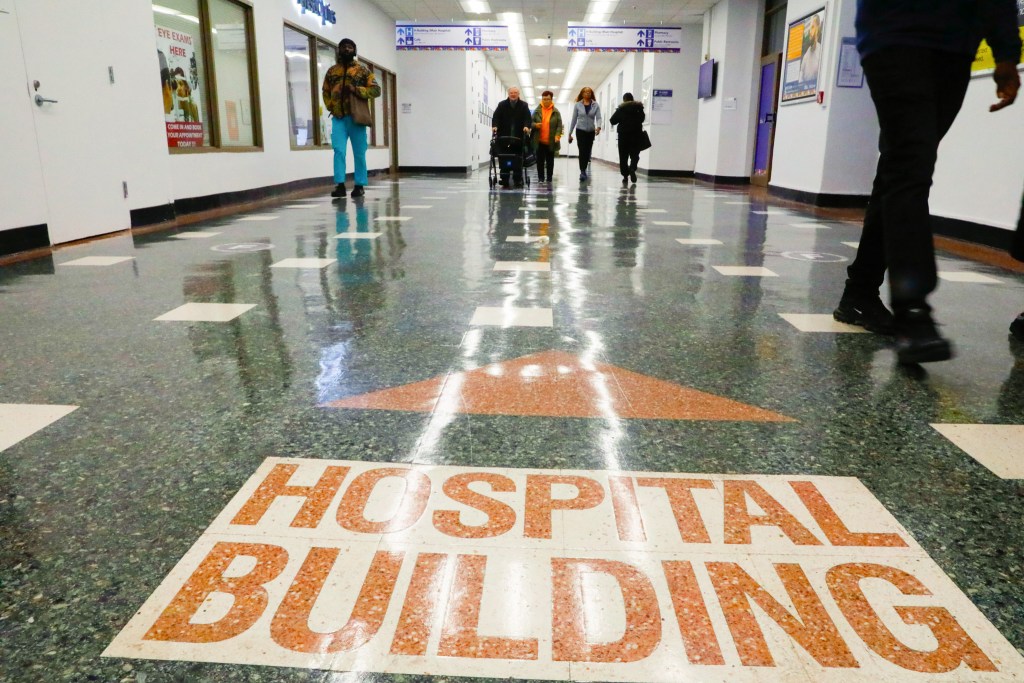
People in and out of Woodhull Hospital in Brooklyn, Jan. 22, 2026. As many as 450,000 New York state residents could lose health coverage thanks to cuts in President Trump’s signature 2025 tax law. Credit: Ben Fractenberg/THE CITY
It originally covered people making up to 200% of the federal poverty line but the limit was increased to 250% in 2024, or about $40,000 for a single person.
But the Trump tax bill sharply reduced funding for the Essential Plan and the Hochul administration won federal approval to restructure it so that only people making less than 200% of the federal poverty line would continue to receive coverage.
Statewide that will continue insurance for about 1.3 million people — but 233,000 city residents will lose coverage.
Some argue that progressive groups like the institute are exaggerating the impact, said Bill Hammond, a longtime analyst of the state’s health care policies at the conservative Empire Center.
Those losing coverage only were insured in 2024 and some may be able to purchase subsidized coverage on the Affordable Care Act exchange even though those subsidies have been reduced.
The Affordable Care Act exchanges are the only option for people with that income elsewhere in the country, he added.
In 2027, new rules will require a majority of Medicaid recipients to prove twice a year that they have worked or volunteered for 20 hours a week. The Fiscal Policy Institute estimates that could force as many as 20% of the 3.6 million recipients statewide off the program.
In all, the state’s impressive rate of insured residents — 95%, trailing only Massachusetts — is expected to drop to around 90%, the institute says.
Those estimates may also be inflated, Hammond argues, because the required work and volunteer hours are based on the federal minimum wage of $7.25 an hour. Since New York’s minimum wage is more than twice as high, recipients will only have to prove they have averaged 10 hours of work per week.
The Hungry City
The cuts to federal SNAP benefits come as demand for help with food has soared.
The number of visits to food pantries in New York City reached 47 million last year, up 87% from 2019, before the pandemic, according to figures from City Harvest.
“That’s about a million extra visits to food pantries a month for certain groups, especially households with children,” said Jerome Nathaniel, director of policy and government relations at City Harvest.
Effective last March 1, the Trump tax law expanded an existing set of SNAP work requirements to anyone 64 or younger, up from 54, and lowered an exemption for people with children to 14 years from 18.
The Fortune Society held a Long Island City food bank ahead of food assistance benefits running out during the government shutdown, Oct. 31, 2025. Credit: Alex Krales/THE CITY
The requirements were also extended to anyone who is homeless, to veterans and to young adults who had been in foster care. Those people began to lose coverage at the start of June if they hadn’t submitted documentation showing they met the work requirements.
The mayor this week said that outreach efforts had reduced by two-thirds the number of New Yorkers at risk of losing their SNAP benefits, reaching 223,000 of the 343,000 people who might be affected. The city worked with about 100 community groups to make sure they reached participants to file the necessary paperwork.
City Harvest, for example, hosted a training session for food banks on how to help people remain eligible, including by showing pantries how they could use some recipients as volunteers, allowing them to meet the requirements for work or volunteering.
Most of the government funding goes to help food pantries and other emergency providers meet the demand. The mayor has proposed $75 million in city assistance for the new fiscal year beginning July 1, but Council Speaker Julie Menin said the Council is trying to increase that to $100 million.
“There is still a lot of uncertainty,” said Nathaniel. “If this year was hard, next year will be one of the hardest years” as more provisions of the Trump tax law take effect. “We need to do more.”
Our nonprofit newsroom relies on donations from readers to sustain our local reporting and keep it free for all New Yorkers. Donate to THE CITY today.
The post Mamdani and Hochul Can’t Repair Trump-Frayed Safety Net appeared first on The City Reporter.
