
On the heels of the $96 million, all-time record-setting Collection of Jean & Terry de Gunzburg – Design Masters sale led by Claude Lalanne’s $33.5 million mirrors, Sotheby’s June Design Week generated a combined $27,568,552 across a three-day series of auctions. The summer auction round kicked off on June 9 with the $8.8 million Art & Design from the Collection of Barbara Gladstone sale, followed by the $10.5 million Of Form and Color: Art and Design from the Emmanuel de Bayser Collection sale on June 10, with the $17.07 million Important Design sale on June 11, which presented pieces from the defining aesthetic movements of the 20th and 21st Centuries. Meanwhile, Phillips’ Design sale on June 12 realized $2.9 million, with an 89.5 percent sell-through across its 76 lots, with most meeting or exceeding their high estimates.
Barbara Gladstone’s eye for design
Opening the June design round, the highly anticipated trove of 140 lots from legendary dealer Barbara Gladstone squarely met its presale estimate of $6.9-10 million with a solid group of design, prints and photographs that proved how her eye for fine and pioneering practices extended well beyond her ability to pick and champion artistic talent. Most of the design pieces in the sale exceeded estimates, led by one of Jean Prouvé’s most desirable sideboards, the BA-12, dated circa 1948, which fetched $294,400 against a $120,000-180,000 estimate. Emile-Jacques Ruhlmann’s pair of “Rendezvous Pêcheurs de Truite” armchairs more than quadrupled their high estimate, selling for $140,800 (est. $20,000-30,000), while Greta Magnusson-Grossman’s low table climbed to $20,480 from a $5,000-7,000 estimate. Other top lots included Jean Royère’s occasional table, which, after several seasons of strong results, easily exceeded its estimate to sell for $40,960 (est. $25,000-35,000), while a table lamp by Mathieu Matégot doubled its high estimate, achieving $20,480, as did the Alexandre Noll lamp, which sold for $38,400 (est. $10,000-15,000). A fantastical Otto Schulz “Paradise” cabinet sold for $44,800, well above its $20,000-30,000 estimate. A pair of “Tre Pezzi” armchairs by Italian designers Franco Albini and Franca Helg sold for $24,320, surpassing a $12,000-18,000 estimate.
Richard Prince painting with gray and raw wood-toned surfaces hangs alone on a white wall.” width=”970″ height=”1213″ data-caption=’Richard Prince, <em>Medusa</em>, 2003. Sold for $1,024,000. <span class=”media-credit”>Courtesy Sotheby's</span>’>
The top lot by value, however, was on the art side: Richard Prince’s Medusa from his Hood series, which landed within estimate at $1,024,000 with fees. But the other highly anticipated lot, Alex Katz’s portrait Halsey 9 (2022), was withdrawn after failing to find a buyer within its $400,000-600,000 estimate.
The artworks in the sale, which outnumbered the design pieces, tended to blur the line between categories. One was the set of six unique “Elliptoeder” chairs by artist Franz West, which sold for $70,400 against a $30,000-50,000 estimate, followed by a table that sold for $24,320. Two “Bunter Stuhls” by West also sold at around the high estimate for $16,640.
Opening the sale, a fresh-to-auction minimal black-and-white graphite-on-paper composition by American abstract painter Myron Stout, dated 1976, fetched $128,000 against a modest $5,000-7,000 estimate, while a pair of ceramic vases by Italian artist Fausto Melotti nearly doubled their high estimate to sell for $23,200. Carroll Dunham’s oil on linen, which Gladstone had acquired directly from the artist in 2015 after showing it at the gallery in 2012, met its high estimate, selling for $358,400, as did Alpha, which sold for $294,500 with fees, and Amy Sillman’s painting sold for $230,400 with fees. An additional Prince painting sold for $166,400, and another, Which Side Are You On?, achieved $256,000, while an ink-on-paper work by Polish artist Alina Szapocznikow—acquired by Gladstone from Parisian Galerie Loevenbruck, which is currently staging a show of the artist—flew to $61,440, doubling a $30,000 high estimate.
Lygia Clark’s seminal 1964 Estrutura de caixas de fósforos met its high estimate at $121,600, and the Daniel Buren, with an estimate on request, sold for $134,400. Gladstone also had iconic Yayoi Kusama pumpkins in her collection, with a larger signed and dated 1983 example selling at $153,600 with fees, and a group of three selling for $230,400 against a $60,000-80,000 estimate. Several ceramic pieces in the selection performed well amid the current market enthusiasm for the medium. Among them, a group by William J. O’Brien, who has also shown at the gallery, all met or exceeded estimates, with an untitled piece fetching $16,640 against a $2,500-3,500 estimate. Also selling for well above estimate were two elaborately magmatic ceramic works by Japanese artist Takuro Kuwata, which landed at $17,920 (est. $4,000-6,000) and $24,320 (est. $2,000-3,000), while a ceramic work by Simone Leigh sold within estimate for $51,200.
A colorful ceramic group piece by Thomas Schütte, which Gladstone included in a 2021 show staging a dialogue between the German artist, Alighiero Boetti and Richard Long, eventually achieved $307,200, but the golden one, Eierkopf, halb, was unsold. Also failing to find buyers were the 1.5-meter circular mirror surface by Anish Kapoor, estimated at $350,000-450,000, a Liz Larner sculpture and another Amy Sillman, estimated at $15,000-20,000. George Condo’s 1984 Madonna of Grapes also failed to sell at its $150,000-200,000 estimate, despite the fact that a few lots earlier, the gold-framed drawing Clown went well beyond its estimate, selling for $166,400. Overall, the sale brought the total value of the Gladstone collection to roughly $27.3 million, combining with the $18.5 million already achieved by a 12-lot selection Sotheby’s closed white-glove in May 2025, above its $11.9-17.2 million estimate.
Emmanuel de Bayser’s collection of a lifetime
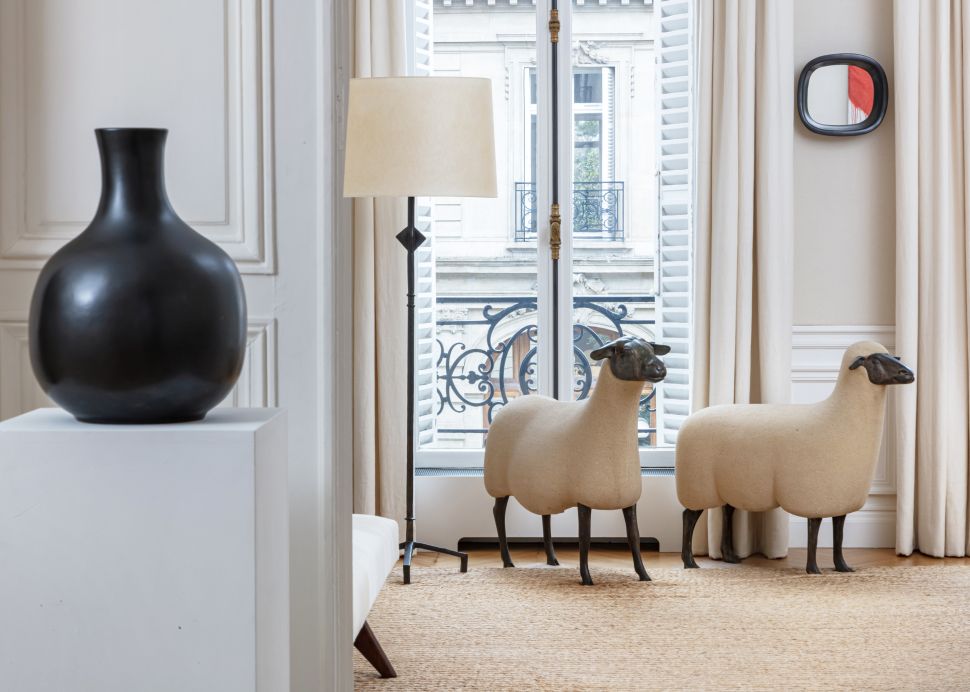
Sotheby’s proceeded with its design round the next day with the collection of design connoisseur Emmanuel de Bayser, a series of masterpieces once housed in his Paris and Berlin residences. De Bayser has said he started collecting design at only 20 years old, beginning with American designers such as Charles and Ray Eames, as well as contemporary pieces and historic postwar works, later adding pieces by Jean Prouvé. Most of the lots performed beyond expectations, starting with the group of three Line Vautrin mirrors, which sold above estimates for $61,440, $82,200 and $96,000, respectively. Among the top lots were some of the most sought-after names in French design: two of François-Xavier Lalanne’s iconic moutons sold for $576,000 and $384,500, well above their $250,000-350,000 estimate. Designs by Alberto Giacometti performed equally well, with a pair of “Étoile” table lamps selling for $294,400 (est. $220,000-280,000) and the “Étoile” floor lamp for $243,200 (est. $175,000-225,000).
The sale included a full group of diverse design and sculptural objects by Georges Jouve, representing the heart of de Bayser’s collection—one of the most exceptional private holdings of the master ceramist. Leading the 70-lot group was a large ceramic sculpture, dated 1958, that fully demonstrated Jouve’s ability to engage with contemporaries such as Henry Moore and Hans Arp through his use of organic forms inspired by nature and an emphatic attunement to his surroundings. Estimated at $70,000-100,000, it sold for $256,000.
Results for other items, from vases to lamps to sculptural seating, were in the five- to six-digit range, generally at or above estimate, with one table lamp selling for $74,240. The sale also included icons of French postwar design, among them seven Standard chairs by Jean Prouvé, considered one of the clearest expressions of his design philosophy. Estimated at $8,000-12,000, they doubled or exceeded estimates, selling for prices ranging from $23,040 to $35,840 for blue versions, with another group of four sold together for $70,000. The colored versions generally perform much better, tending to feel more immediately tied to postwar optimism and institutional modernism than their black or gray counterparts. Other iconic pieces from Prouvé’s multilevel universe, such as the “Visiteur” armchairs, also went above estimate, achieving $166,400 and $230,400 against a $120,000-180,000 estimate.
Pierre Jeanneret’s three-piece “Easy” suite sold for $153,600, more than doubling its $40,000-60,000 estimate. All his other pieces sold above estimate as well, including his file rack ($35,840), the white public bench ($19,200) and two committee armchairs, with the green example going for $32,000 and the red for $40,960, each against a much more modest $7,000-10,000 estimate. On the contemporary side, the two pieces by Rick Owens also exceeded estimates, with a “Brazier” table selling for $10,240 (est. $3,000-5,000) and the pair of “Stag T” stools selling for $35,840 (est. $12,000-18,000). As in the Gladstone sale, figures moved fluidly between categories, with Alexandre Noll’s wood sculptures selling for $83,200 and $32,000, respectively, following strong results for the artist-designer in the recent de Gunzburg sale. More prominent contemporary names, however, failed to find buyers among what seemed to be a predominantly design-oriented audience, with both Daniel Buren’s Cercle coloré vert and a Günther Förg going unsold despite being elegantly paired with French masters in de Bayser’s home. The Jannis Kounellis was withdrawn before the sale, and only the blue Anish Kapoor found a buyer, close to its high estimate at $32,000.
Giacometti, Royère and the blue-chip design chase
Sotheby’s Important Design auction brought more of the most sought-after names from both the 20th and 21st Centuries, as confirmed by recent results. Leading the evening was Diego Giacometti’s “Promenade des Amis” console, which surpassed its high estimate to sell for $5.3 million, eclipsing the previous record set at Christie’s by another variant, dated 1976, from the Edlis Neeson collection, which sold in November for $3.98 million. Another example had just been withdrawn from Sotheby’s evening sale in May with an estimate of $2.5 million.
Several works by Jean Royère, who also performed well in the Jean and Terry de Gunzburg sale in December, were offered and all surpassed their estimates: the rare low table at lot 2 sold for $320,000 against a $200,000 high estimate, a rare “Chevron” three-piece sofa suite sold above high estimate for $640,000 and a “Flaque” low table sold for $448,000. Well above estimate, the sofa and green “Oeuf” armchair fetched $716,800 (est. $300,000-500,000) and $217,600 (est. $100,000-150,000), respectively, while the “Trèfle” floor lamp achieved $435,200 and the pair of armchairs sold for $192,000.
At Phillips, craft, ceramics and contemporary names
Closing the week, Phillips’ Design sale brought the auction house $2,925,333, with 89.5 percent sell-through across its much smaller 76-lot sale. “We saw a very focused and confident sale, with the strongest competition centering on designers like Georges Jouve, Jean Prouvé, and Paavo Tynell, where rarity and sculptural presence really drove interest,” Beth Vilinsky, Phillips’ Senior International Specialist, Design and Senior Vice President, told Observer. “What felt particularly significant was the strength of fresh-to-market works with strong provenance—from important private collections and longstanding holdings—which is always a privilege to bring forward and clearly resonated with collectors,” she added, noting how ultimately it was a sale where the best works didn’t just perform but commanded real attention, with collectors competing for exceptional, often extremely rare pieces.
Leading the evening was Harry Bertoia’s Untitled (Sonambient), dated circa 1975, which fetched $251,550 from an initial estimate of $100,000-150,000. The piece is not only a sculpture but a sounding instrument, part of Bertoia’s late-career body of work in which metal becomes structure, atmosphere and music at once: combining visual, sonic and kinetic properties, Bertoia arranged vertical metal rods on a base so that, when touched, brushed, struck or moved by air, they vibrate against one another and produce resonant tones. Four other works by Bertoia that followed also exceeded estimates, selling for $67,080, $24,510, $25,800 and $77,400, respectively. Strong in this sale as well were ceramics and design attentive to craftsmanship, with a selection of sculptural ceramics by Georges Jouve opening the sale, all surpassing expectations, led by a large mirror that sold for $245,000, more than quadrupling the low estimate.
Strong demand was confirmed once again for the work of British ceramic artist Lucie Rie, with a footed bowl selling for $58,050 against a $10,000 estimate, alongside ceramic works by Hans Coper and Jennifer Lee, which found buyers for $23,220 and $16,770, respectively. Speaking post-sale, Vilinsky attributed this to a broader shift toward more expressive, art-led approaches. Rie’s cumulative auction sales over the past 26 years reached $12.23 million, with her current record at €406,800, set by Bonhams Cornette de Saint Cyr in Paris in December 2023 for a footed bowl circa 1980, surpassing the previous benchmark of £330,200 set just a month earlier at Phillips London in November 2023, when another Rie footed bowl from 1981 sold far above its £50,000-£80,000 estimate.
Momentum continued for French postwar design at Phillips as well, with Jean Prouvé’s “Flavigny” table selling for $193,500 against an estimate of $80,000. Also performing extremely well were all the pieces by Elizabeth Garouste and Mattia Bonetti, key figures in late 20th-century French collectible design who helped pull design away from polite modernist restraint and back toward fantasy, theatricality, craft and historical eclecticism: their “Rodéo” desk and armchair from 1990 went well above its modest estimate of $30,000-50,000, selling for $167,500, alongside a “La Nôtre” cabinet and a pair of library table lamps, both landing above estimate for $41,280 and $30,960, respectively.
Better results, with 100 percent sold, were also reached at Phillips for both generations of Nakashima design and organic elegance, led by a rare and early “Conoid” bench with a single free-form arm, dated 1961, by George Nakashima, which hit its high estimate to sell within its $120,000-180,000 range.
Italian design also found better results, despite still offering clear space for true bargains. One was a unique brutalist yet elegant marble table designed by Carlo Scarpa in collaboration with Marcel Breuer, the “Delfi” table from the “Ultrarazionale” series, selling at its high estimate for an accessible $6,192. A few lots later, the “Cornaro” sofa, also from the “Ultrarazionale” series by Scarpa, fetched $20,640 from a much more modest estimate of $6,000-8,000, and his Mirror, model no. 77 achieved $47,730, more than doubling its $15,000-20,000 estimate. By contrast, an early version of the Mendini “Poltrona di Proust” armchair barely met its low estimate, selling for $28,000.
Turning to American modernism, both T.H. Robsjohn-Gibbings pieces also surpassed estimates, with a set of eight “Klismos” chairs, model no. 3, achieving $64,500 and two “Diphros” stools, model nos. 1 and 20, reaching $23,220 against their $5,000-7,000 estimate. Another notable result came from Finnish master Paavo Tynell, with a rare floor lamp, model no. 9620, soaring to nearly seven times its estimated selling price at $103,200.
Contemporary design is also rising, as the Phillips sale confirmed, with superstar Vincenzo De Cotiis hitting a new high—helped by his position in the ecosystem of design powerhouse Carpenters Workshop Gallery and by the growing appetite for contemporary collectible design that looks unique, materially intense and interior-ready. His low table, model no. DC1716, from the “Baroquisme” series (2017), achieved $70,950 against a $20,000-30,000 estimate, eclipsing the previous auction record of $51,200 set earlier this year. Another contemporary studio also found a new auction record, with Studio Diurne’s carpet from the “Géométrie” 2022 series achieving $10,965 against a $4,000-6,000 estimate. Both Rick Owens design pieces surpassed estimates as well, with a “Plug” coffee table selling for $20,640 (est. $10,000-15,000) and his “Half Box” chair reaching $38,700 (est. $10,000-15,000).
Overall, this summer design session in New York confirmed both the strength of the category and the breadth of the market, with active and dynamic demand from connoisseurs and newcomers alike pursuing works from both historical and new creators, demonstrating the potential of a market that has seen growing appreciation and valuations in less than a decade.
