
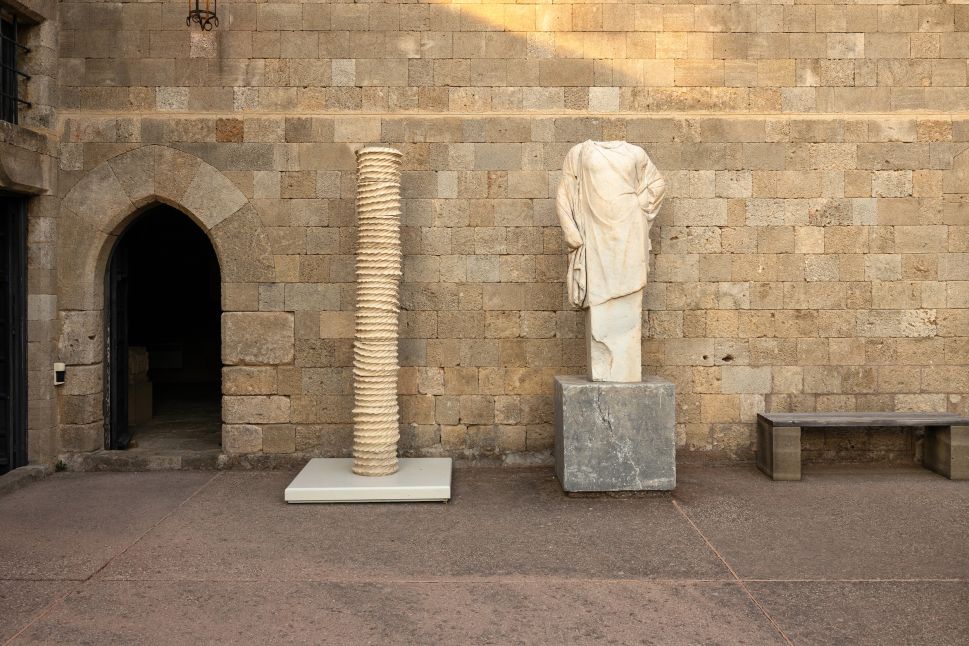
Arriving inside the Medieval City of Rhodes, one senses time loosening its hold. Stone passages and fortified walls still carry the memory of the Knights Hospitaller, while souvenir shops and summer crowds press against that weight with a more familiar kind of immediacy. Into this loaded setting comes the second iteration of the Biennale of Contemporary Keramics, a nomadic project that treats clay not as a minor craft, but as a language of history and contact.
The “K” in Keramics points back to “kéramos,” the ancient Greek word for pottery. It is a simple typographic shift, yet it sets the tone for an exhibition that seeks to engage with an old medium without leaving it inert. Founded by Loukia Thomopoulou, the biennale began in Santorini in 2024 and now lands in Rhodes, a major Greek destination with its own deep relationship to ceramics and artisanal production. Thomopoulou imagines the format as a recurring celebration staged on distinct islands, each edition shaped by the identity of its host.
Co-curated with Stamatia Dimitrakopoulos and Anissa Touati, this year’s edition is titled “Where the Day Starts.” The phrase takes Rhodes as its point of departure. Positioned at the eastern edge of Greece, the island is linked in myth to the place where daylight begins. Rather than using that reference as decoration, the three curators built a framework around brightness and Mediterranean exchange. Dimitrakopoulos notes that the show unfolds across historical locations in the city, gathering works by 42 artists from 18 countries, selected through an open call as well as invitation. Touati emphasizes the Mediterranean as a zone of circulation, where beliefs and objects have crossed borders for many centuries.
“The Biennale of Contemporary Keramics“
Location: Rhodes, Greece
Dates: Through October 31, 2026
Curators: Stamatia Dimitrakopoulos, Loukia Thomopoulou and Anissa Touati
What makes the entire route persuasive is its refusal to isolate the medium from location. The venues are not neutral containers. They are former churches, hospitals, courtyards and collections already marked by political residue. Ceramics, often associated with domestic scale or decorative tradition, acquire an altered temperature here. A plate can advance an argument about inheritance. A vessel can hold a story of migration. A block can speak about housing and repair. The exhibition’s real success lies in this elastic register, where touch remains visible even when the subject expands toward empire and ecological loss. Rhodes amplifies that reach because it has never been culturally singular. Its stones have absorbed the pressures of conquest and tourism, making the island an especially precise public stage for art concerned with transformation and the fragility of worth.
This approach is most moving at Our Lady of the Castle, the oldest surviving church in the Medieval City, dating to the 11th Century. Restored during the Italian occupation of the Dodecanese, the monument bears many signs of Rhodes’s layered cultural past. Inside, Etel Adnan’s Parmi les tilleuls (2021) serves as the emotional anchor. Created in the final year of the Lebanese-American artist and writer’s life, the large ceramic composition gathers landscape and remembrance into an image that appears both specific and shared. It could belong to any coast touched by Mediterranean light.
Nearby is Elysia Athanatos’s Echoes (2024), a vessel whose interior is lined with gold. The Cypriot ceramist has described her long engagement with the sensation of the void, where fullness and emptiness depend on perception. Here, that idea turns luminous. Echoes‘ interior glow speaks quietly with the surrounding Byzantine icons, suggesting a passage between matter and the divine.
Across the street, the Archaeological Museum occupies the former Hospital of the Knights of Saint John, one of the most important Gothic monuments in Greece. Originally built to care for pilgrims and knights during the Crusader period, it now provides a setting for contemporary objects to converse with antiquity. In an upper hall, vessels by Darien Arikoski-Johnson, Fatima Mohisen, Mauro Fariñas and Elina Belou map varied approaches to surface and cultural inheritance. Nearby, GianMarco Porru’s glazed Tirso (2026) and Dionisis Kavallieratos’s Upward Downfall (Hoplite) (2026) bring theatrical force to the display.
Still, the strongest moments happen outside, where pieces are placed among architectural traces and museum fragments. David Scanavino’s A Gift for Giovanni (2026), built from fired stoneware, explores clay as a body capable of holding absence. Its negative spaces preserve what is no longer visible, while its form alludes to maritime routes through which empires once moved culture and power.
In a ruined pavilion, Lucile Littot’s Mutant #3 (2025) hangs like a baroque chandelier after a fever dream. Ceramic elements mingle with polyurethane foam, a construction material that turns luxury into something unstable and almost edible. The piece recalls a tiered cake, with surfaces that seem to drip. Sky-colored enamel meets roses darkened as if by petroleum, evoking wild nature scorched by summer fires. Ruin here is not romantic. It is sensual and damaged, yet strangely alive.
One of the gentlest gestures is by Madrid-based Greek artist Terpsichore Savvala. Installed in a tree, Oscilla (2025) comprises small suspended ceramic forms inspired by archaic Greek loom weights. These objects once belonged to women’s textile labor, but they also carried symbolic value when engraved or offered in ritual contexts. Savvala draws on their basic silhouettes, recalling weights that were sometimes marked with faces of children or female deities. Hanging in the sun and wind, her pieces hover between tool and talisman, domestic work and sacred protection.
The garden path leads to Lucille Uhlrich’s Helios in Reflection (2026), with gold-enameled ceramic coins dispersed in a fountain. Rooted in the historic coinage of Rhodes and its association with the sun god Helios, the arrangement imagines a solar currency. Its reflective surfaces call up the myth of King Midas while asking what gives an object value, what desire distorts and what endures beyond exchange.
The Decorative Arts Collection of Rhodes offers another kind of dialogue. Established in 1986, it holds ceramics, furniture, textiles, engravings and other material from the 16th to the 20th century, revealing links between the Eastern Mediterranean and Europe. Greek artist Atalanti Martinou responds with Quatrefoil (2026), a set of 40 hand-painted and glazed earthenware plates in the permanent collection. Her project engages the traditions of Iznik, Çanakkale and Kütahya, absorbing their floral syntax and intricate botanical patterns in a personal visual language.
The biennale’s most ambitious installation is on display at Kleovoulos Square, near the Palace of the Grand Master of the Knights of Rhodes. A House Awaits (2026), by Algerian-born architect Meriem Chabani in collaboration with Gorbon Ceramics, gathers 100 glazed construction blocks into a fragile field. Gorbon, an Istanbul atelier and factory founded in 1957 by architect Rebii Gorbon, brings industrial knowledge to the piece. The block itself is ordinary, inexpensive and common across the Global South, often used to quickly raise walls or mark a room. Through glaze, its rough body becomes sealed and reflective. Utility changes into recollection.
That shift matters in front of the Palace, first established in the 14th Century as the administrative and ceremonial center of the Knights Hospitaller, then changed by destruction, reconstruction and competing regimes. Chabani’s blocks sit on the ground as both foundation and fragment. They suggest a house that might rise, while held suspended between permanence and impermanence. In their repeated form, they evoke collective labor and propose building as an ethical act, not only a technical one.
The biennale runs for five months and extends beyond its exhibitions through residencies, performances, screenings and workshops with local partners, including the University of the Aegean. This duration gives the project a civic dimension. It does not simply place contemporary ceramics inside heritage settings for contrast. At its best, it listens to those monuments and lets clay articulate unfinished histories. In Rhodes, a medium shaped by hand becomes a way to think about movement and belonging. Ceramics here does more than define a field; it tests whether a major cultural event can redirect attention on an island already accustomed to being seen.
