
The 63 U.S. national parks are the country’s shining glories—a combined 84 million acres of mountain ranges, lava deserts, swamp boardwalks, glacier-fed lakes and old-growth forests, all owned in common and run by the same agency that prints the brown signs. They draw international visitors, road-trippers, retirees with annual passes and kids on Junior Ranger badges. They are also, as of 2026, in the middle of one of the busiest reset years in their history.
Lava fountained 1,500 feet from Halemaʻumaʻu over the winter, the 45th episode of an eruption that began on December 23, 2024, and shows no sign of slowing. Wolves on Isle Royale hit 37 individuals in the April 2026 winter survey, the highest count since the 1970s. Yosemite scrapped its reservation system, presumably because the spreadsheet got overloaded.
America’s national parks don’t usually change all at once—2026 is the exception, as the country marks 250 years since the Declaration of Independence in July. Four weeks later, the National Park Service, established by Woodrow Wilson’s Organic Act on August 25, 1916, turns 110. The 63 parks under its care logged 331.9 million recreation visits in 2024—the busiest year on record, beating the previous 2016 high by nearly a million—and despite a slight 2.7 percent pullback in 2025, they are bracing for another summer of reservation lotteries, gateway-town traffic and shoulder-season scrambles. Eleven of the most-visited parks now charge nonresident visitors a $100 surcharge. Four major parks dropped their timed-entry systems for the year. The agency itself has been short roughly 24 percent of its permanent workforce since January 2025.
For travelers who do not want the lines, the answer is the same as it has always been. Go earlier, go later, or go where the crowds are not. Below, 20 of the most majestic national parks in the USA, from the Atlantic coast of Maine to the volcanic flanks of the Big Island, with what is new for the 2026 season folded in.
America’s Best National Parks
North Cascades National Park
Washington
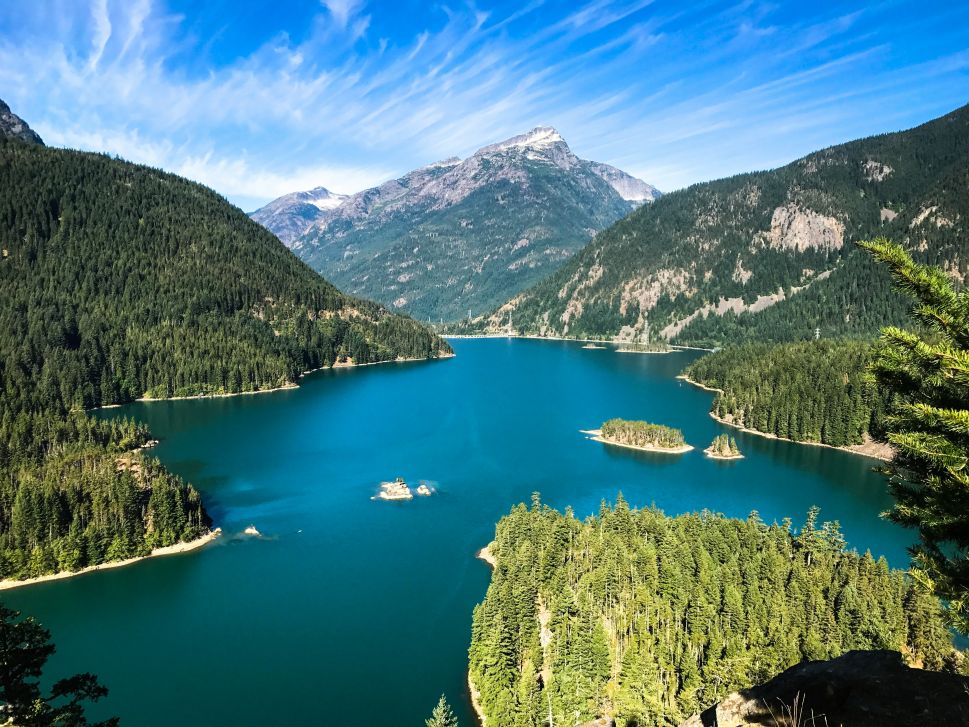
More than 300 glaciers grind through the Picket Range, a wall of peaks named Fury, Terror, Phantom, Ghost and Poltergeist—someone in 1932 was having a moment. North Cascades National Park, three hours from Seattle, holds roughly a third of all the glaciers in the lower 48 and last year drew just 16,485 recreation visits, the second-least-visited park in the country after Gates of the Arctic. The 7.4-mile Cascade Pass climbs through hemlock and silver fir to a meadow at 5,400 feet where marmots whistle and Sahale Glacier hangs above. Diablo Lake glows Gatorade-blue from glacial flour. Stehekin, the small village at Lake Chelan’s head, has no road in: ferry, floatplane or foot. Heads up—State Route 20, the only paved through-road, is broken in the middle from a March 2026 rockslide, and the 26 miles between Diablo and Washington Pass remain closed.
North Cascades National Park.
RC Victorino/Unsplash
Congaree National Park
South Carolina
Don’t be mistaken: South Carolina’s only national park is not a swamp. That word was dropped from the name in 2003, and the locals would like you to know it. Congaree is a floodplain forest, the largest intact stretch of old-growth bottomland hardwood in North America, and it floods about 10 times a year, on schedule. The trees are the draw, with Loblolly pines that push 167 feet and bald cypresses pushing 500 years. The park holds the tallest known specimens of 15 species, more champion-sized trees than anywhere else on the continent. In May, the Photuris frontalis fireflies sync up in tight bursts over Cedar Creek, 70 flashes a minute—a different show from the Smokies’ slower Photinus carolinus, and the park runs a lottery for the eight viewing nights.
Congaree National Park.
Unsplash
Indiana Dunes National Park
Indiana
Indiana Dunes only became a national park in 2019, but the scientific data dates back to 1899, when University of Chicago botanist Henry Chandler Cowles studied dune-plant succession here and accidentally invented modern American ecology. The park curls 15 miles along Lake Michigan’s southern shore, an hour from downtown Chicago by car or a $10 ride on the South Shore Line. There are 1,100 flowering plants and 350 bird species, prickly pear cactus and jack pine on the same dune, the Cleveland-Cliffs Burns Harbor steel mill flaring east of the trail and Gary smoke plumes to the west.
Indiana Dunes National Park.
Steven Van Elk/Unsplash
New River Gorge National Park and Preserve
West Virginia
Designated in 2020, New River Gorge remains America’s newest national park, spanning 70,000 acres along the New River in southern West Virginia. The sandstone walls rise 1,000 feet above whitewater-rated Class III to Class V water, and more than 1,500 climbing routes have been bolted across them, drawing climbers from Berlin to Bishop. The 3.2-mile Endless Wall Trail edges the canyon rim through rhododendron and hemlock. Long Point delivers the postcard shot of the New River Gorge Bridge—876 feet up, 1,700 feet across, the longest single-span steel arch in the Western Hemisphere. Bridge Day, the third Saturday in October, is the only day of the year you can legally BASE-jump it.
New River Gorge National Park and Preserve.
Janeson Keeley/Unsplash
Yosemite National Park
California
Yosemite scrapped its reservation system entirely for 2026—no permits to enter at peak hours, no Firefall lottery for the February light show on Horsetail Fall. It’s a return to normal park rules. El Capitan still lifts 3,000 feet of granite over the valley floor, and Bridalveil still shrouds itself in mist. The Half Dome cables still go up around Memorial Day weekend, with a permit lottery from March 1 through 31. Tioga Pass typically reopens by late May; Glacier Point Road by mid-May. The Ahwahnee, the 1927 grand dame, sets the lodging benchmark. New for nonresident visitors in 2026: a $100-per-person nonresident surcharge on top of the standard $35 vehicle fee.
Yosemite National Park.
Unsplash
Yellowstone National Park
Wyoming, Montana and Idaho
America’s first national park, signed into law by Ulysses S. Grant on March 1, 1872, still stands a step above the rest. More than 10,000 hydrothermal features hiss and gurgle from Yellowstone’s glacier-sculpted basins—roughly half the world’s total. About 500 geysers are active, more than the rest of the planet combined. Old Faithful goes off every 94 minutes on average; Lone Star, three miles by trail from the Old Faithful complex, performs every three hours for a fraction of the crowd. The 2022 floods are mostly settled, with the permanent rebuild of the North Entrance Road breaking ground this summer with two new bridges and wildlife underpasses.
Yellowstone National Park.
Austin Farrington/Unsplash
Grand Teton National Park
Wyoming
Grand Teton sits next door to Yellowstone but feels like a wholly different country. The Cathedral Group rises 7,000 feet straight up from Jackson Hole’s sage flat without a single foothill. Grand Teton itself tops out at 13,775 feet, the second-highest peak in Wyoming. The Snake River loops below with gold trout in the riffles, world-class fly water from Pacific Creek to the Hoback. The draws flow year-round: Spring turns the cottonwoods at Oxbow Bend chartreuse; September brings bull elk down to bugle along the willows; February delivers Nordic skiing through Taggart Lake. The park drew 3.6 million visitors in 2024, the second-busiest year on record.
Grand Teton National Park.
Nate Foong/Unsplash
Acadia National Park
Maine
The only national park in the Northeast hits different. Granite coastline, spruce forests, the carriage roads John D. Rockefeller Jr. funded between 1913 and 1940—Acadia condenses New England into 47,000 acres on Mount Desert Island. Cadillac Mountain summit road requires a $6 vehicle reservation from May 20 through October 25, 2026; sunrise tickets sell out the moment they release at 10 a.m., 90 days out. Precipice and Beehive trails climb iron-rung ladders up granite faces; Jordan Pond House serves up its famous popovers afterward.
Acadia National Park.
Raphael Assouline/Unsplash
Olympic National Park
Washington
Olympic compresses three biomes into 922,000 acres west of Seattle. The Pacific edge runs to tidepools at Hole in the Wall, the rainforests climb the Hoh and Quinault valleys—two of the only temperate rainforests in the lower 48—and the Olympic Mountains push above 7,000 feet at Mount Olympus. Hurricane Ridge lost its day lodge to a 2023 fire and still hasn’t rebuilt; the conceptual design phase wraps in 2026 with no completion date set. The road runs anyway, with portable restrooms and a daily cap of 315 vehicles. Lake Crescent Lodge reopened April 17, and Kalaloch Lodge stays open year-round on the cliffs above the kelp beds.
Olympic National Park.
Jachan DeVol/Unsplash
Dry Tortugas National Park
Florida
Seventy miles west of Key West, past the last channel marker, Fort Jefferson sits on a sand island in 100 square miles of reef-flecked water. The fort was the largest masonry structure in the Western Hemisphere when construction stopped in 1875; it never housed a battle, just Lincoln conspirator Samuel Mudd. The Yankee Freedom III ferry (2026 fare is $220 per adult, departs Key West at 8 a.m.) is the only authorized passenger boat. Key West Seaplane Adventures runs the 45-minute flyover at $507 half-day, $890 full-day. Snorkel the moat wall, tour the fort, or watch the sooty terns at Bush Key. If you decide to overnight, there are 13 primitive campsites on Garden Key—no restaurants, no fresh water and no excuses for forgetting sunscreen.
Dry Tortugas National Park.
Bryan Goff/Unsplash
Great Basin National Park
Nevada
In the empty quarter of eastern Nevada, Great Basin offers what Vegas does not: silence and the Milky Way. The park stands out among others in the U.S.; it is one of just 27 International Dark Sky Sanctuaries. From September 10 through 12 this year, the Astronomy Festival pairs the new moon with telescope tours of the 27-inch Great Basin Observatory. The Lehman Caves, however, are the marquee attraction. They closed in October 2025 for an electrical-system overhaul and reopen May 22, 2026, in limited capacity—only the 30-minute Gothic Palace Lantern Tour, where visitors carry rechargeable lanterns through the marble passages like extras in a Victorian séance.
Great Basin National Park.
Chris Kofoed/Unsplash
Voyageurs National Park
Minnesota
First things first: Voyageurs is a water park. More than a third of its 218,000 acres is lake—pristine boreal water carved by glaciers along the Canadian border, 655 miles of undeveloped shoreline, 500 islands. Everything moves by boat. Houseboats from Ebel’s, Rainy Lake or Voyagaire run a week; ranger-led pontoon tours into Kettle Falls leave from Rainy Lake Visitor Center starting June 15, 2026. The night sky is the other reason to go: Voyageurs is an International Dark Sky Park, and the Conservancy’s Boreal Stargazing Week in February pairs aurora viewing with cross-country skiing. Kettle Falls Hotel, the only lodging inside the park, is reachable by boat across two international borders.
Voyageurs National Park.
Shelly Anderson/Unsplash
Katmai National Park and Preserve
Alaska
In Katmai National Park and Preserve, the salmon run up Brooks Falls in late June, and the brown bears are waiting. The boardwalks at Brooks Camp put visitors 40 feet from a fishing bear. Fat Bear Week, the explore.org bracket that turns September weight gain into a meme, runs in late September; 2025’s champion was Bear 32: “Chunk,” jaw broken, still winning. Brooks Lodge sells out via lottery, but Brooks Camp Campground takes 60 people a night behind an electric bear fence at $18 per person.
Katmai National Park and Preserve.
Paxson Woelber/Unsplash
Great Smoky Mountains National Park
Tennessee
The most-visited national park in America (12.2 million visits in 2024’s blockbuster season) straddles the Tennessee-North Carolina line. Kuwohi—the 6,643-foot peak that was known as Clingmans Dome until the U.S. Board on Geographic Names restored its Cherokee name in September 2024—gives the highest views in the Smokies. Cades Cove’s 11-mile loop closes to motor vehicles every Wednesday from May 6 through September 30, 2026, the morning bike loop a local rite.
Great Smoky Mountains National Park.
David Hertle/Unsplash
Zion National Park
Utah
Zion’s red sandstone walls do the work—2,000 feet of rust-colored Navajo Sandstone, slot canyons cut by the Virgin River and the steepest, most photographed switchbacks in the Southwest. Angels Landing, the chains-and-spine ridge route to a 1,488-foot drop, requires a permit lottery year-round ($6 application plus $3 per person). The Narrows, the bottom-up wade through the canyon’s inner gorge, requires no permit but does require gear that can take a soaking. The free Zion Canyon Shuttle runs March 7 through November 28, 2026. Like Yosemite, a new $100 nonresident surcharge applies here.
Zion National Park.
Arnaud Mariat/Unsplash
Glacier National Park
Montana
Glacier National Park axed its reservation system completely for 2026—that includes no more vehicle reservations at Going-to-the-Sun Road, North Fork, Many Glacier or Two Medicine. The trade-off: a new three-hour parking limit at Logan Pass starting July 1 and a ticketed-only express shuttle replacing the old, free hop-on system. The Going-to-the-Sun Road, the engineering masterpiece that crosses the Continental Divide at 6,646 feet, opens between mid-June and early July 2026, depending on plowing. Unfortunately, the 26 named glaciers that survive are predicted to be gone by 2100.
Glacier National Park.
Harrison Steen/Unsplash
Shenandoah National Park
Virginia
Shenandoah has a big birthday during America’s big year: it turns 90 in 2026. Franklin D. Roosevelt dedicated the park at Big Meadows on July 3, 1936, after the Civilian Conservation Corps built the trails, lodges and overlooks during the New Deal—Shenandoah was the CCC’s first park, with about 10,000 enrollees across 10 camps. The 105-mile Skyline Drive runs the spine of the Blue Ridge between Front Royal and Rockfish Gap with 75 overlooks. Stony Man (1.6-mile loop) and Hawksbill (4,051 feet, the highest point in the park) handle the easier climbs; Old Rag’s 9.5-mile boulder scramble requires a $2 day-use ticket from March 1 through November 30, 2026.
Shenandoah National Park.
Durul Dalkanat/Unsplash
Hawai’i Volcanoes National Park
Hawaii
Kilauea has been erupting in episodes since December 2024. Forty-five episodes through April 2026, lava fountains as high as 1,500 feet from Halemaʻumaʻu, episode 46 forecast for early May. The USGS daily update is the place to check before booking—when the show is on, the after-dark glow from Uēkahuna Overlook (the rebuilt former Jaggar Museum site) is the closest most people will ever come to a planet making itself. Mauna Loa, also in the park, has been suspiciously tame since its 2022 eruption.
Hawai’i Volcanoes National Park.
Cedric Letsch/Unsplash
Petrified Forest National Park
Arizona
Petrified Forest sits along Interstate 40 in northeastern Arizona, where 218 million years of sediment have eroded into the Painted Desert badlands. Petrified wood lines the 28-mile park drive—fossilized logs from a Triassic conifer forest that washed into a river system, were buried in volcanic ash and replaced cell-by-cell by silica until they turned into rainbow quartz. Crystal Forest, Long Logs and the Blue Mesa drive deliver the showstoppers. New for 2026: a fossil prep lab inside Rainbow Forest Museum at the south entrance. Last summer, paleontologists announced a 209-million-year-old jaw fossil here from Eotephradactylus mcintireae—North America’s oldest known pterosaur.
Petrified Forest National Park.
Joseph Corl/Unsplash
