
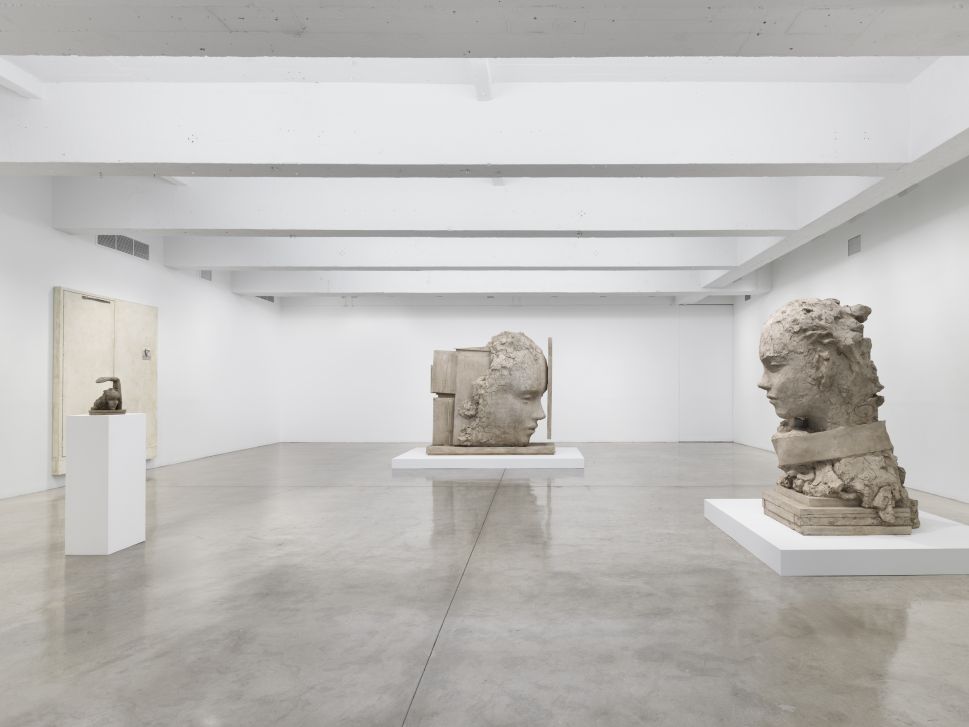
Belgian artist Mark Manders is arguably primarily a sculptor. His best-known works are iconic, monumental half-busts, evoking classical art and the entire tradition of anatomically correct academic sculpture in their perfect proportions and idealized, serene expression, yet always presented as still in process. Many of his pieces look like raw clay, soft and malleable, but are actually cast in bronze or other materials. These works are frozen in the moment of becoming, turning matter into icon, while leaving it intentionally anti-monumental, as something that could collapse at any moment.
Yet the presence of newspapers and books in many of Manders’s works, particularly the most recent ones, offers a hint of the importance of words in his practice. Meeting the artist ahead of the opening of his show at Tanya Bonakdar in New York, one begins to understand how, at the very heart of his relentless exercise of worldbuilding, there is a profound devotion to the role of words in creating and shaping those worlds—as the very anchors of our civilization and a culture that elevates humans as imaginative and creative beings, able to see beyond the present and its physical needs.
“MARK MANDERS“
Artist: Mark Manders
Venue: Tanya Bonakdar Gallery
Address: 521 West 21st Street New York
Through: July 31, 2026
“When I was 18, I wanted to write a three-dimensional book. I was thinking: what if you could write something, you could enter, step into different rooms, where everything is frozen, where you can see somebody thinking? So I thought it was better to start writing with objects,” Manders says as we walk through the ground-floor exhibition space. Dominating the room is Bonewhite Clay Head with Vertical-Cloud, a large-scale female head that appears to emerge from just-dried, cracked white clay. Monument, another giant female head, stands nearby, its neck covered by a kind of binding, as if it had broken before even being completed. Both are silent presences, their eyes emptied, frozen in time, and both are made of bronze, painted with a dusty white patina that makes them appear like relics from an ancient past or otherworldly, even alien presences.
This second piece is like a monument to loss and hidden grief, we learn. “My wife is a psychotherapist, and she works with hidden grief, where people carry something no one else sees,” Manders says, adding that he made this piece thinking about his mother, who lost a child before having him but was not allowed to talk about it at the time, forced to suppress her feelings into silence. “I wanted to make a monument for her, and for all people who carry hidden grief.”
Around these two enigmatic sculptural presences hang two unusually stretched canvases, their surfaces erased with whiteout painterly marks. Held by elastic bands, they take on a physical presence evoking a classical torso, while compressing newspapers at their extremities, which function as both frames and extensions.
All his exhibitions function as systems, Manders explains: works are conceived in relation to one another, with meaning emerging through spatial and formal dialogue rather than isolation, shaping how the viewer physically and psychologically engages with the work. “All my figures are frozen in time. Movement has to come from somewhere else, so I place things next to each other to create that movement,” he explains. “For me, it’s really like a system. Thinking about a show is something really interesting and also very helpful to create works,” he says, describing how sometimes in his studio he makes a work and then moves around it, trying to find what might speak to it. “This empty space creates a kind of desire to have something that speaks to another piece.”
In many of his past shows, Manders has tried to recreate this studio space around his work—part of an evolving project he calls “Self-Portrait as a Building,” intended not as a literal self-portrait but as a conceptual framework in which every sculpture, installation or object becomes a “room” or fragment of a larger, imagined structure.
Scale and size are central concerns for Manders, despite acknowledging that this is perhaps the most underestimated aspect of sculpture. “I think a lot about size,” he explains. “How big something is and how it relates to your body, it’s the main thing. You always see that it’s made on my scale. You feel that physically. It’s on a human scale, but the images can be another scale, so you have two scales at one time.”
On another wall, two canvases are completely covered with newspapers that turn out to be entirely fictional, manufactured by Manders himself, the product of many years of research and labor. Titled All Existing Words, the newspapers are a printed series containing all existing English words, each used only once and placed in random order. He pointed out how the work contains images that refer to many things without pointing to any one. “I made it like a cannibal. I took things from different cultures and put them together until it touches many worlds but not one in particular,” he says. “It took me 14 years. It’s like a dream for a writer—to have all existing words. I’m interested in how we create words, and how we create images, and how they travel from my head to your head. And also that we cannot control images, because images want to spread into as many heads as possible.”
According to Manders, he feels enormously rich because he can draw on all existing cultures. “I can use everything. I feel privileged to be an artist now.” Throughout his work, Manders engages with the rich symbolic and visual heritage accumulated over centuries of art and culture, belonging to the collective unconscious. His works deliberately inhabit a chronological ambiguity, finding even in contemporary expression the timelessness of a relic or cultural artifact that transcends time and space. “When people see the show, they sometimes don’t know if they are in the Met, or the Louvre, or MoMA, or Dia. You know it’s made by me, but it feels like it comes from many moments at once.”
Upstairs, Manders’ work is more minimal and conceptual while remaining poetically evocative. One room is entirely dedicated to landscapes, with cerulean light blue for the sky and earthy tones for the ground, reminiscent at once of Magritte’s and Nicolas de Staël’s palettes as well as the dominant chromatic atmospheres of the Belgian countryside for much of the year. His Landscape Study is raw and seductive in the tactile presence of its painted sand and wood surface, yet also dry and minimal, with only a few elements that, like verses in a cryptic poem, evoke an entire sensorial and emotional space. In Landscape with All Existing Words, compressed fragments of newspapers are contained within a purely light-blue scenography, anchored by an earthy brown base. “It’s also a landscape with all existing words,” he explains. “There are two groups of words—together they are all existing words, but I cut them in half. These two groups talk to each other and together form a landscape.”
The climax of this radically poverista exercise in visual poetry is probably Landscape with Two Vertical Cloisters, which reads at once as a homage to Mondrian’s abstract, theosophical synthesis and to the surreal, suspended atmospheres of Magritte. Tiny tiles are attached to a small metal rod that hovers like a horizon line over a bed of sand, each painted in different shades of blue to represent the sky at different moments. The amount of paint used on each side is carefully balanced so that the line of blue hangs in equilibrium. The result is an extremely poetic image that feels reminiscent of the Dutch landscape tradition while simultaneously gesturing toward the growing tension between culture and nature, gravity and human balance—and toward the fragile, symbiotic equilibrium that requires a conscious effort of the cultural human mind to restore.
Manders’ interest in language and worldbuilding finds an unexpected parallel in the thinking of Daniel Dennett, the American philosopher of mind, whom he cites as a key influence. Dennett’s work dismantles the idea of a unified, stable consciousness, proposing instead that meaning and perception emerge through layered, competing “drafts” assembled over time. Manders’ installations operate in a strikingly similar way: not as fixed narratives but as systems of fragments that acquire meaning only in relation, through accumulation and interpretation. His use of words, objects and invented mythologies suggests that language is not simply a tool for describing the world but a structure through which the world itself is continuously constructed—unstable, open and perpetually in the process of becoming.
While Manders’ works appear imbued with a distinctive melancholic character, they invite an embrace of melancholia’s contemplative dimension—as an opportunity to dwell on past events, examine the nature of existence and acknowledge the creativity inherent in our ability to shape reality. The layered textures of his sculptures and paintings, the accumulation of words in fragments of newspapers and literary materials, gesture toward a temporal density, an awareness of time layered onto itself, and toward the patience required for culture to develop and endure.
Ultimately, Manders’ work expresses a deep optimism about what the human mind can create—imagining and building new worlds that come to life through the combination of imagination and creativity, expressed in images and symbolic structures. He holds a cautious view of contemporary society, particularly as a father, yet maintains a strong belief in the capacity of the human mind to evolve, learn and change. “As a father today, I also look at the world in a more complex way. I don’t always think civilization is going in the right direction, but I really believe in the strength of the human mind. Still, I want to believe that people who make wrong decisions can learn from them and change,” he says.
His work can ultimately be read as a celebration of the endless capacity for worldbuilding that mind and hands together allow us to access, through all the different forms of mythic imagination that can light the way even in the darkness. That exercise of mythopoiesis reaches toward the outer space of the not-yet-possible and turns it into symbolic form—into words and images, narratives that function as installments of eternity, interrupting the passage of time and breaking the spell of the ordinary world to resituate our existence within a broader universal order, where the presence of an enduring world persists just behind the everyday.
