
Spring has finally arrived in New York, and with it the city’s annual two-week art world endurance test: marquee auctions colliding with an almost excessive concentration of fairs that only the Big Apple—the still-undisputed capital of the global art market—could sustain with a straight face. As Frieze, et al., once again pull collectors, curators and art world nomads from across the globe, galleries in Manhattan and the surrounding boroughs are unveiling some of their strongest shows of the year—many of which are surprisingly ambitious, sculptural and installation-heavy, defying the myth that New York’s gallery scene has become nothing more than a glossy extension of the market. To help navigate the sprawling geography of shows opening across Chelsea, Tribeca, the Lower East Side and what remains of the Upper East Side, Observer has selected 10 must-see exhibitions worth a stop as you scurry from fairs to auction previews.
The best gallery shows on now in New York
“David Hammons and Jannis Kounellis”
White Cube New York
Through June 13, 2026
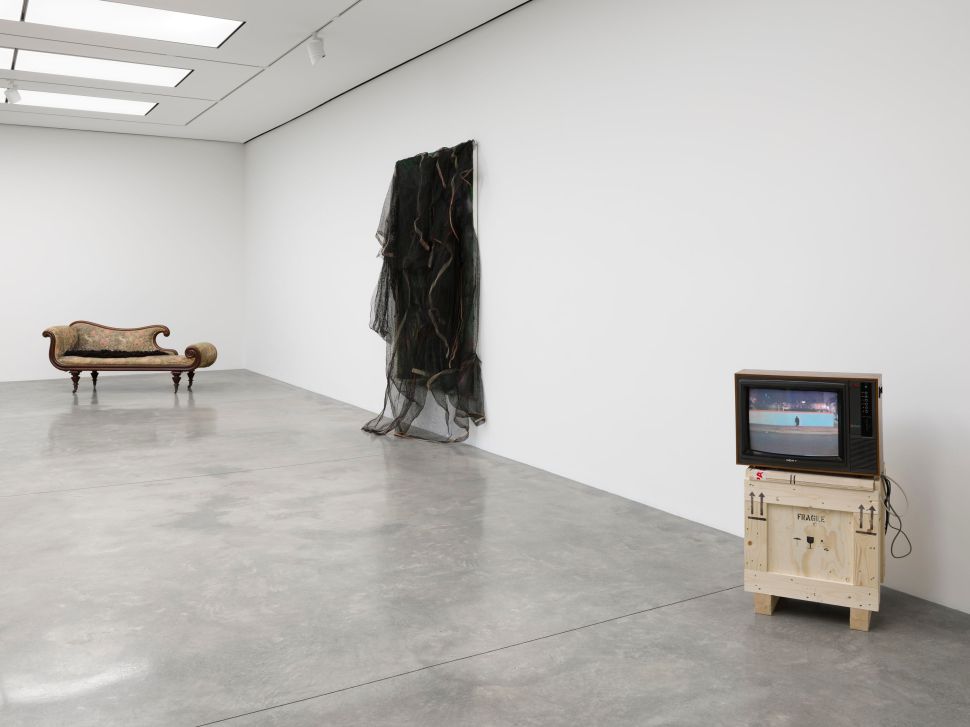
Despite emerging from radically different sociopolitical and cultural contexts, David Hammons and Jannis Kounellis not only developed strikingly similar approaches to matter, meaning and event, but sustained a long relationship of exchange and friendship throughout their lives. In the first joint presentation of their work in more than 30 years, White Cube is staging a dialogue between significant works by the African American artist and late Greek Italian artist, revealing how they shared a refined material intelligence that translated into poetics of resistance and political expression constructed through living matter, minimal gestures and performative tension. In both practices, the language of sculpture emerges from what might be described as a charged poverty or symbolic residue rather than polished form—an art-making that starts from the remnants of the realities each inhabited at a particular historical and cultural juncture. “David Hammons and Jannis Kounellis” revisits the artists’ first encounter in 1993, when they exhibited together at the American Academy in Rome, which sparked a lifelong friendship. Their shared presentation at Villa Aurelia consisted of two military tents erected in the garden, within which each artist was invited to create a singular site-specific installation.
Installation view: “David Hammons and Jannis Kounellis” at
White Cube New York.
© ARS, NY and DACS, London 2026, © DACS 2026. Photo © On White Wall. Courtesy White Cube
Duchamp and Rauchemberg at Gagosian
Gagosian, 980 Madison
Through August 22, 2026
For decades, 980 Madison Avenue stood as one of the central anchors of New York’s blue-chip art world, crowned by Gagosian, which occupied its fifth-floor galleries for more than 40 years. Then came Michael Bloomberg. In 2023, Bloomberg Philanthropies signed a massive lease for much of the building from landlord Aby Rosen’s RFR Holding, effectively displacing several gallery tenants, including Gagosian. A year later, Bloomberg escalated the shift further by purchasing the entire building outright for roughly $560 million. Yet Gagosian ultimately never left the historic address. Instead, the gallery has just unveiled a new 2,275-square-foot ground-floor space designed by Caplan Colaku Architecture—the studio also behind the renovation of Gagosian’s Chelsea flagship and past projects for Gladstone and Gavin Brown’s enterprise—which opened with an extensive presentation dedicated to Marcel Duchamp, paired with a separate exhibition of early works by Robert Rauschenberg from the Cy Twombly Foundation. Timed to coincide with MoMA’s major Duchamp survey, the Gagosian exhibition centers on some of the artist’s most iconic readymades, which Duchamp eventually reproduced in editions after many of the originals had been lost and dealers increasingly pushed to establish a market around his work. The examples on view were produced with the assistance of Italian gallerist Arturo Schwarz and include replicas of seminal works such as Roue de bicyclette (Bicycle Wheel)—made in 1964, after the lost 1913 original, the only surviving example not currently held in a major institutional collection—alongside Fountain (1964, after the lost 1917 original), L.H.O.O.Q. (1964, after the 1919 original), Porte-bouteilles (Bottle Dryer) (1964, after the lost 1914 original) and Boîte-en-valise (1935-1949; contents 1935-1941). The fact that these readymades are themselves replicas only further complicates and subverts conventional ideas of artistic integrity, originality and authorship that Duchamp spent his career dismantling.
Installation view: “Marcel Duchamp” at Gagosian.
Artwork © Association Marcel Duchamp/ADAGP, Paris/Artists Rights Society (ARS), New York 2026. Photo: Owen Conway
“Mark Manders”
Through July 31, 2026
There are several ambitious sculptural shows in New York this month, and among the must-sees is Tanya Bonakdar Gallery’s presentation of Mark Manders in Chelsea featuring some of his iconic monumental bronze busts alongside meditative abstract sculptural landscapes, poetic newspaper-based works and delicate drawings. While Manders is primarily recognized as a sculptor, the exhibition reveals him more fundamentally as a worldbuilder, deeply interested in how words, as much as objects and forms, can construct entire psychological architectures, narratives and systems of reality. Best known for his long-running project “Self-Portrait as a Building,” Manders treats each sculpture, installation and text fragment as part of an evolving fictional structure unfolding across time and space. Monumental female heads appear like unfinished relics suspended between antiquity and futurity, while fictional newspapers containing every existing word used only once condense language into sculptural matter that is itself already a landscape. Upstairs, sparse compositions of sand, compressed newspapers and delicate chromatic balances evoke Magritte, Mondrian and Nicolas de Staël while unfolding like cryptic visual poems. Across the eponymous exhibition, Manders constructs systems in which meaning emerges relationally through proximity, rhythm and silence, proposing art as a meditative space where language, memory and symbolic imagination continuously generate new worlds.
For his sixth solo exhibition with the gallery, Mark Manders presents new work ranging from
monumental bronze busts to abstract sculptural landscapes to works on paper.
Photo by Dan Bradica Courtesy the artist and Tanya Bonakdar Gallery, New York
Stephen Lichty’s “Ghost Stone”
Yve Yang
Through July 3, 2026
Another unmissable sculptural show is an exhibition at YveYANG, staged with the gallery’s characteristic thoughtfulness and experimental curatorial approach. Here, Kansas City-born, San Francisco-based artist Stephen Lichty pursues a singular investigation into the sculptural medium that begins with the material intelligence of nature itself and the geological and human histories embedded within it. At the center is his ongoing research into quartz, a fascination that began more than a decade ago when he encountered an enigmatic boulder while briefly employed as a stonemason’s assistant in the Bay Area. From the material itself, Lichty traces histories of extraction, labor and ecological domination whose effects remain visible today, particularly in the Sierra Nevada foothills, where hydraulic mining violently reshaped the landscape during the Gold Rush era, leaving behind scarred terrain and exposed geological formations that would otherwise have remained buried underground. In the gallery, Lichty stages an elegiac choreography of ecological disaster and human greed through a series of ghostly sculptural presences that carry histories of labor, ecology and exploitation within both their materiality and metaphorical function. Suspended at the entrance is a small hand-cast iron sculpture, produced through an obsessive process involving the collection and refinement of iron sand from San Francisco’s Ocean Beach, connecting sculpture to craft, experimental archaeology and the elemental processes of the earth itself.
Installation view: Stephen Lichty’s “Ghost Stone” at Yve Yang Gallery, through July 3, 2026.
Courtesy the artista nd Yve Yang
Lucia Hierro’s “Moving Day”
Marc Straus, Lower East Side
Through June 28, 2026
Lucia Hierro operates in a different sculptural register—one that turns toward Pop while remaining similarly anchored in everyday reality and the political and socioeconomic dynamics embedded in the objects that populate it. In her wall and floor soft sculptures, Hierro replicates products belonging to the visual vernacular of the New York bodega to examine displacement, memory and the fragile stability of home within the shifting economic realities of a city shaped by relentless gentrification. The exhibition’s title draws from New York’s historical “Moving Day,” a now-defunct tradition during which, for more than two centuries, nearly all residential leases expired simultaneously on May 1, forcing thousands of residents to relocate at once in an annual scene of collective chaos and renewal. Hierro draws a parallel between this historical phenomenon and today’s increasingly precarious cultural landscape, where rising rents and economic pressures continue to displace artists, small businesses and long-standing communities. For the artist, these forces are not abstract: following the loss of both her parents over the past year and a half, the exhibition is a deeply personal meditation on grief, instability and the universal experience of rebuilding one’s sense of home after rupture. Hierro will also be featured in the upcoming “Guggenheim Pop: 1960 to Now,” opening on June 5.
Installation view: “Moving Day” at Marc Straus.
Courtesy the artist and Marc Straus
Kelly Akashi’s “Heirloom”
May 13 – July 25, 2026
Kelly Akashi’s sculptural practice has always explored how materials, through both their physical properties and alchemical transformations, can embody metaphors of resilience, resistance, change and care. At the core of her work is an acceptance of the natural world’s impermanence, alongside art’s capacity to record, index and crystallize fragmented moments of ephemeral beauty. The wildfires that destroyed her studio further exposed both the fragility of matter and its cathartic potential to be reborn in new forms. Following a show in L.A., which came immediately after the devastating fires of early 2025, and marking her first New York presentation with the gallery, Akashi is showing a new body of sculptural work reflecting on how loss and memory are carried and transformed through bodies and materials over time. Across bronze, Corten steel, cast glass and stone, she brings together organic casts, weathered surfaces and enlarged personal objects to consider absence as something materially held and continually reshaped. Developed in part through her recent engagement with the site of her former home and studio, many of the works function as gestures of preservation, attempting to memorialize what has disappeared after its original context has vanished.
Kelly Akashi, Work 2 (Table work hand with thorny branch from palm), 2026.
Courtesy Lisson Gallery
Giuseppe Penone’s “The Reflection of Bronze”
Gagosian, Chelsea
Through July 2, 2026
When it comes to sculpture not only inspired by but made through symbiotic collaboration with nature and its cycles, Arte Povera artist Giuseppe Penone remains one of its undisputed masters. The Italian artist is now the subject of an expansive exhibition at Gagosian in Chelsea featuring poetic, full-scale landscape installations in a choreography of bronze sculptures and interventions that transform the gallery’s white cube into the warm interior of a forest. His first exhibition with Gagosian, curated by Adam D. Weinberg, director emeritus of the Whitney, “The Reflection of Bronze” centers on Penone’s late-1960s exploration of trees, which led to his celebrated carved tree works and spine-like constellations, culminating here in monumental bronze sculptures that stage both the tension and the possible symbiotic union between the human and natural worlds. Within this cathedral of organic and inorganic alchemical transformations, evolving forms seem suspended between growth and fossilization, as the organic crystallizes into bronze—a material carrying the full weight of art history while simultaneously eternalizing transient natural processes. In this way, human art-making begins to mimic geological time itself, its slow layering and stratification paralleling the sedimentation of memory. “Year after year life’s experiences envelop us, the memories accumulate and form their own substance which holds no shape but carries weight. Each memory is knowledge,” reads one poetic line from the exhibition.
Installation view: Giuseppe Penone “The Reflection of Bronze” at Gagosian.
Artwork © Giuseppe Penone/2026 Artists Rights Society (ARS), New York/ADAGP, Paris. Photo: Maris Hutchinson
Firelei Báez’s “feet squelching on wet grass,
nourished by uncertainty”
nourished by uncertainty”
Through July 31, 2026
A relentless worldbuilder and storyteller whose practice is informed as much by anthropological research as by spiritual sensitivity, Firelei Báez makes her highly anticipated debut at Hauser & Wirth with an enveloping constellation of radiant new paintings, works on paper and large-scale bronze sculptures. A highlight is View of Nature (2026), an eight-panel painting stretching across the entire back wall of the gallery’s first floor. Drawing on John Emslie’s similarly titled 1852 engraving, the work traces gradations of climate and geography from the equator to the Arctic Circle, translating them into a visual taxonomic palimpsest that reveals the deep entanglements between ecological and human history. Blending parallel narratives and codes of representation, Báez has developed her own alternative system for mapping the history of civilization through the creative appropriation and reworking of colonial historical documents. In this show, the works grow more abstract, capturing the energetic flows that entangle different beings and their fates in relation to both their social and natural surroundings, as the artist constructs a counterhistory that considers the planet’s evolution beyond the human perspective. Drawing on anthropology, geography, folklore, fantasy, science fiction and social history, Báez layers symbolic languages and appropriated iconographies into an ever-evolving personal mythology that investigates how bodies and nature shape our experience of being in the world.
Firelei Báez, Not even unalterable limitations (or a transformational topology for
remembering Willard’s Chronographer of American History), 2026.
© 202 6 Firelei Báez / Artists Rights Society (ARS), New York Courtesy the artist and Hauser & Wirth
Sanford Biggers’ “The Gift of Tongues”
Through June 13, 2026
For his new exhibition at Marianne Boesky, Sanford Biggers goes all in, staging an immersive, psychedelic choreography articulated through quilt-based two-dimensional works, layered canvases and eclectic sculptural assemblages drawing from multiple iconographies and cultures. “The Gift of Tongues” unfolds as a fluid, idiosyncratic crossing of histories and creative expressions, all seemingly converging in a simultaneously imaginative and spiritual pull toward transcendence beyond earthly, time-bound reality. Biggers transforms the gallery’s white cube into a kind of playhouse: an intricate theatrical labyrinth of strategically placed curtains and false walls where new works from his Codex, Chimera and Shimmer series emerge like fragmented vignettes, inviting visitors to move through a tangled web of historical assumptions and slippery symbols—a patchwork of mutable archetypes that remains perpetually open to reinterpretation. Biggers works through a deliberately hybrid practice combining painting, sculpture, textiles, video, performance, sound and archival material, creating collisions between materials, histories and symbolic systems that layer African diasporic traditions with American popular culture, Buddhism, jazz improvisation and postminimalist abstraction.
Installation view: Sanford Biggers “The Gift of Tongues” at Marianne Boesky.
Photo: Jason Wyche
Bony Ramírez’s “El Cielo del Mar”
Green-Wood Cemetery Chapel, Brooklyn
Through June 6, 2026
This show is neither in a gallery nor a museum, but is likely one of the most ambitious site-specific presentations currently on view in New York. With “El Cielo del Mar,” Bony Ramirez takes over the neo-Gothic interiors of a cemetery chapel to stage his own interpretation of a spiritual and emotional journey, his signature playful characters inhabiting an expansive multimedia environment curated by Anne-Laure Lemaitre. The exhibition draws inspiration from secular, mythological and symbolic connections between the sea and the afterlife, with a title referencing both the healing power of the ocean—particularly within Caribbean culture—and its parallel to a greater beyond. Outside stands a large assemblage centered on a reclaimed boat, evoking difficult journeys and the mythological role of vessels transporting souls to the afterlife, from Charon crossing the Styx to the passage from the Nile to Duat. Inside the chapel, four wooden sculptures stand like guardian figures or fragmented self-portraits, introducing a subtle tension between protection and confrontation as they silently witness visitors moving through the space. At the altar, a monumental multi-paneled installation integrating stained glass, carved architectural elements and theatrical scenography transforms the chapel itself into an active participant in the work. A recurring horse motif—traditionally associated with freedom, passage and the untamed force of the sea—appears here wearing blinders, evoking the human struggle to grasp the fleeting nature of life. At the center of the space, a circular plinth invites visitors to leave behind a name or thought connected to grief beneath sculptures embodying the five stages of mourning. At once anthropological storytelling and collective ritual, the exhibition is an invitation to embrace and process grief as an essential element of the human journey.
Installation view: “El Cielo del mar” at the Historic Chapel of Green-Wood Cemetery in Brooklyn.
Photo: Daniel Greer
