
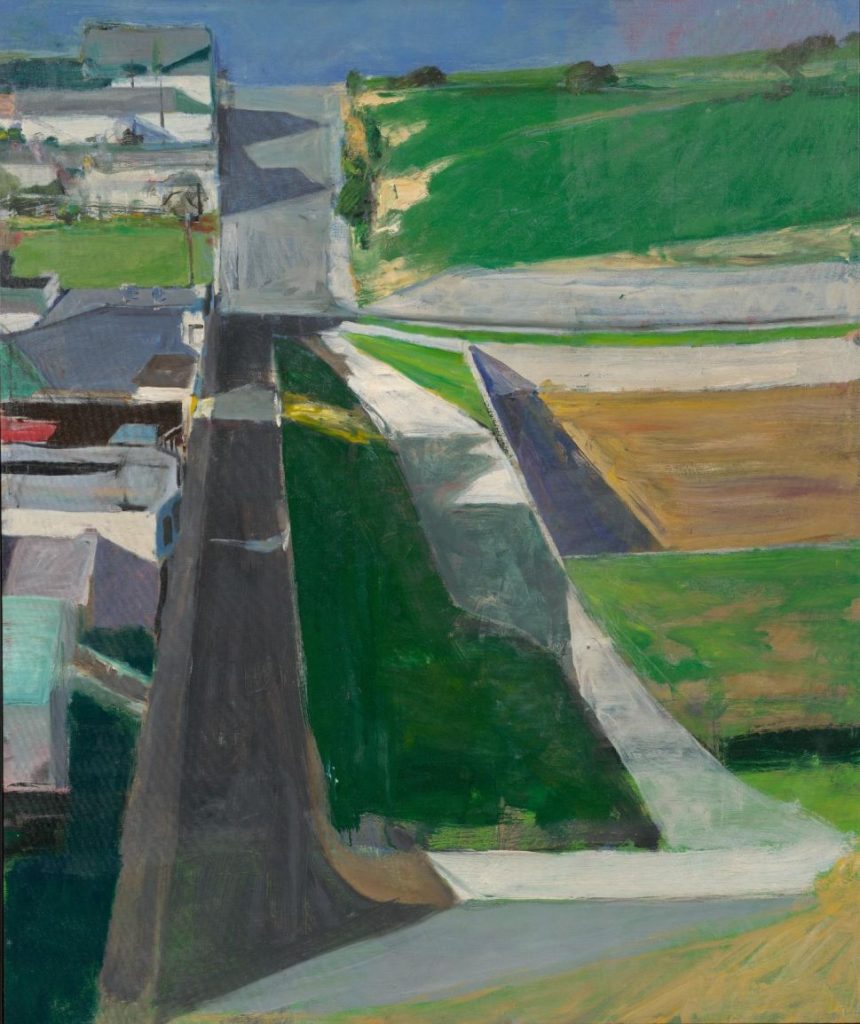
In the Golden Age of Air Travel in the early 1950s, people saw for the first time aerial views that revealed the delineated lines and rectangles of farmers’ fields. For Richard Diebenkorn (1922-1993), this geometry was captured in his early landscape abstracts, like his Sausalito, Albuquerque and Berkeley series. Loaded with vibrant color and acute angles, all of his work was informed by the architecture, texture of the land, the vertical and horizontal planes, curved and straight vistas, the Pacific Ocean and the dazzling clear sun. When other painters gravitated to New York as the happening place for art, Diebenkorn tried it for a year and went back west, where he stayed, painting every day for the rest of his life.
From the early abstracts, he moved into figurative paintings during the 1960s. Female silhouettes, sometimes faceless, the figures are backdropped by blocks of color. Evoking subtle, pensive narratives, one woman drinks coffee, another sits looking out the window, smokes a cigarette, stands beside a friend. These simple acts with the elegant bodies quietly in repose are mysterious—what are they thinking? Diebenkorn’s figures are structural, simplified forms, minimal and singular, with space all around that isolate the figure. During these early years, he continued to paint still lifes, like the charming Still Life with Orange Peel. You can feel the California sun on the orange of the peel, splayed on the light turquoise and white striped tablecloth. His women are sleeveless or in striped skirts. It is clearly warm in his part of the world.
Where Diebenkorn skyrocketed to fame was with his Ocean Park series that he began in 1967, which culminated in 135 paintings. The strong spatial compartmentalization, fusing exterior and interior, come from his studio in Ocean Park, Santa Monica. Windowpanes, the ceiling and wall molding, the strong clear sunlight and the shapes of shadows are a combination of line and action, calligraphy and color. The paintings are sensuous and in motion, as if you can see the artist’s process. He worked and reworked, sitting for long periods of time in his studio just looking. He said that he had a “predisposition to spareness and aloneness… Sometimes I get rooted to the chair… thinking it’s almost finished, famous last words, and then a year later I’m still working on it.”
His blues, turquoise, cobalt and ochres are in the landscape, but these are more like graphs, mappings of the land. Strips of black may line one edge, sharp and clear, a short diagonal in a corner. He was an exacting artist, methodical and calm. He worked on a series of engravings, over and over until he got just the right amount of blend, shape, edge. Sometimes he destroyed paintings because of their excessive literalness, yet he was a gentle, slow painter. The late critic Peter Schjeldahl said that Diebenkorn had “the reticent stubborn grace that marks most of the Bay Area’s finest painters,” that included David Park and Wayne Thiebaud. Diebenkorn was shy and thoughtful, avoided crowds and was beloved by the students he taught for a number of years at the San Francisco Art Institute, University of Southern California, and other schools. One student said, “He taught how to get to the human but preserve the intensity of non-objective painting. Diebenkorn bridged both.”
In 1992, Gagosian mounted a Richard Diebenkorn exhibition, the last solo show before Diebenkorn’s death. Recently, Gagosian has partnered with the Diebenkorn Foundation and now represents his work. I was fortunate to see the Diebenkorn exhibition at Gagosian’s Madison Avenue gallery this past December. Curated by Jasper Sharp, writer and filmmaker, the large gallery showcased an exciting array of paintings and works on paper covering six decades. Larry Gagosian knew the artist in California and visited his studio a number of times. “It’s a great honor for me and the gallery to carry his legacy forward,” the dealer said in a statement. There is also a four-volume monograph, Richard Diebenkorn: The Catalogue Raisonné, with 2,176 pages from Yale University Press. Copies are available but hard to find.
Diebenkorn was a pioneer. A great admirer of Matisse and Cézanne, he seemed to reinvent both: “I’m really a traditional painter, not avant-garde at all,” the artist said. “I wanted to follow a tradition and extend it.” He did that, transcending any particular period. He is one of the great 20th-century talents who wasn’t diluted by trend or the noise of opinion. His training, unflinching self-criticism and continual experimentation pushed him to keep working. He was, throughout his career, undaunted in his passion.
