
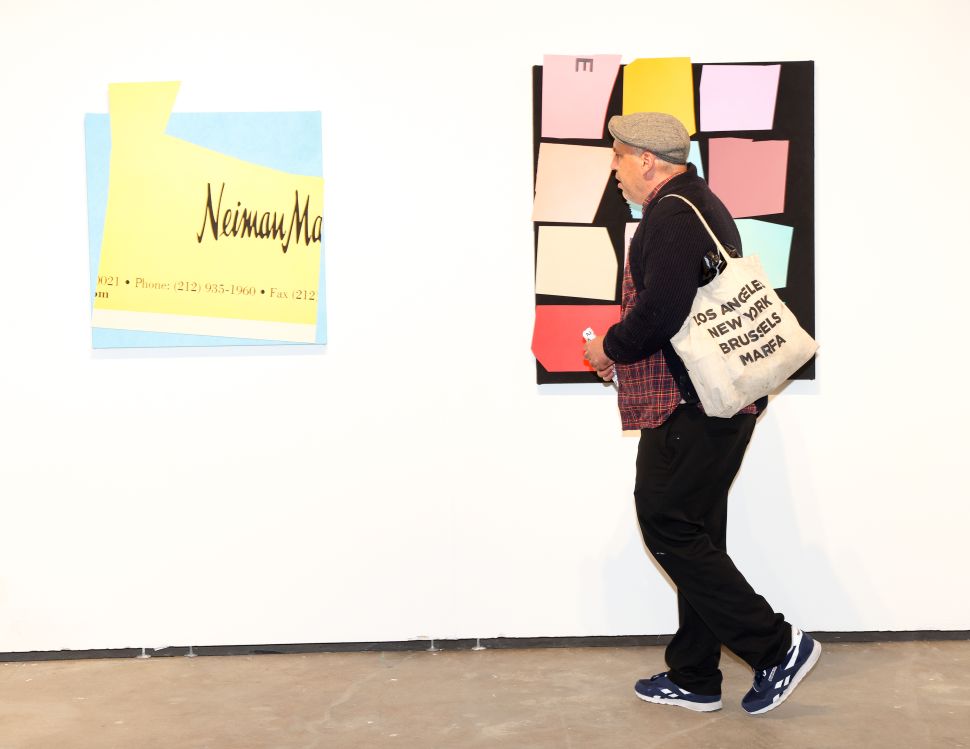
With Frieze New York opening just a few blocks away, Future Fair close by and the 1-54 Contemporary African Art Fair in the same building, NADA opened in good company. At 10 a.m. on May 13, it welcomed VIP guests, still fresh with early-day curiosity, to take a quick first look before what would be, for most, a long day of fair hopping. But as a group of primarily made up of New Yorkers and American collectors roamed the aisles, there was not the clear sense of urgency that once animated NADA’s fast sold-out previews. Maybe it was the simple fact that there are more than six fairs overlapping, though it might have to do with the fact that despite NADA’S international profile and a strong presence from the Americas, there were just a few gems from Asia and very few exhibitors from Europe.
Still, across the 110 exhibitors presenting this year—more than half participating for the first time—there were plenty of opportunities to discover emerging talent and rising galleries. By the evening of the preview day, some of the most interesting presentations had led to sales and several holds, particularly among dealers who’d brought curated solo or duo presentations and set prices strategically under $10,000 or even in the $2,000-5,000 range.
Feia Studio, for example, sold out its solo booth by São Paulo-born, New York-based artist Marianna Peragallo. Based in L.A., Feia—”ugly” in Portuguese—is run by Thomas Martinez Pilnik and Jake Cavallo, whose eccentric proposition celebrates failure through art that embraces curiosity, intrigue, novelty, beauty, disgust and everything in between. This is certainly the case with Peragallo’s eerily paradoxical yet whimsically playful surreal assemblages, which transform familiar objects and characters from the everyday vernacular into pocket parks of possible harmony amid urban chaos. Using the relics of daily city life and drawing attention to their overlooked symbolic value, she reactivates and reimagines them, giving them new life as cartoonish characters animated by humor, grief, queerness and resilience. Prices range from $1,600 to $3,000. “Almost all the works are staying with New York City collectors, which feels like a strong indicator that people are connecting with fairs in their own towns, and using the opportunity to explore the market and get introduced to new artists,” Martinez Pilnik told Observer, emphasizing how exceptionally validating this was for a new gallery championing emerging and often under-shown artists.
Tribeca gallery LATITUDE also sold 90 percent of its booth within the first two to three hours of the fair, presenting a solo booth of paintings by young Chinese artist Shangfeng Zhang. Exploring the intersection of contemporary life and the lingering emotional impact of mythology, Zhang brings mythic resonance into intimate moments of everyday life through a sequence of subdued interiors and inward-looking figures suspended in their environments. The psychologically charged atmospheres point to a rich inner world where imagination moves beyond the physical to find tropes and archetypes within recurring social patterns and roles. All works were priced under $3,000.
Also from L.A. but with strong ties to China and broader Asia, Yiwei Gallery had multiple red dots within the fair’s first hours around the similarly fantastical, fairytale-like paintings of Kay Seohyung Lee, selling eight of them by the evening at prices ranging from $950 to $3,500. Rendered in luminous blue and emerald tones, Lee’s works unfold as meticulous micro-worlds of storytelling, populated almost entirely by female characters who seem extracted from different layers of history: princesses, dames and other archetypal figures caught between fantasy, hierarchy and social performance. Lee transforms the language of historical painting and fairy-tale pageantry into a sharper meditation on visibility, exclusion and the fragile architectures of individual and collective identity. Born in Seoul and based in Philadelphia, the artist grew up near U.S. military bases in Korea, where histories of occupation, migration and geopolitical tension shaped her early understanding of power and belonging.
Miami-based Spinello Projects presented a sentimental, hyperrealistic sequence of narrative-driven paintings by Puerto Rican artist Esai Alfredo, isolating delicate moments of human connection and emotional exchange against the infinity of the night horizon. Expanding on his ongoing exploration of memory, belonging and queer identity, these atmospheric paintings were inspired in part by the closing scene of Wicked, in which two protagonists reflect on the lasting impact of their bond before parting. The series is also a poetic revisitation of the artist’s own experience of migration between Puerto Rico and the United States, which was shaped by the rhythms of connection and farewell, distance and displacement, as that of an entire generation that grew up within today’s global mobility. By the evening, the gallery had sold half the booth, with prices between $3,500 and $25,000.
Kates Ferri also reported early sales for its solo presentation of Malaysian artist Justin Lim, whose vibrant paintings transform domestic spaces into intimate psychological landscapes where presence is felt through absence. Empty chairs, cushions, patterned objects and soft pools of light suggest bodies that have just left or might soon return, making the furniture itself feel charged with memory. His carefully composed scenes are rendered with a lush varnished finish that gives the surfaces a heightened clarity, while slightly distorted perspectives pull viewers inside the room and subtly destabilize their sense of place. Bridging Southeast Asian material culture and the lineage of European still-life painting, Lim reveals the cross-cultural influences embedded in domestic interiors. On the first day, the gallery sold three pieces in the $10,000-15,000 range.
Similarly vibrant but with a more queer and playful charge is the pink-walled booth of artists’ residency and cultural hub Somad, presenting the expansive world-building of Filipino American artist Keith Lafuente. Through plush kinetic sculptures, acrylic paintings on canvas and fabric and an 8.5-foot-tall kinetic sculpture, Waiter (Kain Na!), Lafuente turns the familiar into something cute, absurd and quietly uncanny, building a universe animated by labor, service, repetition and uneasy humor. His multidisciplinary practice treats Filipino-ness like fabric that can be cut, sewn, unpicked and reworked, teasing out threads of idealized nostalgia, colonial domination and culturally ingrained values of service and adaptation. There is something exhibitionist and voyeuristic in the way these figures perform their tasks for the viewer, trapped in loops of effort and display: labor becomes both performance and Sisyphean effort, while the booth’s playful spectacle carries a sharper undertone of instability, suspended between forced exhibitionism and psychological exhaustion.
Some Indigenous perspectives were also present at NADA this year, with an absolute standout being Milk Moon Gallery’s booth, which Kelly Tapia-Chuning transformed into a sacred space. A mixed Xicana artist with Indígena ancestry from the Sonoran Desert and the Sierra Madre, Tapia-Chuning has a textile- and research-based practice that appropriates and reimagines the traditional Mexican serape as a site and exercise of decolonization, revealing the histories, erasures and ancestral knowledge held within it. The booth presents four of them, each representing one of the natural elements—earth, air, fire and water—through their traditional color scheme, converging in a fifth installation at the center that becomes an energetic nucleus where the continuous vital exchange between them is enacted: the fifth element of harmony and balance, present throughout Mexican Indigenous knowledge systems. When we spoke, the artist described her practice as a combination of ancestral design, personal memory and relation to a stratified and often complex heritage; for her, art-making is a vehicle for entering into conversation with a largely erased inheritance, even while far from it, and for communing with her ancestors using her body as conduit. With prices between $17,000 and $18,500, the presentation attracted institutional interest and two works were on hold by the afternoon.
Similarly centered on ancestral knowledge and inherited traditions is the booth of FORGOTTEN LANDS, a platform dedicated to contemporary Caribbean art and its diaspora. The gallery stages a two-person presentation of works by Andrae Green and Cyle Warner, recently shown at the Bronx Museum’s AIM Biennial. Both artists examine how Caribbean subjects resist the structures meant to contain and reduce them, reimagining and reconstructing the cultural, symbolic and historical terms through which Caribbean subjectivity is seen. In Green’s paintings, deliberately blurred and doubled figures refuse fixity, dismantling representational architectures and emerging in a state of flux and transformation in response to a shifting landscape. Warner operates in a more tactile, craft-based register, using colorful breeze blocks to build new narrative structures and myths that address archival absence. Two works by Warner sold by the evening for $1,000 and $10,000. Also revisiting the Indigenous cosmology of her own land through contemporary image-making that draws on both personal family memory and an inherited symbolic archive is Chuvash artist Polina Osipova, presented by JO-HS. Drawing on the Chuvash belief that ancestors inhabit the night sky, her textiles, archival photographs, wearable sculptures and self-portraiture bring craft and digital culture together, contrasting this cosmology with Soviet-era narratives that reframed Chuvash identity through the rhetoric of space conquest. Having grown up surrounded by “rocket” playgrounds and the legacy of a local cosmonaut, Osipova turns toward a cultural return to more ancient mythologies that were muted or manipulated by propaganda, asking what remains of the true identity of her community and her land. With prices ranging from $15,000 to $16,000, the gallery placed a small work but reported several ongoing conversations.
A similar world-building exercise, blending personal and societal pressures with a tension between craft and the industrial, emerges in Loucia Carlier’s Cornell-like assemblages, as she turns found images of New York, screen prints and found materials into compact theaters of aspiration, conditioning and desire. Presented by Mexico City-based Third Born, her Cheap Dreams series evokes threshold spaces—waiting rooms, storefront displays and deserted commercial interiors—where materials such as Hermès craft leather carry an aspirational charge, while miniature frames and box-like enclosures expose the scripts embedded in luxury, consumption and looking. Once one learns that Carlier is a former model, her sensitivity to social control and the performance of identity becomes even clearer. These works reflect the experience of standing still, looking and being looked at, suspended between desire, self-construction and display, with prices ranging from $1,250 to $3,750.
Several presentations at NADA this year also push into more ambitious sculptural and installation-driven territory. Among them is Capsule Shanghai, making its NADA debut with a monumental project-section installation by Douglas Rieger. Titled “Male Fantasies,” the booth stages a powerful metaphor for the dynamics of power embedded in any interrelational encounter, moving between the mechanical and the corporeal, the sensual and the unknowable. Anchored by a large sculpture that is at once menacing and seductive, the work enacts a tense anatomy of rigidity and vulnerability, empowerment and disempowerment, echoing our increasingly unstable relationship with fast-shifting technologies designed to optimize, discipline and maximize life itself. Inspired by Klaus Theweleit’s book of the same name, the installation explores the paradox of psychic body armor, where machine and body, brutality and fragility, defense and play uneasily coexist.
PIEDRAS, from Buenos Aires, presents a quietly powerful four-person show centered on the body, identity and the material traces of encounter, featuring works by Jimena Croceri, Carla Grauer, Teresa Grunauer and Sonia Ruiz. Particularly compelling, both aesthetically and conceptually, is Croceri’s Impossible Jewel, a series of bronze sculptures originating from a collaborative, performative process in which participants were invited to identify empty spaces within their own bodies or in relation to others. These voids are then translated into sculptural forms, turning absence into presence and intimacy into object. Paired with documentation of these performances, the works reveal the body’s invisible architectures, appearing like impossible jewels or tools for reaching places that cannot otherwise be touched: gaps between bodies, internal spaces, psychic absences and zones of relation. Though Croceri already has an institutional profile, with work in the collections of MACBA in Barcelona and the Harvard Art Museums, her prices remain relatively accessible, ranging from $7,000 to $10,000.
In the TD Curated Spotlight section, curated by Anthony Elms, artistic director at the Mattress Factory in Pittsburgh, Post Times presents a solo booth by Anthony Discenza that probes the unstable relationship between textual and visual systems of representation. Using fragments of information, technology and speculative fiction not as genres but as methods, Discenza examines how contemporary experience is shaped by the metanarratives embedded in technological and representational systems, revealing how truth today is often constructed through systems rather than direct experience, with meaning emerging through gaps, contradictions and inference.
This tension between technology and materiality, along with an analysis of the physical engineering behind the devices and digital reality that now accompany every moment of daily experience, returns elsewhere in the fair. Particularly compelling in the Projects section is the work of Eric Rannestad, presented in a duo booth titled “Ghost in Machines” with Leon Zhang by the fast-rising Chilli gallery. Raised in Montana and trained in computer science at Harvard, Rannestad brings together environmental and digital logics: the natural world appears as something gradually corroding, while the technological world tries, almost anxiously, to map, plot and compensate for that decay. His sculptures are in motion and transformation, driven by an ongoing process of oxidation and corrosion that exposes the slow instability of matter itself, while his paintings evoke a fluid world suspended between environmental erosion and the data structures that attempt to measure its disappearance. His canvases are priced at around $2,500 and his corroded sculptural works at around $5,500; two canvases sold by the evening, with two more on hold.
Turning this inquiry into matter and techne in a more intimate register is Moldovan-born artist Elena Roznovan, presented by L.A. gallery Central Server Works. Emerging from her own postpartum experience, Roznovan’s intimate cast concrete sculptures combine hybrid watercolor works with organic materials—hair, milk and video—examining motherhood in its contemporary dimensions: biological, emotional and social at once. Trained first in engineering, Roznovan previously explored connection through technological and responsive systems, but in this new series, titled Bossmom, shifts from networked interaction to embodied experience. The same concerns—dependence, participation and pharmaceutical control—are relocated to the artist’s own changing body, in an intimate exercise of embodiment and disembodiment that operates through fragile, visceral materials. Here, the body is not simply represented but materially present, physically vulnerable and already technologically hybrid in its dependence on various apparatuses, exposing the tension between intimacy and social regulation that shapes even the supposedly natural experience of motherhood.
Among additional day-one sales: by noon, Tache had sold out its booth of works by Dien Berziga, while L.A. gallery Gattopardo sold the majority of its solo presentation of Kim Fisher, priced from $7,000 to $17,000. Francis Gallery had sold at least half of its booth by the evening, while Gillian Jason Gallery sold six works by Emily Ponsonby, priced from $6,000 to $7,000. SITUATIONS reported placing five works by Renelle White Buffalo, priced from $4,500 to $16,000, and Ala Projects sold three works by Gabriela Agreda, priced from $500 to $1,200. Constitución Galería sold two works by Martin Farnholc Halley for $6,000 and Mrs. sold a work by Meghan Brady for $3,000.
Of course, there’s still plenty of time for collectors to circle back around to NADA with checkbooks in hand. With New York’s busy art week still in full swing and city life moving at its usual briskly relentless pace, buyers will likely return and more visitors will arrive over the weekend. The dealers? Remain optimistic.
