
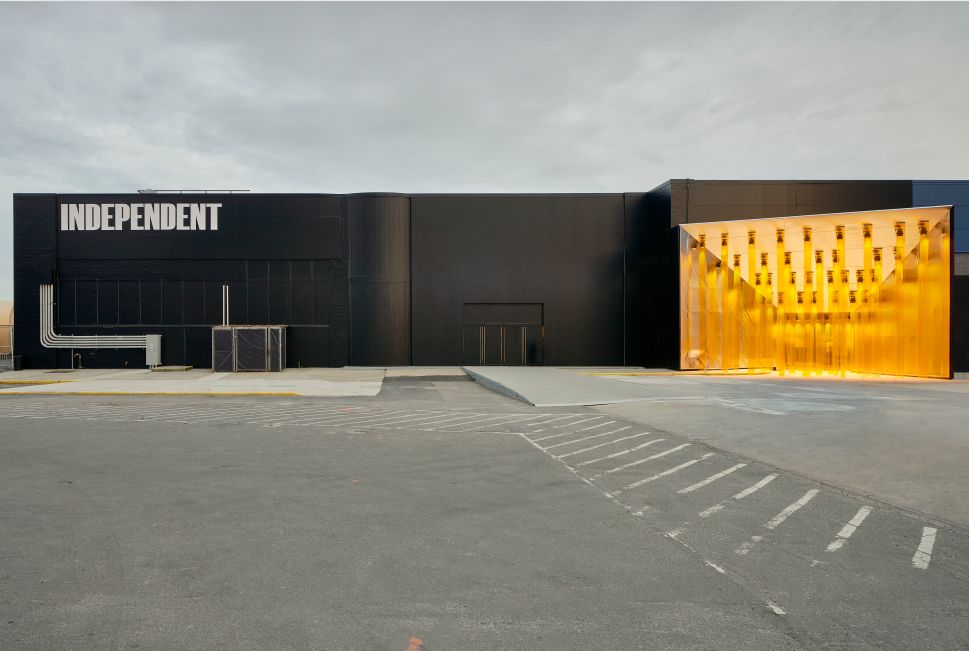
Independent opened yesterday (May 14) in a new location in Lower Manhattan’s Pier 36, which is much less central and less immediately connected than Tribeca, but still worth the trip for the quality of its presentations. The larger space allowed the fair’s thoughtful selections to breathe, which matters more than you might think in a week ultimately defined by information overload. The emphasis on solo presentations, which make up 70 percent of the presentations, and tightly focused booths make the experience pleasantly digestible—even for those of us trying to visit as many New York art fairs as possible.
“The layout is generous, and I think the quality of the fair is superb, so we are very happy to be here,” gallerist Susanne Vielmetter told Observer. She’s presenting a three-part booth with works by Samuel Levi Jones, Robert Pruitt and Nate Lewis in a shared conversation around paper, materiality and the tactile force of image-making. Jones is presenting new assemblages that question authority, representation and recorded history by physically deconstructing books tied to systems of power—from legal and historical volumes to institutional texts—and reassembling them into abstract, grid-like compositions. Here, those seams of control and collapse extend into works incorporating disassembled American flags and pulped paper, recalling Rauschenberg’s charged reworkings of the national symbol while speaking to the decadence and crisis embedded in the image’s very fabric. Robert Pruitt is showing new portraits in coffee wash, conté, charcoal and pastel, fusing the mundane and surreal through figures shrouded in sumptuous textiles, spiritual iconography, science-fiction references and otherworldly adornments, expanding his mythology of a Black past, present and future. The third section is dedicated to Nate Lewis, whose hand-sculpted inkjet prints treat paper as a bodily and sculptural surface, layering drawing, embossing, frottage and carved texture into figures in motion. Drawing from music, capoeira, medical imagery and the flight patterns and wing structures of butterflies, Lewis extends the booth’s dialogue around surface, material memory and embodied meaning.
The response, according to Vielmetter, has been extremely positive from the fair’s early hours, with two works reserved for museums and several others already spoken for. “In this new reality, there is more than we hoped for, so we are off to a great start,” she said, acknowledging that the market is no longer operating at the pace of 2022.
Vielmetter Los Angeles booth at Independent presents works by Samuel Levi Jones, Robert Pruitt and Nate Lewis across several white partition walls.” width=”970″ height=”647″ data-caption=’Vielmetter Los Angeles at Independent 2026. <span class=”lazyload media-credit”>Photography by Andy Romer / CKA. Courtesy of Independent</span>’>
Brazilian gallery Almeida & Dale has presentations both at Frieze (with François Ghebaly) and at Independent, where it has a shared booth with David Nolan Gallery and is staging a dialogue between Chakaia Booker’s tire sculptures and the chromatically charged photographs of Miguel Rio Branco, highlighting the artists’ shared attention to latent histories, material memory and the uneasy beauty that can emerge from what society leaves behind. Booker transforms discarded rubber tires into compressed, torsioned, shadowed forms that appear almost posthuman—totemic dark creatures in which urban residues are charged with bodily tension and a strange ritual presence. Rio Branco’s photographs instead dignify marginalized communities and urban environments through layered textures, subtle mirroring and saturated color, revealing the existential density of places often dismissed as degraded or peripheral.
New York dealer Charles Moffett reported strong interest in the gallery’s presentation of works by the late Swiss artist Silvia Heyden, including seven tapestries dating from 1973 to 2013. Heyden, who died in 2015, drew inspiration from nature while experimentally disrupting fiber art’s prevailing orientation toward the grid, expanding the medium’s potential for vibrant expression, intrinsic rhythm, visual complexity, subtle movement and infinite color. By the evening, the gallery had sold two: one for $14,000 and another for $18,000.
Nearby, Kiang Malingue has a booth of works by Taiwanese artist Tseng Chien-Ying, whose paintings on Asian paper transform the body and its fragments into a microcosm of contemporary life, desire and shifting perception. Using ink, gouache and mineral pigments drawn from East Asian painting traditions, gold and silver leaf, black foil and the moriage technique—a raised decorative process more often associated with ceramics and murals—Tseng builds surfaces where color does not simply sit on paper but seems to breathe into it. Drawing from Taiwanese and transcultural pop iconography, literary classics, body politics and fetish, Tseng infuses the human form with emotional intensity and the quotidian with an erotic charge. The gallery placed roughly half of the booth early on, with works priced between $12,000 and $27,000.
Italian gallery SECCI has a solo booth of works by Lebanese artist Omar Mismar, whom many may remember from the last Venice Biennale. The presentation pairs the artist’s ancient-looking mosaics of fragmentary bodies with his new works from “Root and Branch (شيل ما تخلّي).” Created on salvaged PVC flex banners once used for advertising and marked by years of sun, rain and exposure, the latter works resemble landscapes, scars, scrolls and shrouds. Across them, fragments of graffiti slogans tied to Lebanon’s 2019 protest movement emerge, partially concealed beneath layers of paint, in an echo of erasure and censorship in public space. Works are priced from $9,500 to $26,000; the gallery reported that a small work sold and two large mosaics were on hold.
Towards the end of the fair, 12.26, from L.A. and Dallas, is showing the work of Julia Maiuri, whose paintings offer dense psychological views combining multiple levels of memorial space and sensation in cinematic images. Priced between $6,000 and $10,000, most sold early on. Meanwhile, MARCH has a solo booth of works by Dianne Settles, whose rich storytelling on canvas immortalizes and celebrates the vernacular, collapsing multiple memories into single scenes while reflecting on motherhood, community and collective effort. Drawing on Western tradition and the art history of her father’s native Vietnam, Settles’s lively compositions explore what it means to exist as part of a collective, portraying the ways culture, politics and ideology intertwine in community—a timely reflection in a moment of division. All works were priced at $12,000, and the gallery had sold several by 4 p.m. Across the board, the dealers we spoke with were optimistic that the next few days will bring even more conversations and sales as fair-hopping buyers make their way to Pier 36.
