
Spare a thought for the many people in the art world who touched down this week fresh from a magnificent time in Venice and then, somehow, found themselves in the Shed. The jolt is a little like when Neo wakes up from the Matrix for the first time, yanking from his throat the tube that had been sustaining him via a steady diet of spritzes and cicchetti. But Frieze New York is not so different from Venice. Everything here is for sale, too, and, for all its faults, the Shed is not much bigger than a palazzo, so the fair tends to be manageable in size. Dealers focus on quality over quantity and can bring ambitious works, since they don’t have to ship them very far. Meanwhile, collectors feel like they have the time to linger, whether they’re hunting for gems or masterpieces.
Should you end up visiting the fair this weekend, you should set your gait to saunter and make your own discoveries. But also be sure not to miss mine.
The best art at Frieze
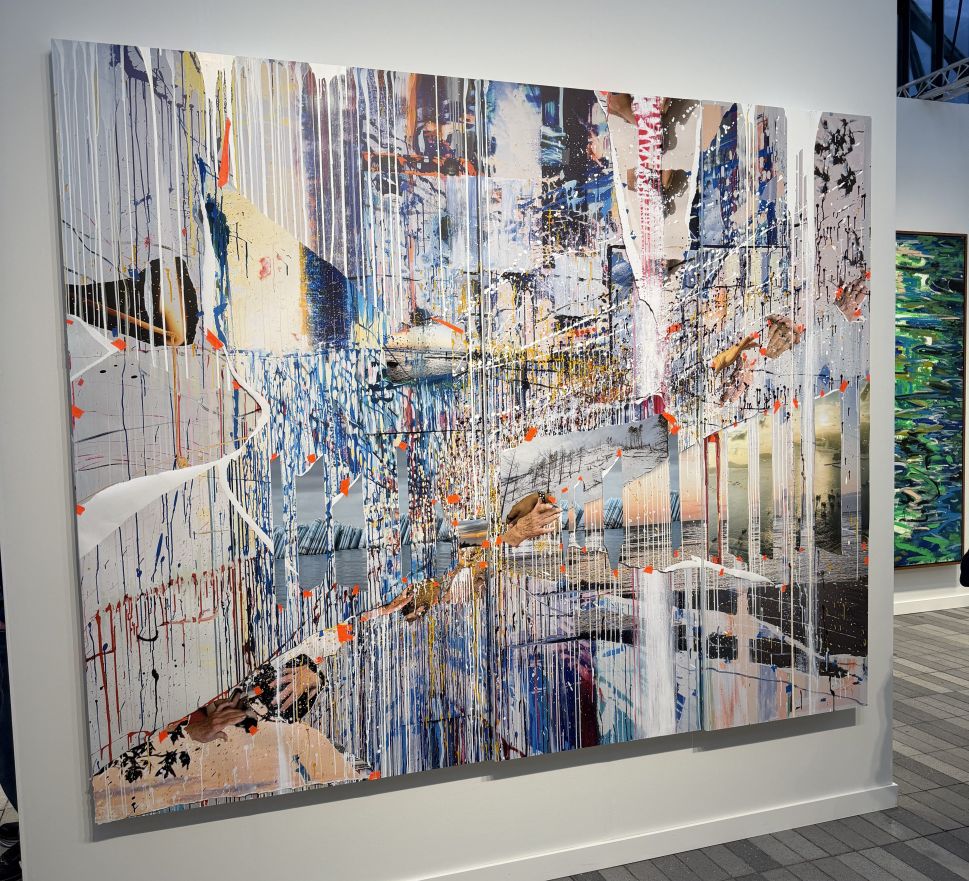
Sarah Sze, Badlands (2026)
Many years ago, I profiled Sarah Sze (b. 1969) for this publication. Digging into her work and personality, I found her to be a bona fide genius—she was later named an actual genius with a MacArthur Grant—but I found myself wondering what it would be like to collect her. The question was answered not long after that year, at the home of collectors Michael and Susan Hort, at the annual party they throw at their Tribeca loft showcasing their collection. Somewhere in an upstairs bedroom, Sze had taken over a linen closet, utilizing thread, light, cotton and, as I recall, some toilet paper to create a miniature universe. Very cool, but sometimes guests are coming over, and you need to replace the hand towels. May I offer you a more practical solution at the Gagosian booth? This remarkable new mixed-media piece remixes photographic elements, as if a tropical getaway were attacked by a torrent of paint. As with all her work, there are conspiratorial lines of plot to follow if you’re looking for that, but I think it’s more fun to relax your eyes and let it wash over you. For me, the overall effect is akin to when a vandal cracks those video advertisement screens in the subway, which is to say it’s terribly beautiful.
Sarah Sze, Badlands (2026).
Photo: Dan Duray for Observer
Cindy Sherman, Untitled #686 (2025)
Some years ago, I was in the VIP lounge at a New York art fair during an afternoon champagne toast, and there I asked director John Waters if he’d seen anything good while perusing the fair. “I enjoyed the Cindy Shermans,” he said, then looked around the room conspiratorially. “Actually, I’m enjoying the Cindy Shermans that I’m seeing right now, live and in color.” Obviously, this forever changed the way I interact with the work of Cindy Sherman (b. 1954) at art fairs, where both men and women compete over who can do the dumbest stuff to themselves via surgery and couture. This new photo is one of her finest in years. So often in her self-portraits, Sherman turns herself into a monster, or a creature so melodramatic that you’d cross the street to avoid it. Here she is positively snuggly, beckoning to you with a mitten in a way that says, “I gotta be me.” There doesn’t appear to be a real sepia filter on the photograph, but the fake tan and gold amplify the orange of the inundating tiger print to create a universe of richness and comfort. A welcome respite from the more traditional Shermans who prowl the surrounding fair.
Cindy Sherman, Untitled #686 (2025).
Photo: Dan Duray for Observer
Yeni Moa, fig 21.7 lossy (2023)
Sargent’s Daughters
The press materials call these works by Yeni Moa (b. 1971) “cyborg assemblages,” and indeed, it is the blend between the organic and technological that makes this floor piece compelling. At the center is a bubble of greenish mercury glass, which seems to animate it. Despite the firm, reflective nickel-plated steel that constitutes the majority of the piece, you can feel the natural return in the loose shape and the welding on the other side. It begins to feel like there’s nothing Moa could do to make this work feel unfriendly. The spikes at the far end feel decorative, inviting, as though this creature only wishes to reach out to you in a greeting. It’s nice that the artist found a way to be cyberpunk that neither uses neon nor references the internet. If you buy this work, you should probably install it in the tool shed so someone mistakes it for a device with a real purpose.
Yeni Moa, fig 21.7 lossy (2023).
Photo: Dan Duray for Observer
Joe Andoe, 3/20/26 (2026)
This oil on linen work is a painting in reverse, an exercise in removal by Joe Andoe (b. 1955). “His painting technique is almost comically casual,” Deborah Solomon has written, in that he uses mostly his thumb and a bit of cloth to remove paint from the canvas until the design emerges. Andoe is said to be a favorite among his cohort, folks like Ed Ruscha and Richard Prince, and this painting demonstrates why. The leaves, stems and buds of these flowers all have a unique identity despite being made in the exact same way. The way that he has signed and dated this work right in the middle of it is punk rock in a way I enjoy. It goes well with the color. One should not assume the background to be an afterthought, either. There’s a great deal of movement there. If it were just a monochrome from which Andoe had removed nothing, it would probably still be compelling.
Joe Andoe, 3/20/26 (2026).
Photo: Dan Duray for Observer
Akinsanya Kambon, Oya—Goddess of The Wind (2015)
Ortuzar and Marc Selwyn Fine Art
In his review of the Venice Biennale, Jason Farago noted that curators these days tend to favor artists’ biographies over their output. This is true, but it’s hard to separate the life of Akinsanya Kambon (b. 1946) from work like this. Kambon came to embrace a particular strain of Pan-Africanism after serving as a Marine Corps infantryman and combat illustrator in Vietnam. He joined the Black Panthers and traveled to Africa conducting oral histories about anti-colonial struggle. He brings all his research and talents to bear in this piece. You can see his talent for drawing at the base of the goddess’s dress, which seems to depict a merging of birds and leaves on branches. The dress continues up in a curious pale blue with designs of satisfying texture. The figure’s features are strong and compelling, but here we notice most of all the quality of the patina. Her skin looks ridiculously realistic, owing to Kambon’s ceremonial attitude about kiln firings, which incorporate eucalyptus leaves and sawdust. This work feels like a vivacious artifact.
Akinsanya Kambon, Oya—Goddess of The Wind (2015).
Photo: Dan Duray for Observer
