
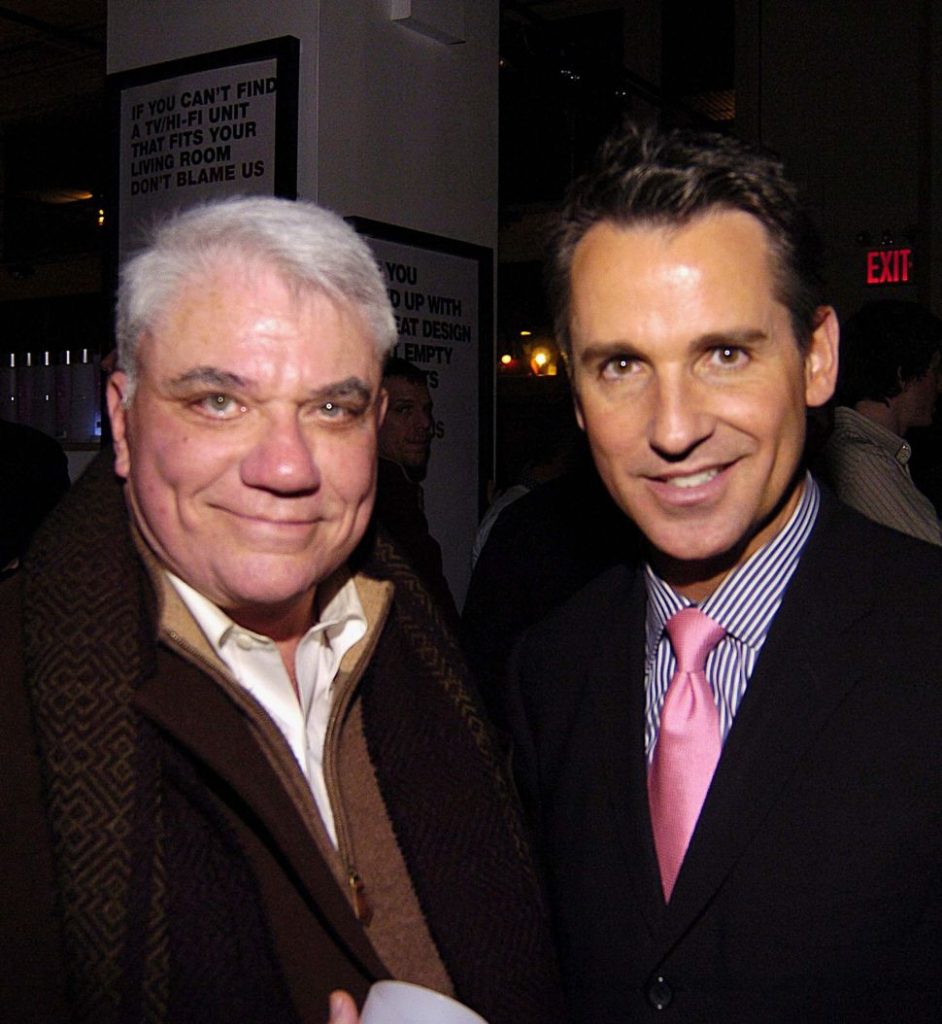
At the bottom of Rex Reed’s obituary a week ago today, on May 12, 2026, I invited readers to share their memories. A very close and very private friend of Rex’s told me that “all Rex ever wanted was to be loved and to be famous.” Maybe the call for remembrances was my way of honoring that. Maybe I wanted to know if he got what he wanted.
The emails started coming. Dozens of them, from critics, actors, writers, artists, producers, pals, lovers and fans. Many included photos—handwritten letters Rex had sent them, typed notes on his stationery, things they’d kept for years, sometimes decades.
Rex was a man who wrote back, even if you weren’t his friend. To teenagers. To strangers. To almost anyone who took the time to reach him. They didn’t expect a reply, but they got one (gracious, thoughtful). He was relentlessly social, holding court at parties, burning up the phone lines. Sending five-page responses to three-paragraph letters.
An entire generation of gay men grew up watching Rex on TV, recognizing something they couldn’t yet name. One put it simply: “There weren’t many role models for Future Homosexuals of America in the 1970s.” Rex was among the few. For them, he was rarer than a critic.
Many people discovered Rex as children. A 9-year-old watching talk shows past his bedtime. A 14-year-old writing fan letters from the suburbs of L.A. A 10-year-old who saw him in Superman and became obsessed with Myra Breckinridge. A child whose single, immigrant mother found such joy in Rex’s writing that the child’s memories of Rex are inseparable from her memories of making a new life in America. They found him on television, in libraries, in their parents’ newspapers. And they followed him for the rest of their lives. Many of them wrote to Rex. (Many got letters back.)
The reviews, of course, quoted from memory. One reader’s favorite Rex pan sparked a decades-long obsession with a forgotten 1969 film; this year, that reader—now a successful screenwriter—helped restore it. Several readers noted, with sadness, that they’d been checking Observer, hoping to see his byline, wondering what happened.
In letter after letter were his eyes, his voice, the way he moved through space, the way his entire body paused, almost quizzically focused on the person in front of him. People describe Rex the way you describe someone you know and love every inch of, even from your living room, even as a child, even if you never met him.
In 1971, Rex wrote to a 14-year-old girl who’d sent him a fan letter: “I sometimes think I’m writing into a vacuum and nobody ever sees what I write. It’s comforting to know I got through to somebody.”
In an age when everything can be generated, here’s the evidence that something irreplaceable happens when a person sits down and puts words on a page about another person. Here’s what it means for writing to matter. Human writing. Writing about humans. Writing to humans.
Rex spent his life doing that. He was an Observer, in every sense, for almost 90 years.
Like most parents, I correct certain words that come out of my children’s mouths. Stupid. Ugly. We’re not supposed to say such things. But this past week, every time I’ve reflexively gone to stop one of them—mostly, my four-year-old—I pause, thinking about Rex.
There are stupid things in the world. There are ugly things. And if nobody’s willing to say so—clearly, without hedging, without apology—what does it mean to call something beautiful?
Rex wasn’t cruel for cruelty’s sake. He believed that for words to mean anything, you have to be willing to use all of them. Even the uncomfortable ones. Especially those.
That’s what I want my children to learn. Say what you see and make sure your praise is worth something—because you’ve proven you’re not afraid to say when it isn’t.
Letters to the Editor: Memories of Rex
Trapped in an Episode of ‘Dynasty’
Role Models for Future Homosexuals of America
Room for Just One Southern Gay
A Fight About When World War II Started
Insane Demands Aboard the Ship
“For someone brought up in the shadow of the movie industry, you seem remarkably fresh.”
Saved by Lemon Meringue Pie at the Beverly Hills Hotel
Everything Good Rolled Into One
“You have a tremendous talent for knifing your way into the dark recesses of the human heart.”
Lyrics as They Were Meant to Be
“I’m still in The Observer, you know.”
A Jacket That Someone Threw Up On
An Escalator at Bloomingdale’s
Remembered My Favorite Color (Not My Name)
“The bulk of Redditors are the unconscious stepchildren of Reed.”
How to Be Your Own Best Friend
“I couldn’t wait to read the next one.”
Clark Gable Left Out in the Sun
Rex Reed’s Guide to Movies on TV & Video (1992) in the Family Room (2026)
Gushing to Bomer at the Airport
Snarky Barbs on ‘The Gong Show’
Waiting Around the Fairchild Lobby
He Never Answered, But I Loved Him
The Way I’d Like to Remember Him
A Catalog of the Best Film Has to Offer
“My lasting memory of Rex will now always be of my having made it down to the end of the page.”
These messages have been edited for clarity and brevity.
The Rex Reed Foundation
William Kapfer & Eric Baker
Following the passing of our dear friend, Rex Reed, we have been moved by the overwhelming response from those whose lives he touched.
In lieu of a traditional funeral, we will host a tribute celebration this autumn honoring Rex’s remarkable life and legacy—in the spirit of the beautiful tribute he produced with Deborah Grace Winer and Michael Alden for his longtime friend Polly Bergen in 2015.
For more than six decades, Rex Reed was one of the most influential voices in American cultural criticism. As a legendary film critic, celebrity interviewer, author and longtime member of the New York Film Critics Circle, he shaped the national conversation around film, theater and popular culture.
This gathering will celebrate not only his extraordinary professional accomplishments, but also the wit, intellect and generosity so many of us were fortunate to experience personally. Friends, colleagues, artists and loved ones will come together to honor a singular life that left an indelible mark on media and the arts.
We are also establishing The Rex Reed Foundation to support media, arts, journalism and cultural storytelling while nurturing future generations of creative voices.
Details about the autumn celebration and foundation will be shared in the coming months. The foundation website, RexReedFoundation.org, will launch soon.
We are deeply grateful for the kindness and support during this difficult time.
Rex Reed and William Kapfer in 2007.
Patrick McMullan via Getty Image
Trapped in an Episode of ‘Dynasty’
Deborah Grace Winer
When I saw Joan Collins move through the crowd toward Rex Reed, and by default, me, I got that special sickening feeling you get when you’re friends with a famous critic who’s known for blending unfiltered opinion with unbridled literary flair that—like nuclear fusion—creates a lot of unpredictable energy.
Joan approached—coiffed, bejeweled, with a blinding smile and raising one manicured finger toward Rex.
“Hi Joan,” he Louisiana-drawled.
She wagged her finger and smiled even wider.
(Was she mad?)
“Rex, you naughty, naughty boy,” she cooed in British, patting his cheek.
(Yep.)
“I should be very, very angry with you.”
“Oh, Joan,” he laughed.
Then she kissed him while relaying unhappiness at his review of her recent one-person evening.
He didn’t think he’d said anything bad.
(Though there was that line, “You can accuse her of hanging on beyond her prime, but if you meet her in a dark alley, bring Mace.”)
Then they embraced. They’d been friends since the 1960s.
It was like being trapped in an episode of Dynasty.
Rex on a beach in Malibu, 1973.
Getty Images
Rikki-Tikki-Tavi
Richard
I first met Rex in 1972 in Florida. I was a journalism student in my second year of college when I wrote Rex a brief, three-paragraph letter asking to interview him. He responded with a five-page handwritten letter detailing how impossibly busy he was—major deadlines, phones ringing off the hook, hundreds of letters weekly. At the end of this tale of woe, he invited me to pick him up at the Orlando airport and have dinner before he spoke at an event for Air Force wives in Cape Canaveral.
I arrived at the airport and we walked to my yellow Corvette. Rex, who had no filter, immediately delivered his first unsolicited critique about my car. He was hilarious. As we drove to the motel, the second critique arrived—this time about my name.
My birth name was Richard, but living in the south, I’d acquired the nickname Rikki. Rex asked how I came up with that ridiculous name and spelling. I explained my grandmother loved the childhood story Rikki-Tikki -Tavi and proclaimed that was my name.
Rex sounded off: “In England, Richard is Dick. That’s a no. In New York, Richard is Yo, Rich. That’s a no. In the south, Richard is Ricky, and definitely not spelled like a childhood tale. From now on, it’s Richard. Got it.” I said OK.
His motel surprisingly had a nice restaurant. Over dinner, we talked about our journeys as two young southern boys on a mission. A handsome, perhaps gigolo-type young man approached our table, probing to see if there might be interest. There was not. Yet another critique followed—Rex noticed the gentleman’s expensive bracelet. My mother was a major Bvlgari customer, and I recognized it immediately. When the check arrived, Rex made no effort to pick it up. In all our years together, I never knew Rex to pick up any check, ever. I wasn’t fazed—my father always paid for everyone, everywhere.
Rex asked if I’d like to stay over. Not wanting the two-hour drive back to campus, I checked into the room next door. We continued talking in Rex’s room, eventually falling asleep while staring at the ceiling from our separate beds.
Rex’s humor was profound. His constant complaining about work made me realize he truly loved it—loved to complain, and more than anything, wanted to be famous. He barked a lot about life, but I saw him as a dog barking with his tail wagging. He loved deadlines. He almost never laughed. Instead, he had a grin.
I decided to have fun with his humor. I found a printing store, composed a “form letter” for Rex to use, had 1,000 copies printed, and sent them to his New York apartment—along with the exact Bvlgari bracelet he’d criticized. I knew he admired it. His response was immediate and hilarious.
In 1975, I moved to New York City. At Rex’s insistence, I found an apartment on Central Park West where we could be near when turmoil engulfed us. He also insisted I use his answering service, where live operators answered our phones. We shared a magnificent lady, Louise, who reminded me of Mabel King in “The Wiz.” She fiercely protected us and never shared anything about our lives to anyone—not even Rex’s callers to me or mine to Rex.
I first learned of someone named Rick who answered Rex’s phone and took messages. Once, he telephoned to probe my friendship with Rex. I’ve always been fiercely private, and I asked Rex about Rick, adding I wasn’t cool with anyone asking about my private life. Rex said Rick was his assistant, though I suspected otherwise—he was there too late and sometimes too early. Rex never talked about Rick. I knew about Rick, but as we were not romantically involved, I didn’t think twice about his edits in his life, or even mine. Years later, Rex would share more, particularly about Rick’s untimely death.
My friendship with Rex wasn’t one where I leaned on him. He, though, leaned on me several times, especially when peril knocked at his door.
I am petrified to share this, as I am not a writer, and stepping into his world in print is something Rex would no doubt greet with his notorious, mischievous grin. More than anything else, Rex wanted to be famous and loved. Rex was both.
Toronto Star via Getty Images
Role Models for Future Homosexuals of America
Charley Soderbergh
I remember seeing Rex Reed on a TV talk show, his legs crossed, and an elbow propped on the arm of the chair. His hand would sometimes gesture, and other times cradle his chin when he listened. I must have been 9 or 10.
There weren’t many role models for FHA’s (Future Homosexuals of America) in the 1970’s, outside of camp comedians like Paul Lynde, Charles Nelson Reilly, Rip Taylor. They were full of snark, confetti and exaggerated laughs. Rex’s brand was different, cool. Measured. As if he knew something—not just film and literature, but people. He had all the cards and held them close to his natty suit.
I always wished I’d had a chance to meet him and chat about the things we had in common: Going to LSU, writing movie reviews for The Daily Reveille (my notables were Hairspray and Moonstruck) and being a gay Libra in that sultry, conservative atmosphere—albeit 30 years apart.
I can imagine myself genuflecting next to his chair, and his expressive eyes saying, “What on earth?” Rest in peace, Rex. There was no one like you.
Corbis via Getty Images
Room for Just One Southern Gay
Kevin Sessums
One of my great regrets is not knowing him better. I always thought of myself as having the “Rex Reed slot” at Vanity Fair, and maybe the reason he never got his byline in there more often. So I was not only a bit shy and intimidated to cultivate a friendship, but was also sort of gilded with a bit of guilt that there seemed to be room for only one southern gay guy who knew his way around fame and fought for his sentences.
My Aunt Jo down in Mississippi turned to me when I was about 12 or 13 and said, “You know who you remind me of… Rex Reed.” She thought she was being a bit unkind, but as I looked back on it in later years, I realized it was one of the kindest and most perceptive things anyone had ever said to me.
Rex and I were once sitting in a van down in Louisiana, being hauled to a fancy-enough lunch at a renovated plantation upriver from New Orleans. We were both participating in panels at the Tennessee Williams Literary Festival that year. On the way home after an awful afternoon of putting up with the rising humidity and the kind of the-south-shall-rise-again queen who owned the place and could sashay while sitting at the head of a luncheon table, we kept each other in southern stitches by saying what we’d really thought about the outing we’d had to endure. During a lull in our laughter, I told him about my Aunt Jo saying that about me and how much it had meant to me.
I think he was touched by that. I hope he was.
Filling the silence with a fumbled sigh that sometimes our tears can form when we’re trying not to let them form themselves, he turned his head to look out the van’s window at the Louisiana landscape where he had lived the life that led to his longing to live a much bigger one so much farther upriver.
He lived it. We are all lucky that he did.
Rex attends a screening at the offices of the Directors Guild of America in Hollywood, California, on March 20, 1974.
Penske Media via Getty Images
A Fight About When World War II Started
Marcia Froelke Coburn
I met Rex when I was in college in Chicago, dreaming about becoming a feature writer, and he was in town promoting a book (his collection of movies and TV shows, Big Screen, Little Screen). It was 1970 or 1971. He was encouraging, and we kept in touch. He had a tremendous influence on me and my writing. I was a kid with a dream, and he took me seriously. He listened to everything.
I have wonderful memories of spending time with Rex at Cannes and in Toronto. I spent a week or so with him in New York and then at his house in Connecticut, reading his draft Personal Effects. I had a few suggestions he liked and a few more he hated. We got into a huge fight about when World War II started. It was before the internet, so we both just dug in on our differing opinions. (I was thrilled when he dedicated the book to me.)
When I was in town with others on the staff of Chicago Magazine for the National Magazine Awards, Rex joined us for a celebratory drink after we won. It was a dream come true; the man who encouraged me and listened to me when I was just a kid was there, celebrating me.
A few years ago, I was in NYC for a quick turnaround trip, and we were supposed to get together for dinner. But a ferocious thunderstorm blew in, and he didn’t want to drive from Connecticut (and I didn’t blame him), so we spent a few hours on the phone and then I was gone the next day. We didn’t have another opportunity to see each other after that. I regret it so much.
The cover of Rex Reed’s 1986 novel Personal Effects, which sold 75,000 copies in its first printing and was optioned by NBC.
Courtesy of Rex Reed
Ron Galella Collection via Getty Jake Hooker, Lorna Luft, Rex and Liza Minnelli at Lorna Luft’s birthday party in 1977.
Truth Will Find an Audience
James Grissom
Rex gave me this advice about writing: “You can only write as you do, even after the imitation of others. We all do that, but finally, it’s your voice that comes out. Tell the truth, and your work will find an audience. It will also find some detractors, but that’s the price of exposure, of having an audience. Never waver.” As both a writer and a friend, Rex never did.
Jake Hooker, Lorna Luft, Rex and Liza Minnelli.
Ron Galella Collection via Getty
Insane Demands Aboard the Ship
Barry Avrich
In 2012, Rex Reed was a guest critic and programmer on a 10-day Floating Film Festival on a luxury cruise liner. Rex had been campaigning for years to come and was envious of Roger Ebert, who had been joining us for years.
I could not have prepared enough for Rex’s insane demands once he boarded the ship. It would have been easier to book Marlene Dietrich.
Rex required a fax machine, 12 cases of distilled water, a purser to steam his shirts daily and wood hangers, preferably cedar. His job was to introduce a few films and then pay tribute to Richard Benjamin and his wife, Paula Prentiss.
No one ever saw Rex during the day; he was too busy faxing reviews to Observer. At night, he was on parade, dressed in a tailored, nautical blue jacket with monogrammed brass buttons, a silk pocket puff and pressed white or blue pants. He held court and told old Hollywood stories.
The day of the Benjamin tribute, I asked if he needed notes, and he scolded me: “Rex Reed does not need notes.” An hour before the tribute, he demanded notes. He took them from me without a thank you, as if I were a cabin boy delivering his pants.
Rex was a talented pain in the ass. He will be missed by many people, with the exception of a certain ship’s staff and a handful of directors, I’m sure.
WireImage
Glamour Over the Lilac Hedge
Amanda Vaill
In the summer of 1997, when I was in between the completion and the publication of my first book, Everybody Was So Young, my family and I rented a cozy Colonial saltbox in Roxbury, Connecticut, that was next door to Rex Reed’s larger and grander 18th-century country house. He very kindly asked us to drinks one evening, and because he was rarely there during the week, he invited us to use his hydrangea-lined pool, which was situated across the dirt road that ran by both our houses.
I would swim laps there in the morning before getting down to work on my copy-edited manuscript—that’s where I came up with the idea of what would be my next book, Somewhere: The Life of Jerome Robbins; but on Fridays, when I’d hear the growl of Rex’s red wire-wheeled convertible coming up the hill to disgorge weekend revelers on his lawn, the pool became off-limits. For the rest of the weekend, we’d hear laughter and the sound of the record player filtering through the trees, as if we were Nick Carraway and Rex was hosting a Gatsby party next door. Who was there? We wondered. Liza Minelli? Diane Von Fürstenberg? Elizabeth Ashley? We imagined a whole world of glamor and boldface names on the other side of the lilac hedge.
And then Monday would come, and everyone went home; and as lovely as it was to retake possession of the pool and the hydrangea bushes, some of the magic was gone.
Rex and Diane von Furstenberg in 1975.
Penske Media via Getty Images
Getty Images Liza Minnelli and Rex (right) with guests at a Liza Minnelli party at the Waldorf on February 2, 1970, in New York, New York.
Happiness for Momma
Adrianna de Madriguera
My momma was Regina Santos, an amazing woman who came to this country from Brasil. She worked hard supporting two households—here and in Brasil—as a single mother of three. She deserved so much better in her life. But through everything, she was smart and loving and well-read.
I have fond memories of my momma reading columns by Rex Reed, Liz Smith, Suzy and Cindy Adams. New York City icons.
When I got older, I read them too. He brought my momma much happiness, laughter and light. I thank him a million times for that.
I read about his passing this morning. Mr. Reed is one of a small group of people from my youth who will always have a very special place in my heart. He will be missed in so many ways. He brought smiles and giggles. Class and camp.
Liz Smith and Rex in 1979.
Penske Media via Getty Images
“For someone brought up in the shadow of the movie industry, you seem remarkably fresh.”
Meg McSweeney
In the summer between ninth and tenth grades, I jazzed up my reading list with the tantalizingly titled Do You Sleep In The Nude? and Conversations In The Raw. To hold up my end of the conversation, I wrote Rex Reed a long letter with my impressions of what he’d written, along with other opinions. Because of course he cared what a 14-year-old girl in the suburbs of Los Angeles thought (it’s likely that my missive included lamenting that the MPAA rating on Myra Breckinridge prevented a sophisticate like me from seeing it). He sent a gracious reply.
Courtesy of Meg McSweeney
My father saw it. And he said, “Son, I don’t think I understand this movie.” I said, “Don’t worry. Nobody else does, either.”
Saved by Lemon Meringue Pie at the Beverly Hills Hotel
Andrew Goldman
In 2022, I went to the Dakota to interview Rex Reed for my podcast about aging showbiz legends, “The Originals.” I was horrified when the SD card of my digital recorder ran out of space, and I had to sprint ten blocks to grab a new one at Staples. “Why didn’t you bring more tape?” he asked. It wasn’t clear he understood digital recording and did his best not to seem miffed by the 30-minute interruption. I felt, as I should have, like an idiot, but Rex was game to keep going. I was appreciative and relieved that Rex reviewed movies, not podcast interviewers. I will forever treasure the memory of my afternoon listening to Rex giddily unload on everyone and everything.
Narrowly escaping the Manson Family murders was just one of the stories he shared.
I was invited that night. Jackie Susann was a very good friend of mine. We were both at the Beverly Hills Hotel, and she was promoting Valley of the Dolls. I was promoting a book, one of my books, and we were both at the Beverly Hills Hotel.
Jackie called me and said, “I’m going to dinner at Sharon Tate’s, and she wants you.”
I said, “I don’t want to go. This is lemon meringue pie night at the Beverly Hills Hotel; it’s my favorite thing on the menu here, and I love it. And only this one night of the week do they have that.”
She says, “Well, I’m not going to go if you don’t go.”
I said, “Well, go ahead and go.”
She says, “No, I’m going to come over in my gown, and we’ll have dinner on trays in your room.” In my suite.
So neither of us went, and she called and woke me up at 6:00 in the morning. She said, “Johnny Carson just called and woke me up, and told me what’s going on, you will not believe, everybody at that dinner party was murdered.”
I joked for years that I was going to write a book that I was saved by lemon meringue pie.
He was a dream subject.
Rex, Maximilian Schell and ‘Valley of the Dolls’ novelist Jacqueline (Jackie) Susann in 1974.
Penske Media via Getty Images
So, You Want to Be Rex Reed?
Charles McNulty
Early in my tenure as the Los Angeles Times theater critic, I was making a trip back to New York to catch up with the Broadway season. A woman seated next to me on the flight, unfazed by the book I was hiding behind, asked what I did for a living. Upon finding out, she confidently remarked, “So, let me guess. You want to be the next Rex Reed and review movies one day?”
I did what I usually do in those awkward social exchanges and laughed exuberantly in ambiguous agreement. I didn’t feel the need to explain that theater wasn’t a stepping stone to a higher-profile beat for me. Nor did I wish to admit that I hadn’t Reed’s gift for public gab or his fluency in so many disparate realms of entertainment.
There was a reason he came to represent the figure of the taste-maker in public consciousness. He revealed himself to his readers through the vibrant force of his likes and dislikes, but most of all, he transmitted his passion for great talent to them, and they never forgot the treasures he led them to discover.
Ron Galella Collection via Getty
Everything Good Rolled Into One
Ernestine Sclafani Bayless
I am a New Yorker (now living in L.A.) who grew up in Rex world and read everything he wrote. My family loved Rex, and I loved Rex. As a little girl, I remember thinking he had presence, charisma, honesty and glamour, all rolled into one.
He felt like someone I had known forever, and that he would always be here. He was larger than life in every way. To think he would leave us was unimaginable.
When I read Rex had passed early Tuesday morning, I immediately texted my friend, the great TV host Bill Boggs, who interviewed Rex a bunch of times. Bill replied, simply, “Rex was an important part of our culture.”
I hope Rex knew, in the end, that he was loved by oh so many.
Courtesy of Joseph Manghise
Small, Sweet Memories
William Kapfer
Rex was that he was an incredible baker. He made a truly mean lemon icebox pie with a Nilla Wafer crust and genuinely loved the whole baking experience. The best part was always a day later, after the pie had settled. We’d have a slice with a cup (three scoops) of International Coffee.
I’ll never forget going with him to the Orange County Fair one year to buy the blue-ribbon-winning blueberry pie. We stood waiting until 4:01 p.m. because the women guarding those pies were absolutely not going to let us buy one a minute early.
It’s those small, sweet memories.
His curiosity, patience, humor and appreciation for life’s little pleasures were wrapped into moments like that.
For the rest of my life, every time I order dessert, a part of me is going to think about Rex.
Rex and William Kapfer at the 18th International Palm Springs Film Festival Awards Gala in 2007.
WireImage for BWR Public Relatio
Getty Images Rex and Lauren Bacall in 2009.
The Right Explosive
Stephanie
My godmother, Paula Laurence Bowden, introduced us. She was a fixture in musical theater; she had acted in numerous productions, both on and off Broadway, since 1937, when Orson Welles cast her in his play, Horse Eats Hats. She had it in her head that Rex should write a one-woman piece for me. Never happened. No matter.
We took a few trips together to NOLA for the Tennessee Williams Festival. We read “This Property Is Condemned” for their gala. When an open slot appeared in the festival schedule, an interview with Rex Reed was decided—but there was no one to do it. I raised my paw, stayed up all night reading everything about him. I had only a few grenades; I knew he’d do the rest. Pull out the right explosive and let him do the talking. Rex told me on more than one occasion that it was the best interview he ever had.
He was bereft when Angela died, and Polly Bergen and Jean Simmons. I filled a small female blank for many dinners and culinary outings. He could be very bossy in the kitchen. I loved it.
I knew a thoughtful, tender, brilliant, opinionated, elegant, wicked, delicate soul—a jewel of a man. Once I knew Rex, I didn’t feel I had to look for a friend to fill the empty spaces.
I was crushed to hear the news. I wondered why I hadn’t heard from him this winter. I figured he was working. I know I’ll be bereft this summer without my great chum. I loved him, and I know he loved me.
Ron Galella Collection via Getty
With Chopsticks
Kevin Lewis
I met Rex Reed at industry receptions, critic screenings and retrospectives. When I was with the National Board of Review, I telephoned him with the names of the annual award winners because he didn’t have a fax machine in the early 1990s.
I never thought of Rex Reed as sour in person. He reminded me of Joan Rivers because he always treated me as an equal, as Joan did when I met her. Both were polite and humble. They respected people.
I was an industry reporter, not a popular one. For twenty years, I was an East Coast feature writer for first the Directors Guild of America Magazine and later the Motion Picture Editors Guild Magazine Cinemontage. My articles are online on their websites. I also published interviews in Moviemaker and Backstage. I published scholarly articles in Film. History and Films in Review. My daytime jobs were with the Shubert Archive and the American Theatre Wing. I was the curator of three exhibitions at the Museum of the Performing Arts at the New York Public Library at Lincoln Center. So I was regarded as a nerd by the flashy critics and ignored. Not by Rex Reed because Rex was a scholar who could outshine college professors with his knowledge
Rex always wanted a film retrospective on Fred Zinnemann. We both shared an appreciation for him. Rex really loved studio movies for their classical storytelling. I loved the painterly compositions in 1940s movies, my favorite period.
My favorite Rex Reed quote? On The Johnny Carson Show in 1973, he called the flop film musical Lost Horizon “Brigadoon with Chopsticks.”
What distinguished Rex Reed from other emerging film critics in the counterculture and post-Vietnam era was Reed’s search for the moral integrity he found in the great American and global cinema. He revered Fred Zinnemann because Zinnemann explored characters who triumphed over moral collapse.
Rex and Joan Rivers at the 2010 Tribeca Film Festival.
Michael Loccisano
Like Mother and Son
Mathew Hargreaves
The photo of Reed with Lansbury showed they had the same jaw shape, like they could have been mother and son.
Angela Lansbury and Rex in 1980.
Ron Galella Collection via Getty
“You have a tremendous talent for knifing your way into the dark recesses of the human heart.”
PJ Castellaneta
In the early 1990s, I wrote and directed a no-budget film, and Mr. Reed hand-wrote me this lovely note. Although I never had the film career I had hoped for (I was told years later that I was just too openly gay and normal and didn’t indulge in any of the Mary, Monster or Martyr tripe that was standard at the time), I believe this film and my following film in 1998 helped pave the way for others. It was the rare encouragement I received from people like Mr. Reed that kept me going, and for that I will always be grateful. He will be sorely missed.
A letter from Rex.
Courtesy of PJ Castellaneta
Mission: Impossible
Frank DeCaro
Rex Reed showed me, as a kid reading him in the Daily News, the career I wanted to have when I grew up—as a real journalist but also a campy performer. In 2002, he played himself on one of the five Oscar preview specials I co-wrote and starred in for Comedy Central. It was a half-hour mockumentary called The Big O! True West Hollywood Story—a behind-the-scenes look at the uber-gay movie critic I played on The Daily Show with Jon Stewart.
We didn’t tell Rex that my mission on the show had always been to “out-Rex Reed Rex Reed” (my review of What Women Want was “Who cares?”), but when I proudly announced on that special that my strongest suit was my “bitchiness,” it was obvious to whom I was paying tribute.
Rex didn’t think the script was very funny, but he did it, and we were thrilled.
Later that day, Bea Arthur shot her cameo for the same special. She said, “This script is hilarious.” We decided to take her word over his. But really, a pan from Rex Reed was a badge of honor in its own right.
I’m bummed he’s gone, but happy to have rubbed elbows with him. He will continue to inspire me to be gayer and funnier and more myself forever. Rex Reed was a true queer icon, and if I ever made fun of him—and I did, in Spy Magazine no less!—it was because I adored and admired him so very much.
Ron Galella Collection via Getty
Lyrics as They Were Meant to Be
Harvey Granat
Rex joined me as my special guest for two programs in a series I hosted at 92Y, over a 10-year period.
At the first, a Jerome Kern tribute, he sheepishly asked if he could sing a couple of songs. He sent me a short list of the last songs Kern wrote, and I had my musical director ready for him. His voice was lovely and sincere. He delivered the lyrics as they were meant to be sung.
The second program, a tribute to Fred Astaire, turned out to be one my audience would long remember. Rex told the story of attending the Cannes Film Festival with a planeload of Hollywood stars. At the opening-night dinner, he was seated at a table full of major celebrities, including Fred Astaire. There was music playing, and people were dancing.
Rex turned to Astaire and told him he had always dreamed of dancing with him. At this, Astaire rose from his seat, took Rex by the hand and onto the dance floor, and made his dream come true. All the stars applauded.
Ron Galella Collection via Getty
Getty Images Robert Evan and Rex with a guest during the ‘National Academy of Television Arts And Sciences Gala Honoring Robert Evans’ at the Americana Hotel in New York City, New York, October 30, 1975.
“I’m still in The Observer, you know.”
Elliot J. Cohen
I ran into Mr. Reed about two or three weeks ago at our local bank. He was going out, and I was going in. I recognized him just after we passed, and I quietly said, “Mr. Reed?”
He turned, and we spoke for a minute or two. I made sure to tell him how much I enjoyed his writing over the years—Rex’s story of his first visit to Melina Mercouri, who opened the door with a gracious, husky, steely greeting: “So… you are Rex Reed.” And his “you-are-there” piece about the London opening of the musical version of Gone With the Wind, which had me laughing so hard at the time that I literally fell out of bed.
As we parted that day, Rex’s last words to me were, “I’m still in The Observer, you know.” I did know. And how nice that I now get to share that moment with you.
Getty Images
When Rex Approached
Matt Polk
As a young press agent, it felt significant when I saw Rex walking towards us to collect his theater tickets. He was a legend.
Irving “Swifty” Lazar (L) and Rex in 1978.
Penske Media via Getty Images
A Jacket That Someone Threw Up On
Joe Bello
Unless I missed it, I am surprised no obituary or tribute mentioned Rex’s frequent use of nausea to describe how he felt about something.
References to the byproduct of gastrointestinal distress would also routinely appear in Rex’s criticism.
In the Daily News, he expressed his disapproval of Stephen Bishop’s wardrobe at the 55th Academy Awards, depicting the singer as wearing a jacket that “looked like someone threw up all over.”
Rex, Pat Newcombe and Jean Simmons in 1974.
Penske Media via Getty Images
A World of Musical Darkness
Jane Scheckter
I met Rex over 30 years ago. I used to see him when he was a host of the Lyrics and Lyricists series at the 92nd Street Y. I sang in two of them, one with Rex. His knowledge of Yiddish, spoken with his slow Southern drawl, made the audience just adore him.
He and I shared a love for the great jazz pianist Mike Renzi, and Rex loved to sing whenever Mike was playing piano. Rex knew all kinds of hidden gems by the great composers. One time, Rex sang a Sammy Fain song written during World War II, and it brought out so many of the same emotions after 9/11. I loved it so much, Rex sent me his music arranged by Renzi, and I made a CD in 2003 with that song as the title (“In Times Like These”). Rex wrote the liner notes for my CD. A quote from his notes: “A great CD, beautifully performed, sensitive arrangements, and impeccable choice of material.” He loved my very young pianist, Tedd Firth, who played in the style of Renzi, and Rex planned a show at the Carlyle for Polly Bergen with Tedd as musical director. Rex loved people with talent.
The last time I saw Rex, we were both leaving after a show at Birdland in April 2024. After a quick cheek kiss, Rex told me he loved my latest CD, which had just come out, and that my PR lady had sent him a copy. Rex told me he sent me a long email writing about how much he loved my latest recording. I mostly sing the lesser-known standards by the greatest composers. I told Rex I hadn’t received the email and asked him to please resend it, since any quote from Rex was so special. He couldn’t find the email. Here is what he wrote back to me, and it truly shows his thoughts on the world of music today: “Thank you for being a continuing beacon in today’s world of musical darkness. You can always be counted on to keep on keeping on. I thank you for it all. Rex”
He was so charming with that wonderful, slightly bored, slow Southern drawl voice of his. Rex will be missed. There has never been anyone like him, nor will there ever be again.
Rex in 1987.
Ron Galella Collection via Getty
An Escalator at Bloomingdale’s
Lawrence Leritz
As a young teen growing up in a small town in Illinois, I remember reading a magazine article about the film Myra Breckinridge. It seemed very exotic to me. A few years later, I moved to NYC on scholarships with the Harkness Ballet and the School of American Ballet and entered into a whole new world. One of the new people I met was Rex Reed.
Many years later, I joined an organization named Dancers Over 40, where I serve on the Board of Directors. DO40 has produced many panels over the years, including two on which Rex appeared.
I enjoyed chatting with him after the first event, celebrating Broadway’s Joseph and the Amazing Technicolor Dreamcoat and the 100th birthday of film star Marge Champion in 2019. Rex was trying to remember where we first met. I suggested it was probably at a party with my agent and friend, ICM’s Mitch Douglas, whom I had attended many celebrity-filled parties with. Rex and I enjoyed sharing a bit of gossip, especially about Mitch’s former client, Tennessee Williams.
In reality, Rex and I first met in the 80’s during my early NYC days, when a very flirty Rex descended on an escalator at Bloomingdale’s. He introduced himself, and I shook his hand, smiled and continued walking. And I continued smiling because I had just met the actor from Myra Breckinridge.
Dyan Cannon and Rex during Bette Midler Opening at The Palace Theater in New York City.
Ron Galella Collection via Getty
He’s Sleeping
F. Thomas Simpson
My husband, Stefan Fauble, was very close to “Uncle” Rex. He always had a story in the chamber, didn’t he? We were heartbroken to hear the news this morning. We had just seen him last fall and were looking forward to seeing him again this July—although we did have a sense he was near the end when our last three calls were answered with “he’s sleeping.”
Getty Images
Needless to Say
Bryan Batt
Rex was a man of great style, taste, and wit. Needless to say, I was flattered that he enjoyed my work and honored to have his kind support.
Penske Media via Getty Images
Hunting Up ‘Rex Stuff’
Glen Kelly
I had friends who knew him, and they brought him over to my apartment maybe six months ago. He was clearly not very well. We watched Member Of The Wedding, one of his favorite movies. Afterward, we hunted up Rex Reed stuff on YouTube. He was astonished that this stuff was available. I don’t think he had ever looked at YouTube before.
He was fun, though irascible. He would make claims that we sort of assumed he made up, like telling us he was with Yoko when John Lennon was shot. Once, he told us that Judy Garland had interviewed him on TV. We assumed he was just mixed up, but while on YouTube, we found a show where Judy was sitting in for someone, maybe Merv Griffin, and Rex Reed was indeed interviewed by her.
I’m not positive that it was Merv Griffin that Garland was subbing for. It could have been Jack Paar or someone else. The basic idea is true, however.
WireImage
Remembered My Favorite Color (Not My Name)
Audie Marks
I did not know him well. He was a good friend of a friend, so we would run into one another at screenings or private parties.
He never remembered my name, but he would always say, “Oh, you are so-and-so’s friend, and your favorite color is blue.” He was right on both counts.
The cover of Rex’s ‘People Are Crazy Here’, a collection of Rex’s intimate interviews with stars from the 1960s and 70s.
Courtesy of Joseph Manghise
Penske Media via Getty Images Rex (2nd from L) and Fran Lebowitz (R) attend a dinner, following a reading of works by Truman Capote at Lincoln Center, in 1980.
“The bulk of Redditors are the unconscious stepchildren of Reed.”
There’s gotta be some irony to the fact that this thread is littered with caustic and lazy one-liners, the very sort of comments Rex Reed himself was accused of launching in his columns. The fact is that the bulk of Redditors are the unconscious stepchildren of Reed. If there’s an afterlife and Reed is perusing the reactions to his death, he’s probably laughing.
It’s sad; movie criticism feels a lot less fun without personalities like Rex Reed around, even when you completely disagreed with him.
Rex, Kaye Ballard, Mabel Mercer and Sylvia Sims.
Ron Galella Collection via Getty
How to Be Your Own Best Friend
James Grissom
Drs. Mildred Newman and Bernard Berkowitz were a therapist couple who wrote How to Be Your Own Best Friend and other best-selling books. They built a large celebrity clientele, including Rex and Nora Ephron, who based the therapist in Heartburn on Mildred.
Rex referred me to the books, and he sent me copies of both How to Be Your Own Best Friend and How to Take Charge of Your Life. It was another example of Rex’s generosity, and I know that I was not the only person to whom he sent those books
If you have a subscription to Esquire Classic, there is a long article on the couple, and Rex is mentioned. I posted it to my Substack.
Courtesy of James Grissom
The Accurate Version
Suzanne G
I’ve loved that guy for more than 50 years (since my teens), and I’ve hated the way he’s been diminished to a caricature too often in recent years. You confirmed that my cherished version of him is the accurate one.
Getty Images
“I couldn’t wait to read the next one.”
Darlene Clark
I heard on the internet this afternoon that Rex Reed was gone. I’m a native NYer and have been “goin’ to the movies” since I was a kid. I can’t remember now the first publication that I read Rex in, but I instantly became a fan. Exactly why, I couldn’t tell you—because I can’t even remember the movie he reviewed or whether I agreed or disagreed with what he wrote, but I do remember absolutely loving it, and that I couldn’t wait to read the next one.
Look, if I wanted to see a picture, I’m going, and I couldn’t care less what anybody said or wrote. However, he was so witty, smart and decisive in his opinion that I found myself not seeing a picture if he panned it. He wrote what he knew to be absolutely correct, and I just thought he was great for that alone, and then it seemed like he was gone. I would see him out and about on Page Six or in a magazine. (There were so many back then that were interesting.) When he started writing for the New York Observer, I wouldn’t miss an issue. Rex was back! So now he’s gone, and I have missed him and will continue to. He was one of the greats; a real NY’er, handsome, urbane and when he stepped out… sooo sharp! There are no more like him.
Dusty Springfield and Rex in 1976.
Penske Media via Getty Images
Clark Gable Left Out in the Sun
Kim Onder
I fell in love with Rex when he wrote that Charles Bronson was “Clark Gable left out in the sun too long.” I’d give anything to write as he did. If that’s not possible, I’d just like to have his dimples.
Getty Images
The Guts
Adam Baruch
Rex Reed’s theater and movie reviews meant a great deal to me. I read them weekly without fail. He had the guts to call mediocrity for what it was, and he did so with great humor. He was his own man. A few years ago, I emailed him, and he graciously replied.
Mr. Reed was also a superb journalist. I miss him already.
Penske Media via Getty Images
Rex in Bermuda
Peter Rainer
Rex was a colleague for many decades in the movie critic biz. I started out at Mademoiselle magazine in 1974 and proceeded as film critic for the LA Times, New York magazine and, for the past 20 years, the Christian Science Monitor and the NPR affiliate here in LA.
I was on a festival jury with him (Bermuda’s fifth International Film Festival) in 2002, and he was not amused by the festivities. I have very fond memories of Rex, particularly during that Bermuda sojourn, when he was in top curmudgeonly form. “Rex in Bermuda” would make a terrific comic one-act or movie.
I always enjoyed seeing him at screenings and at TIFF, and sadly noted his absence there last fall.
Rex at the Cannes Film Festival in 1975.
Penske Media via Getty Images
Rex Reed’s Guide to Movies on TV & Video (1992) in the Family Room (2026)
Bill Garland
I was very saddened to hear of Mr. Reed’s passing. I’ve probably heard his name my whole life, but I became very aware of him in 1978 when I saw him in Superman. I was in college at the time. Years later (1987-ish), I started reading his film reviews in the NY Observer. This was before the internet, so I subscribed to the print edition to get his reviews.
I remember clipping them out and saving them. It was about that time that he had his show, At the Movies, with Dixie Whatley, which I always recorded. He was the best. To this day, I keep a copy of Rex Reed’s Guide to Movies on TV and Video, 1992-1993, in my family room and consult it regularly. It’s a treasure.
May his memory be a blessing. I’ve been reading him for so long that I feel like I’ve lost a friend.
Rex Reed’s Guide to Movies on TV and Video, 1992-1993
Courtesy of Rex Reed
A Delicious Chortle-Snort
Eleanor O’Sullivan
I covered movies for the Asbury Park Press in NJ from 1978 to 2008. Rex and I ran into each other at screenings quite a bit, and I made sure I sat near him so we could yak. He was so knowledgeable about movies and filmmakers, had been everywhere and knew everybody, so I often just listened to his stories. He was a wonderful raconteur. He had a sort of chortle-snort laugh, which was delicious.
Rex often talked about his friendships with Hollywood beauties. I seem to remember he described a long trip he made west, stopping to see Jean Simmons, Jane Wyman and Joan Fontaine. Of course, I grilled him about how these gals looked and how they were doing. Without being indiscreet, he spoke about their marriages and how they had handled stardom.
I remember the movie we screened that starred a formerly gorgeous male TV-movie star who, in his older years, had aged alarmingly, or so I thought. Rex cleared up that notion:
“Eleanor, nobody knows what 60 and beyond look like in Hollywood because they’ve all had facelifts!” Then he told me which movie stars—male and female—had had work done.
Beyond being great fun, Rex was a gracious man. He suggested I call him at home if I were looking for screening dates (the studios often hid movies that were dogs or screened some films for a precious few). I was amazed; his number at the Dakota was listed in the phone book, and he answered my calls.
I will miss Rex and his perceptive and amusing reviews.
Rex and Gloria DeHaven attend Red Ball Benefiting Mary Lee Johnson Institute on February 13, 1995 at the Plaza Hotel in New York City.
Ron Galella Collection via Getty
Gushing to Bomer at the Airport
Paul Serrano
I was an enormous fan of Reed’s work. I’ll never forget reading his review of Sex & the City 2. I nearly fell out of my chair laughing after reading the first sentence (“The only thing memorable…is the number two part, which describes it totally, if you get my drift”), and burst out so loud that everybody in the office turned around and asked what was so funny.
Later, Rex wrote a short blurb about a film starring Matt Bomer called Papi Chulo, which I recorded on my TiVo after stumbling upon it while channel-surfing. It was marvelous. Then, coincidentally, my wife bumped into Matt Bomer at the airport bookstore a few days later!
She gushed to him about how great the film was, and he was very pleased, down-to-earth, and happy to chat with her for a bit. She couldn’t stop talking about it; a moment in her life that wouldn’t have happened without Rex. Bless him, may he rest in peace.
Joanna Gleason and Rex in 1977.
Penske Media via Getty Images
Assumed New Yorker
David Sweet
I was first introduced to his writing in The New Journalism, which included his famous Ava Gardner profile. For many years, he wrote movie reviews for The North Shore Weekend, a publication I helped start outside Chicago.
Until today, I assumed he was a lifelong New Yorker. I had no idea he was from the South.
When I lived on 75th and 3rd from 1996 to 2003 and worked mainly at WSJ.com, I loved the New York Observer (which was pink if memory serves). I’m glad to know it lives on.
Rex and a guest attending the ‘Mae West Press Conference’ in 1970.
Ron Galella Collection via Getty
A Missed Opportunity
Robin Bett Levenherz
I was Arnold Weissberger’s right hand (his memoir transcriber), and I remember the day Mr. Reed came in to see him. There was talk—real interest—about Mr. Reed possibly becoming involved in a television project, and I believe he came to discuss the possibilities with Arnold. Obviously, it never materialized, which, in hindsight, feels like a missed opportunity.
What has astounded me over the years is that Arnold was never truly celebrated or recognized for what he was: the “attorney to the stars,” a man who helped shape and set the precedent for theatrical law. He was a figure of enormous consequence in the theatre world, yet today he is barely remembered. It’s difficult to reconcile that.
Moreover, his memoirs (which I have) were never published. Nor was there ever a tribute to honor him—despite the fact that the curtain never went up on a Broadway show without Arnold and Milton Goldman in the front row.
I thought about reaching out to Mr. Reed again just yesterday—to see if he had any interest in celebrating Arnold and his life. The fact that he is gone has saddened me. His books are still on my shelves; I was captivated by his voice long before I saw him in Arnold’s office.
So I suppose this is simply to say: I remember those moments—the possibility of Mr. Reed engaging in some sort of TV show—and I wish it had materialized. And I still hope, somehow, that someone in the theatre world would take an interest in Arnold, in his unpublished stories, and in the work I’ve been trying to shape around them.
Milton Goldman, actress Vivian Blaine and Rex in 1984.
Ron Galella Collection via Getty
Does This Make Sense?
Frank Santore
As a Baby Boomer/Generation Jones member who always saw him on television, here is what I believe about Rex Reed: He was the Samuel Pepys of our time, without the self- loathing.
Does this make sense?
Ron Galella Collection via Getty
Courtesy of Richard
Do You Sleep in the Nude?
Marta Varela
Do You Sleep In The Nude? was one of my early reads about movies. I enjoyed his uncompromising style.
May he rest in peace.
Courtesy of Rex Reed
Time Did Not Heal His Rage
Shinan Govani
To mourn Rex Reed is to mourn an entirely lost age of conversation and longing, re: the world of cinema. When the stars were bigger, yada yada. After Pauline Kael. And before Siskel and Ebert, he was the very personification of that thing that doesn’t exist anymore: the film critic known to the general public. As evidenced by the fact that he even appeared as himself in 1978’s Superman, one of the earliest blockbusters.
When he was bad, he was good. And when he was worse…he was incorrigible! His razor-bladed reviews in the Observer stood out to me, for sure, when I started reading him in the ‘90s whilst living in NYC. I continued to seek him—and the paper—out when I returned to my home in Toronto; no small feat finding a copy of the salmon-hued paper then in Canada.
Later, I got to know him a bit when he would appear, on cue, at the big Film Festival in Toronto every year. He did not disappoint. Decades later, he was still kvetching about the injustice of Elizabeth Taylor winning an Oscar for Butterfield 8. Time did not heal his rage.
Rex, Roger Smith and Ann-Margret in 1975.
Penske Media via Getty Images
A Masterful Listener
Ed Epstein
I first met Rex when I was New York Press contact for MCA/Universal Pictures. We had a lot in common: I was a fan of the same actresses he was—I was to learn, among other things, that he had been Claudette Colbert’s houseguest in her beautiful Barbados home (“She’s a dear friend,” he proudly noted); Natalie Wood, whom I worked with, adored him.
He was a generous soul. When I became an author, and Rex reviewed some of my books, his reviews were always on target; my publishers were always impressed and overjoyed—people cared about what Rex had to say.
We always saw each other at critic Judith Crist’s annual Survival Party, in her and husband Bill’s Riverside Drive apartment. The conversation was always fascinating. Rex was a master at telling a story and a great listener.
To say that he will be greatly missed is an understatement.
Robert Wagner, Natalie Wood and Rex in 1976.
Ron Galella Collection via Getty
Snarky Barbs on ‘The Gong Show’
Paul D. Meehan
I thought of Rex Reed the other day. The day before he died, oddly, I sent him the following note, which bounced back.
May 11, 2026
Mr. Reed,
I hope this finds you well. As children growing up in the suburbs of New England in the 1970’s, with television content limited to three to four channels, my brother and I distinctly recall your snarky barbs on The Gong Show. We both pointed at the screen when we recognized you in Superman. And many years later, when you walked past us as we dined outdoors in Newport, RI.
Thanks for the memories.
Getty Images
A Cousin in Indiana
John Tartaglia
I’m 72, and I grew up with him on talk shows; I loved his reviews and bought all his books. He was an original. His being gay never entered my mind back then. Although I had a cousin in Indiana that he reminded me of, whom I later found out was gay. As am I. (Maybe I picked up on it subconsciously)?
Bernadette Peters, Rex and Joan Rivers in 2010.
Patrick McMullan via Getty Image
Waiting Around the Fairchild Lobby
Anita Razman
I was a teenager living in Brooklyn, New York, in the 1970’s and became aware of Rex Reed’s pithy and informative film reviews and interviews. I started reading collections of his articles—I remember guiltily checking out Do You Sleep in the Nude? from my local public library. But I was really thrilled when I found out from my father, who worked at Fairchild Publications, that he had seen Rex Reed in the lobby of the building where he (my father) worked. It seemed that Rex Reed also worked for a Fairchild Publications organ—though not the same as my father’s! I begged my father to take me with him to work one day so we could wait around in the lobby to spot Rex. Alas, he never did take me.
I think that I was so intrigued by Rex Reed because, in addition to his writing style, he was so interesting to look at and listen to. I often caught his appearances on television and just thought he was gorgeous and funny at the same time. He remains my favorite film critic, and I was delighted to find his column in The Observer and to see that he was still reviewing films. He recently appeared at a film music event at a museum here in Phoenix, AZ, where I now live, but I was unable to attend.
Rex Reed was truly an original. We shall not see his like again.
Artist Andy Warhol and guests attend Rex Reed’s private cocktail party and screening of Paramount’s new Elizabeth Taylor film ‘Ash Wednesday’ on November 6, 1973.
Penske Media via Getty Images
Seven and Utterly Smitten
Elaine Lorenz
Rex is a sparkling memory from my unconventional childhood. As an only child and only grandchild, I spent most of my time around adults. On weekends and during the summer, I was allowed to stay up as late as I liked, and no one monitored what I watched on television. I looked forward to Johnny Carson and Dick Cavett, viewing with my mother, uncle and grandmother.
The first time I saw Rex, he was promoting Myra on Carson. I was 7 years old and utterly smitten. He was gorgeous; I was transfixed by his banter and charm. No surprise, my closest friends are highly intelligent and entertaining gay men.
Ever since then, I chased anything with Rex’s name on it. I have every book and have done my best to read or watch anything attached to Rex.
His scathing movie reviews made me laugh, often to the point of tears. At the same time, his positive reviews were so heartfelt. Good or bad, I knew they were honest to Rex, whether I agreed with him or not.
I, too, was born in Fort Worth. Grew up there and moved to Dallas after college. I decided to contact Rex out of fandom, curiosity and being stir-crazy. Of course, I told him right away I’d been in awe of him since I was a child.
Rex emailed me back almost immediately. He was so kind. Right away, he said how nice it was to hear from someone who liked him. The tone of his emails was always genuine, sincere and calm.
I’d been concerned for a while because his articles had become increasingly sporadic. But there was nothing like seeing the devastating news yesterday. I’m shattered to hear the degree of suffering towards the end.
He was someone I always hoped to meet. I still hope I do, on the other side.
Jerry Herman and Rex in 1978.
Penske Media via Getty Images
Perception So Unique
Adrienne Merrill
I did not know Rex Reed personally, but I had the opportunity to exchange a handful of wonderful emails with him from my home in Los Angeles. I had always wanted to tell him his books, profiles and reviews hold a special place and that I first discovered him in the high school library in the 70’s. My mom also loved Rex Reed and enjoyed his late-night TV appearances. His wit and perception of a subject were so unique that his opinions could never be confused with those of another reviewer.
Rex was generous, funny and thoughtful to a longtime reader and someone outside of publishing or journalism. His kindness will stay with me always. He was America’s greatest critic.
Rex and Donna Murphy in 2008.
Patrick McMullan via Getty Image
Dating Troubles
Kevin
I remember watching him on talk shows where he was brutally honest and often hilarious in his reviews. I recall one appearance where he lamented how much trouble dating was. He said something like “You buy dinner, go to a show, and don’t even get laid!” A few years ago, I emailed him to let him know how much I enjoyed his television appearances. Rarely does a critic have this much going for him. Will be greatly missed.
Sally Kellerman, Rex and Sue Mengers at Swifty Lazar’s Oscar night party at the Bistro in Beverly Hills, California.
Penske Media via Getty Images
Someone We Relied On
David Bass
I grew up with Rex Reed as a critic in NYC. My mother was a well-known community theater director on Long Island.
Rex was always someone we relied on for his candid reviews.
Your story brought back a lot of memories, and I think what you covered in your article about his life was a great tribute to him and his impression on the world of movies and art itself.
Thank you for the article. I am sure he is smiling down on you and watching over you for eternity.
Rex and Eleanor Perry attend a party in the New York City home of Donald Brooks on February 10, 1974.
Penske Media via Getty Images
Wives of TV Stars
Victor Gentile
I am one year older than Mr. Reed, but I remember his ascent as a critic so clearly. He was brilliant. He had just enough
bite.
In my youth, I was a personal assistant to a television star. I became very good friends with my employer’s wife. She and the other wives of the television performers never missed a Rex Reed column.
They loved him and his form of, as they put it, ” bitchiness.” He was a great addition to the spirit of the mid-sixties to mid-seventies—the last of the great, old Hollywood.
Penske Media via Getty Images
When Criticism Was Art
Patrick Galvan
I never knew Rex Reed. The closest I came was an email my college self wrote circa 2012 (which, looking back, I’m not sure I ever sent; I might’ve been intimidated and/or thought he’d never respond). But as a Millennial who grew up fascinated by the golden age of film criticism, he was a name and personality I was quite aware of. I read his reviews now and then, and often watched archived clips and episodes of the Dick Cavett and Mike Douglas shows, where he defended movies against various forms of censorship.
When I think of Rex Reed, I think of the age he helped represent—a time when film criticism was a popular art form, and critics were celebrities in their own right. He outlived his contemporaries from that era (Siskel & Ebert, Stanley Kauffmann, Pauline Kael, Vincent Canby, etc.) and was writing long after most of them had passed or retired. Now that he’s gone, I feel like that once wonderful era (that I often wish I could’ve experienced) has officially closed.
Penske Media via Getty Images
He Never Answered, But I Loved Him
Andrew Hopf
I never met Rex Reed, but I loved him. As a directionless undergraduate, my only certainty was needing to be the 21st century’s answer to those insouciant ‘60s establishment types, like Reed, and his close friend novelist Jacqueline Susann and Dick Cavett, who had both been on his show more than once.
Wits all, to be sure, but it was Reed’s background as a flamboyant southerner that most closely matched my own. But it wasn’t Rex Reed the film critic that hooked me, rather Rex Reed the New Journalist, the celebrity profiler. More than just sloe-eyed, doe-eyed love letters to the glitterati, his were sociological studies, breathtaking snapshots of a time and place gone forever.
The paperback compilations of these essays (Do You Sleep in the Nude?, Valentine’s & Vitriol, Conversations in the Raw) have moved cross-country with me in the decade plus since I discovered him for myself, from the frat house to my first apartment to the Brooklyn pre-war I’m writing from now.
Celebrity worshipper that I am, I’ve never been the type to pen fan letters. I made an exception for Rex Reed many years ago, sitting down to write a fawning note detailing what he had unwittingly taught me about form and style. He never answered. I didn’t care because I loved Rex Reed.
Courtesy of Rex Reed
Movies Were My Currency
Phillip
As a gay man who grew up in the 70s and 80s, confused about where I fit, the entertainment industry was my safe space, and the movies became my currency. I, too, used to write reviews until I segued into PR and marketing. I was no Rex Reed, but I understand him all too well. He will be missed.
Ron Galella Collection via Getty
And I Knew
Francesca
I had just pulled up the Drudge Report page and was about to click away when I caught a glimpse of that beautiful face. And I knew.
Just the other day, I checked to see if Rex had reviewed Prada 2 and realized he hadn’t reviewed anything lately. I wondered why.
I’m a full-on cinemaholic, and Rex was my ‘go to’ for honest reviews that didn’t give everything away. There are other reviewers that I’ve liked, but Rex was numero uno. He lived a full, long life.
I wish I could have run into him somewhere, just by chance.
Penske Media via Getty Images
The Mad, Movie-Loving Writer
Larry Karaszewski
In the ’60s and ’70s, movies mattered. They were at the center of America’s cultural conversation. Folks argued at dinner tables about the latest Kubrick and Coppola. So it follows that the people who wrote about film held great power. Pauline Kael at the New Yorker and Roger Ebert at the Chicago Sun-Times were considered the smartest, the best critical thinkers. But Rex Reed was the star.
Actors and studios were terrified of him because he held nothing back. A huge, bitchy personality, he was among the first critics to make the transition from the page to TV. His appearances on Dick Cavett’s late-night talk show were electric. I discovered him when I was only nine, staying up way past my bedtime. He was on the tube discussing the Oscar chances of a young actress named Cathy Burns, who was nominated for the 1969 film Last Summer. Reed’s passionate advocacy for that movie put Last Summer on my young radar, which led to a lifelong obsession that culminated this year with an acclaimed restoration and rerelease. He also turned me on to Kim Stanley and Séance on a Wet Afternoon.
More than his reviews, what he should be remembered for are his celebrity interviews. There was nobody better (OK, maybe Grover Lewis). Pick up Do You Sleep in the Nude? and People Are Crazy Here. His time with Peter Fonda, originally written for Esquire magazine, is particularly insightful—you even get a brief cameo from baby Bridget.
Rex Reed was such a celebrity during this period that he made the big leap from writing about films to actually appearing in them—playing the pre-op Myron in the bonkers movie version of Myra Breckinridge. He tries to make lines like “Where are my tits?!” work. Of course, Reed panned the film when it came out.
As the years went by, he became something of a self-parody. But let’s not allow “Rex Reed” the caricature to dilute recognition of the mad, movie-loving writer whose prose remains such a blast to read.
Caricature (by Al Hirschfeld) of the cast of the film ‘Myra Breckinridge,’ 1969.
Getty Images
The Way I’d Like to Remember Him
Sridhar Pappu
Kappy adored Rex. The last time I saw him was at an NYO reunion Lauren Ramsby had thrown a few years back.
He had just come from a screening, which is the way I’d like to remember him.
Rex and Diane von Furstenberg in 2020.
Getty Images for Lincoln Center
Together, on Canes
David Finkle
As a first-night critic, I often ran into Rex Reed at the theater and occasionally elsewhere. I can’t say we were friends, but we were friendly. I suppose it’s true that towards his last few years, his closest friends had died. You may know that on nights out to this or that place, his most constant companion for many years was Polly Bergen. When she died, she was replaced (after I don’t know the length of the interval) by the singer (perhaps the best in Manhattan then) Joyce Breach, whom, as a cabaret reviewer, I knew well. She died within the past year. The last time I saw them together—as we were all commiserating after a press night at & Juliet—they were both on canes.
Rex and Polly Bergen during 55th Annual Tony Awards at Radio City Music Hall in New York City.
Ron Galella Collection via Getty
No!
Joseph Manghise
I got to meet Rex at a party once. Later, I had a phone conversation with him in which I pitched a story idea. I was working as the editor of a local weekly magazine. When Rex heard what we were offering to pay him for the piece, he laughed and promptly hung up. A legend to the end.
Will Ragozzino/BFAnyc.com
Streaming Through
Paul Lancia
I didn’t know him and didn’t follow him much. More stumbled into him. But I remember him.
When I was a kid in the 70s, he stood out.
Rex was unafraid to speak his mind. I liked that. He went through life himself and made no bones about it.
I have not thought about him in years, but now he is streaming through.
Rex in 1996.
Ron Galella Collection via Getty
From That Point Forward
Tom Duquette
As a teen in the 70s, I discovered his witty and on-point movie reviews in the Daily News.
I made a point of reading his work whenever or wherever I found it from that point forward.
What an amazing life and career he had.
Still Very Handsome
Patrick McDonald
I first heard of Rex from the film Myra Breckinridge, which fascinated me. I was very young when I saw it for the first time; I think about 16. Rex was wonderful in it.
I met him only once, through my friend, the artist Robert W. Richards, at a birthday party. We had a lovely conversation; he was charming. He was older, still very handsome, with beautiful eyes.
Ron Galella Collection via Getty
A Catalog of the Best Film Has to Offer
Nathaniel Schachter
He was the best critic ever. I adored his reviews and agreed with the large majority. In an age of mediocre output, he was most times the only one shooting straight, not pulling any punches, and always critiquing with such cutting humor. His taste, his craft, his mental catalog of the best film has to offer, made his pieces true, honest, revealing and totally on-point. I’ll really miss his perspective and depth of film knowledge.
Rex and Bruce Dern.
WireImage
“My lasting memory of Rex will now always be of my having made it down to the end of the page.”
Bernard Bernstein
My lasting memory of Rex will now always be of my having made it down to the end of the page.
Thank you.
Rex, Jean Simmons, Donald Brooks and Pat Newcombe at a party in 1974.
Ron Galella Collection via Getty
Penske Media via Getty Images Rex Reed attends a party at the New York City home of Fereydoon Hoveyda on January 30, 1977.
