
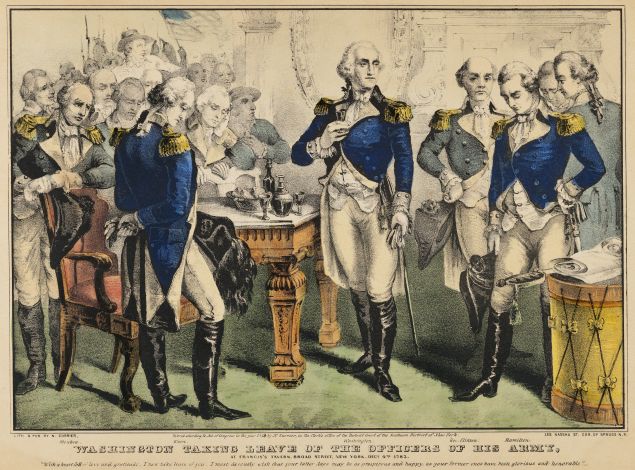
On the night of December 4, 1783, nine days after the British finally cleared out of New York, George Washington walked up a staircase on Pearl Street into a low-ceilinged room above a tavern, and told the men who had won him a country goodbye. He embraced each officer, walked out to the Battery and boarded a barge bound for Annapolis to resign his commission. The upstairs room is still there. The tavern downstairs is still pouring.
This is the part of America’s 250th birthday that the brochures tend to skip. The Founding Fathers were not, by and large, museum people. They were tavern people—legislators who drafted resolutions over a Hot Ale Flip (a Colonial-era beer-and-rum cocktail), generals who quartered their officers inside inn rooms, presidents who walked a block from the White House for oysters. The country was assembled in rooms outfitted with bars, and a surprising number of those rooms are still in business. They survived British torches, Confederate cannon, Prohibition raids, urban renewal and Grubhub. Alas, not all legacies are meant to last forever. City Tavern in Philadelphia, the great Founding Father canteen, has been closed since 2020. McCrady’s in Charleston, where Washington was fêted in 1791, didn’t survive the coronavirus pandemic. But with these 19 bars, there’s plenty to celebrate leading up to the Fourth.
The Best Bars to Celebrate the 4th of July
Fraunces Tavern
54 Pearl Street, New York, NY 10004
The most consequential drinking room in American history sits on the southern tip of Manhattan—a Georgian brick walk-up that has been serving food and drink since King George II was on the throne. On December 4, 1783, Washington summoned his Continental Army officers, including Henry Knox and Baron von Steuben, to the second-floor Long Room and bid them farewell: “With a heart full of love and gratitude, I now take leave of you.” The Long Room upstairs is preserved as part of the Sons of the Revolution museum, but the ground floor operates as an independent bar and restaurant with a serious cocktail program and an annual reenactment every December 4. Tavernkeeper Samuel Fraunces—likely Black or mixed-race, called “Black Sam”—went on to become Washington’s presidential steward. Order the punch.
Fraunces Tavern.
Fraunces Tavern
The White Horse Tavern
26 Marlborough Street, Newport, RI 02840
The National Park Service calls it the oldest operating tavern in America, and the math backs it up: this gambrel-roofed clapboard was already a century old when the Revolution started. William Mayes pulled Newport’s first liquor license here in 1687 to sell “all sorts of strong drink.” The Rhode Island General Assembly met in the dining room, the criminal court convened upstairs, and Hessian mercenaries quartered inside during the British occupation from 1776 to 1779. The pinewood floor, 95 percent original and once treated with whale oil, has the spongy give of a thing that has held three-and-a-half centuries of weight. A 13-star flag hangs in the dining room, where the cavernous fireplaces are sized for cooking whole deer and the duck Scotch egg is the kitchen’s trump card. So is the beef Wellington.
The White Horse Tavern.
The White Horse Tavern
Warren Tavern
2 Pleasant Street, Charlestown, MA 02129
Named for Dr. Joseph Warren, the Sons of Liberty leader who dispatched Paul Revere on his ride and was killed two months later at Bunker Hill, Warren Tavern was one of the first structures rebuilt after the British torched Charlestown in 1775. Washington stopped in for refreshments in 1789 while visiting his cabinetmaker friend Benjamin Frothingham. Paul Revere ran the King Solomon’s Lodge of Masons that met upstairs for two decades, with Revere himself as Grand Master. The ceilings are low enough that you can picture a six-foot-two Virginian ducking his head. Charlestown’s Bunker Hill 250 programming is anchored here through 2026, and the locals still recite the line: there would be no July 4th without June 17th. Order the New England clam chowder and a pint of something local.
The Griswold Inn
36 Main Street, Essex, CT 06426
“The Gris” opened the year of the Declaration, supplying food and lodging to the shipbuilders working on Connecticut’s first warship, the Oliver Cromwell. In April 1814, around 130 British marines occupied the inn during a War of 1812 raid that burned 28 Essex ships—one of the worst attacks on American soil that everyone has now forgotten about—and demanded a hot Sunday breakfast before heading back to their boats. The inn still serves the “Hunt Breakfast” every Sunday in commemoration. The Tap Room is a 1735 schoolhouse that was rolled to the site by oxen in 1801. The ceiling is original crushed-clamshell-and-horsehair plaster. In the Gun Room, a Revolutionary musket was discovered with a hidden note in its barrel: “My dear son Jared, I send you this my gun, do not handle it in fun, but with it make ye British run.”
The Griswold Inn.
Caryn B. Davis
Old ’76 House
110 Main Street, Tappan, NY 10983
The Orangetown Resolutions, an early protest document against the Crown, were signed on this site on July 4, 1774—two years before the Declaration. The tavern served as Continental Army headquarters during the Tappan encampment and held Major John André, the British spy caught with Benedict Arnold’s plans to surrender West Point, from September 25 to October 1, 1780. Washington personally denied André’s request to die by firing squad rather than the rope, and he was subsequently hanged on the hill behind the tavern on October 2. An inverted portrait of Benedict Arnold still hangs over the fireplace as a deliberate insult. The menu offers Eggs Benedict Arnold without irony. The dining room ceiling beams are original; the fireplaces are wide enough to walk into. A confession: the prime rib is excellent. A second confession: the historical drama outpaces the cocktail list.
Old ’76 House.
Shutterstock
McSorley’s Old Ale House
15 East 7th Street, New York, NY 10003
At McSorley’s, expect two beers, light or dark, served in matched pairs of small mugs. The only menu addition in 50 years was a Feltman’s hot dog. Lincoln stopped in after his February 1860 Cooper Union address; the chair he sat in is kept behind the bar. Grant came, then Teddy Roosevelt, JFK, Boss Tweed, Harry Houdini, Woody Guthrie and John Lennon. The Fighting 69th Infantry made it their de facto headquarters during the 1863 Draft Riots. Above the bar hangs an original 1865 wanted poster offering $100,000 for John Wilkes Booth. Houdini’s handcuffs hang from the rafters. The wishbones suspended from the gas chandelier were left there by World War I doughboys heading to Europe—the ones still hanging belong to the men who didn’t come back. The tradition continues through Iraq and Afghanistan. The motto carved into the back wall: “We were here before you were born.”
McSorley’s Old Ale House.
McSorley’s Old Ale House
McGillen’s Olde Ale House
1310 Drury Street, Philadelphia, PA 19107
Tucked into Drury Street, an alley between 13th and Juniper, McGillin’s opened the year Lincoln was elected. The Irish immigrants who founded it raised 13 children upstairs. Union soldiers reportedly celebrated the surrender at Appomattox here in 1865. The bar survived the 1918 flu, Prohibition (operating as an “ice cream parlor” with a tea room upstairs that was definitely not a speakeasy) and Covid. Every liquor license the bar has held since 1871 is framed on the walls, with one telling gap for the dry years. The original wooden “Bell in Hand” sign hangs above the bar, surrounded by reclaimed signage from defunct Philadelphia institutions—Wanamaker’s, Strawbridge & Clothier, an F.W. Woolworth subway tile—a kind of municipal taxidermy. Order the Yards-brewed McGillin’s 1860 IPA and a roast beef sandwich. The Irish stew won’t disappoint either.
McGillin’s Olde Ale House.
McGillin’s Olde Ale House
Gadsby’s Tavern Restaurant
138 North Royal Street, Alexandria, VA 22314
The 1785 building next door is a city museum; the 1792 City Tavern half is a working restaurant and bar. Washington attended his Birthnight Balls here in 1798 and 1799. Jefferson held his inaugural banquet in the dining room in 1801. Madison, Monroe, Adams, Hamilton and Lafayette all dined here. The original ballroom woodwork was sold to the Met in 1917 and is still on view in the American Wing—what you see today is a careful reproduction of the original room. Yards Brewing’s “Ales of the Revolution” are on tap: Washington’s Tavern Porter, Jefferson’s Tavern Ale and Poor Richard’s Spruce, brewed from a Franklin recipe. The annual Birthnight Ball reenactment in February is the centerpiece of Alexandria’s America 250 calendar.
Gadsby’s Tavern Restaurant.
Gadsby’s Tavern Restaurant
Round Robin Bar
1401 Pennsylvania Avenue NW, Washington, DC 20004
Inside the Willard Hotel, a block from the White House, the Round Robin is the bar that runs the country between hearings. Senator Henry Clay introduced the mint julep to Washington at this circular mahogany bar. Lincoln stayed at the Willard for the 10 days before his 1861 inauguration. Julia Ward Howe allegedly wrote “The Battle Hymn of the Republic” upstairs. Mark Twain, Walt Whitman and Ulysses S. Grant—who reportedly coined “lobbyist” while smoking cigars in the lobby—were regulars. Dr. Martin Luther King Jr. finalized the “I Have a Dream” speech in a Willard room hours before delivering it on August 28, 1963. Bartender Jim Hewes has worked the Round Robin for more than 25 years across six administrations and assigns each president a personal drink. In summer, he stirs more than two dozen Maker’s Mark juleps a day.
Round Robin Bar.
Round Robin Bar
Old Ebbitt Grill
675 15th Street NW, Washington, DC 20005
D.C.’s oldest bar and restaurant, also a block from the White House, in a different direction. William McKinley lived in the original Ebbitt House while serving in Congress; the Washington Post reported his 1897 inaugural party booking on November 22, 1896. The building was nicknamed “Army and Navy Headquarters” through the 1860s. Ulysses S. Grant, Andrew Johnson, Grover Cleveland, Teddy Roosevelt and Warren G. Harding all reportedly drank here. The animal heads above the main bar are credited to Roosevelt’s hunting trips. Clyde’s Restaurant Group bought the place at a 1970 auction for $11,200 and moved it to its current location in 1983, bringing the F Street antique clock, Charles B. Shefts’s carved-glass panels of the Treasury, Capitol and White House, and an iron-spindled marble staircase rescued from the old National Metropolitan Bank.
Old Ebbitt Grill.
Old Ebbitt Grill
Dobbin House Tavern
89 Steinwehr Avenue, Gettysburg, PA 17325
The oldest building in Gettysburg opened the same year as the Declaration. Reverend Alexander Dobbin built it; his abolitionist son, Matthew, carved a three-foot crawl space between the first and second floors to hide escaped enslaved people moving north on the Underground Railroad. The space is still there, visible from the dining room. The tavern served as a Union and Confederate field hospital after the July 1 to 3, 1863, battle, and Lincoln’s procession to deliver the Gettysburg Address passed in front on November 19, 1863. Seven fireplaces, native stone walls and six themed dining rooms—including one where guests eat in a four-poster bed. The basement Springhouse Tavern is built around three natural springs that still flow under the floor.
Dobbin House Tavern.
Dobbin House Tavern
The Pirates’ House
20 East Broad Street, Savannah, GA 31401
The adjoining Herb House, dating to 1734, is the oldest standing structure in Georgia. By the 1750s, the inn was serving sailors at the edge of the colonial port. Robert Louis Stevenson immortalized Savannah in Treasure Island—”I was with Flint when he died at Savannah,” says Long John Silver—and pages from a rare early edition hang framed in the Captain’s Room. Fifteen dining rooms now spread under peg-beam ceilings, with an “Old Rum Cellar” beneath the Captain’s Room. The Shanghaiing tunnels and Captain Flint’s ghost are local legend; the building’s age, the colonial seaport context and the Treasure Island connection are all genuine.
The Pirates’ House.
The Pirates’ House
Old Talbott Tavern
107 West Stephen Foster Avenue, Bardstown, KY 40004
Old Talbott Tavern predates the town it sits in, and calls itself the oldest bourbon bar in the world, which actually understates the case. Daniel Boone gave a deposition here in April 1792. Louis-Philippe of France—the future king, then exiled—arrived October 17, 1797, and a member of his entourage painted murals on the wall (which were badly damaged in a 1998 fire). A young Abraham Lincoln stayed here around age six or seven, in 1812, while his parents fought and lost a land-title lawsuit that drove the family to Indiana. Andrew Jackson, William Henry Harrison, Stephen Foster and General George Patton all drank here. Jesse James—a relative of Bardstown’s sheriff—reportedly fired at the painted birds in the Louis-Philippe murals after one too many drinks.
Old Talbott Tavern.
Old Talbott Tavern
Napoleon House
500 Chartres Street, New Orleans, LA 70130
The mayor who built Napoleon House, Nicholas Girod, supplied militia and provisions to Andrew Jackson before the Battle of New Orleans on January 8, 1815. The legend that Girod schemed with Jean Lafitte to smuggle the exiled Napoleon here from St. Helena is unproven, but it gave the place its name. The Impastato family ran it for 101 years, from 1914 to 2015, and introduced the Pimm’s Cup to America somewhere between 1915 and the 1930s. The bar still sells more Pimm’s Cups than any establishment on earth, and serves a warm muffuletta, toasted, which is the local heresy. Beethoven’s Eroica Symphony, originally dedicated to Napoleon, plays on a loop. The walls are patinated nearly black, the courtyard banana trees lean over the wrought-iron tables and the old wooden bar is hollowed by a century of elbows.
Napoleon House.
Napoleon House
Tootsie’s Orchid Lounge
422 Broadway, Nashville, TN 37203
The youngest bar on the list is indispensable to the cultural-patriotic frame. Tootsie’s sits one alley behind the Ryman Auditorium, home of the Grand Ole Opry from 1943 to 1974. Willie Nelson said it best: “It’s 17 steps to Tootsie’s and 34 steps back.” Hattie “Tootsie” Bess kept a cigar box of IOUs for broke songwriters—Willie Nelson, Kris Kristofferson, Waylon Jennings, Roger Miller, Patsy Cline, Tom T. Hall and Loretta Lynn all cashed her informal credit. Roger Miller wrote “Dang Me” here. Nelson got his first songwriting gig walking out the back door. The garish purple paint job was an accident—debt-paying contractors used the wrong color, and Tootsie kept it. She was buried in 1978 in an orchid gown, in an orchid casket.
Tootsie’s Orchid Lounge.
Tootsie’s Orchid Lounge
Buckhorn Exchange
1000 Osage Street, Denver, CO 80204
Founded by Henry “Shorty Scout” Zietz, who scouted with Buffalo Bill Cody, the Buckhorn holds Colorado Liquor License No. 1—the very first issued when Prohibition ended in 1933, still framed on the wall. Theodore Roosevelt dined here in 1905 when his presidential train stopped in the Rio Grande railyard across the street, and afterward asked Zietz to be his hunting guide. The flag from Roosevelt’s train hangs in the upstairs lounge. FDR, Eisenhower, Carter and Reagan followed. JFK’s 1961 Colorado fishing license is on a wall. Five hundred and seventy-five taxidermy mounts line the room, alongside a 125-piece antique gun collection and a white-oak bar built in Essen, Germany, in 1857 and shipped by oxcart from New York. Order the Buffalo Bill Cocktail, which is really just bourbon and apple juice and was reputedly Cody’s poker drink, and a plate of buffalo, elk or rattlesnake.
Buckhorn Exchange.
Buckhorn Exchange
The Palace Restaurant and Saloon
120 South Montezuma Street, Prescott, AZ 86303
This is Arizona’s oldest bar and the spiritual heart of Whiskey Row. Wyatt Earp, Virgil Earp and Doc Holliday drank here before decamping to Tombstone—Virgil lived in Prescott as town constable. The defining anecdote happened on July 14, 1900: as the Whiskey Row fire raced through downtown, regulars hauled the massive hand-carved Brunswick bar across the street to Courthouse Plaza and kept drinking while the building burned around their old spot. They rebuilt by 1901 around the same bar, which is still in use—24 feet of solid oak with a cherry top and French plate-glass mirrors, originally shipped around Cape Horn from New Jersey to San Francisco and packed in by mule. Theodore Roosevelt visited in 1907 to commission a statue of Rough Rider Bucky O’Neill. Bullet holes are still visible in the pressed-tin ceiling.
The Palace Restaurant and Saloon.
The Palace Restaurant and Saloon
The Occidental Hotel & Saloon
10 North Main Street, Buffalo, WY 82834
At the foot of the Bighorns on the old Bozeman Trail, this was Owen Wister’s drinking room: the climactic shootout in The Virginian—”When you call me that, smile”—is set on the street outside. Buffalo Bill, Calamity Jane, Teddy Roosevelt, Tom Horn, Butch Cassidy and the Sundance Kid (whose Hole-in-the-Wall hideout was nearby) and Hemingway all stayed here. The Johnson County Cattle War of 1892 swirled through the lobby. The original imported back bar carries 23 still-visible bullet holes. Cowboy spur scrapes mark the back stairs, and a six-shooter indentation creases one room door. Rescued from the wrecking ball in 1997—the building was eight weeks from demolition—and now houses 18 themed rooms and a Thursday-night bluegrass jam that has run 16 years and raised a quarter-million dollars for charity.
The Occidental Hotel & Saloon.
The Occidental Hotel & Saloon
Saloon No. 10
657 Main Street, Deadwood, SD 57732
Wild Bill Hickok was shot dead by Jack McCall during a poker game on August 2, 1876, holding two pair, aces and eights—the original “Dead Man’s Hand.” That actually happened at Nuttall & Mann’s Saloon, later renamed Saloon No. 10, at 624 Main Street—across the street and down the block from today’s bar, on a site that burned in the 1879 Deadwood fire. The current Saloon No. 10 was conceived as one of America’s first theme bars in 1938 and now holds South Dakota’s largest whiskey selection, sawdust on the floor and a “Wild Bill’s Death Chair” displayed in a velvet-lined illuminated case above the front door, though current owner LuAnn “Louis” LaLonde concedes the chair’s authenticity is doubtful. The murder is reenacted multiple times daily. A competing “Wild Bill Bar” at the actual original 624 site has reclaimed the “Original Location” branding since 2013, which is part of Deadwood’s particular charm.
Saloon No. 10.
Saloon No. 10
