India’s rise in the global art market has been well-charted, though it’s perhaps less well-known that mega-collector and patron Kiran Nadar has, in part, led the charge. She was able to bring in Manuel Rabaté, the longtime director of Louvre Abu Dhabi, as the director of the Kiran Nadar Museum of Art (KNMA) ahead of the unveiling of its landmark building spanning more than one million square feet in Delhi. Set to become the largest integrated cultural center in India, spanning centuries and categories in both spatial and acquisitive scope, the museum will have multiple exhibition spaces, a performing arts center, a library and archive center, an education center and several restaurants.
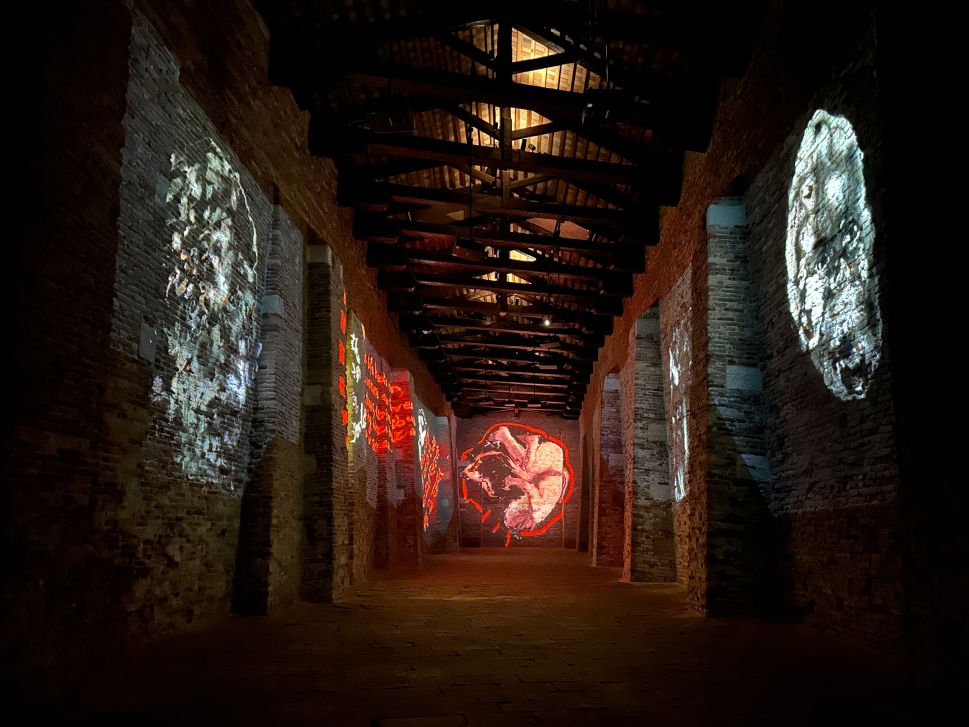
In addition to opening India’s first private institution dedicated to modern and contemporary art, Nadar has also been behind some of the recent records for Indian artists, most recently buying M.F. Husain’s record-breaking large-scale 1954 painting Untitled (Gram Yatra), which sold for $13.8 million at Christie’s New York last October. On the occasion of the opening of Nalini Malani’s striking show “Of Women Born” at Magazzini del Sale, an official collateral event of the 2026 Venice Biennale supported by KNMA, Observer sat down with Nadar—who is arguably one of India’s most influential arts patrons—to discuss her vision and priorities.
Nadar’s museum has been in the making for years, but finding the right space took time. KNMA, a non-commercial, not-for-profit institution supported by the Shiv Nadar Foundation, dates back to 2010. “It was not an immediate decision to start a museum. It had been there on the annual agenda for a long, long time,” she clarified. “We had another space that didn’t work out, and we had an architectural committee that decided on the architect for the project, and that was given to David Adjaye at Adjaye Associates. The work started about four years ago.”
But why build a museum of this size? “I think it’s important. We have a large collection today, and I want the collection and art to be visible to all sections of society, not just to the affluent, but going down to laypeople as well,” Nadar candidly replied. “That is why the space is as large as it is. We have a museum and a cultural center in the space, so we are going to do a lot of cultural activities with theater, dance, music and other forms of culture.”
Nadar started collecting around 1989, and in the beginning, she had no intentions of building a museum. “I was building my home, and I wanted to collect a few works for that home,” she explained. “I looked at the artists I knew and understood so I started by collecting moderns.” She then became increasingly interested in art and its dynamics, and began collecting both from artists themselves and through auctions. “Soon, I had more work than wall space, so I started putting it in my husband’s office and in various places.” When space started to run low, she began placing works in storage. “I never looked at the storage, so I felt that was really not a very intelligent way to do it. I thought I might build a space where others could see my collection. That is how it started.”
By the time she opened her first space in 2010, nearly 15 years had passed since she began collecting and her collection already numbered about 500 works. “I had thought that a small space would be enough. I never thought we would be in this giant place that we are in today. That happened as I started the museum, and then my collection also grew.”
Today, the collection numbers more than 16,000 works; Nadar describes it as encyclopedic, spanning modern and contemporary art, the Bengal School, miniatures, antiquities and work by Western artists, as well. While she initially bought guided largely by instinct and personal knowledge, she now works with advisers. Nadar’s activities have also moved beyond collecting to actively supporting artists’ careers, organizing exhibitions, collaborating with institutions and promoting Indian art internationally. Over the last three years, there have been several important shows for South Asian artists in the U.K. and the U.S., and KNMA has played a role in most of them. According to Nadar, it is about visibility, engagement with the global arts narrative and giving Indian artists a voice, and the international dimension is central to the museum’s mission. The goal is not only to present Indian art within India but also to place it in the global art narrative. To this end, KNMA has established ongoing partnerships with the Barbican, Qatar Museums and MoMA.
The current show in Venice is part of KNMA’s efforts to promote the work of contemporary Indian artists abroad, marking the second time the museum has taken over the location for a major exhibition. (It has also secured the space for the next cycle.)
Emerging from a similar intention is the recently announced major exhibition of South Asian art, “The Meeting Ground: Scenes from the KNMA Collection,” organized in collaboration with Christie’s and taking place at its London location this summer, from July 16 to August 21. Curated by Akansha Rastogi with Preeti Bahadur, Avijna Bhattacharya, Premjish Achari and Srinivas Aditya Mopidevi, the exhibition will bring together modern and contemporary practices alongside folk and Indigenous artistic expression from South Asia. Starting with modernist artists like M.F. Husain, S.H. Raza, Jeram Patel, K.C.S. Paniker, K.G. Subramanyan and K. Ramanujam, many of whom are already familiar to the market and have seen rising prices, the show will trace the history of art from the 1950s to today across different centers of artistic creation in India. It will also include lesser-known but ascendant masters of Indigenous traditions such as Jangarh Singh Shyam and Jivya Soma Mashe, as well as a collaboration between Gauri Gill and Rajesh Vangad. Another exhibition of works from the collection will follow in September, she anticipates, this time in collaboration with MoMA in New York.
Nadar acknowledges that Indian art has gained stronger recognition, but she believes it remains undervalued compared with other Asian markets, such as China. In the last couple of years, however, prices and collector interest have risen significantly, and she is very optimistic. “Earlier, collectors had very small budgets. Today, they have increased their budgets. And there is a general interest in art,” she affirmed. Yet she sees that most of this new energy is focused on Indian art, partly because Western art is much more expensive.
With the museum, Nadar aims to stage dialogues both between periods and between national and international names, unfolding a story of cultural exchange and mutual influence. “There have been different resonances between Indian art and Western art. If we look at the Impressionist phase of art, it was fascinating. We had different ways in which Indian art was appreciated through the recent Modern art history,” she said. “At our opening, we will have a few Western artists as well, but they will mainly be artists with some connection to India, like Anish Kapoor, Raqib Shaw or Bharti Kher. They are all artists who have some sort of linkage with India.”
This is not the first time she has contributed to this kind of intercultural dialogue. In spring 2025, she was able to bring to India the first Caravaggio painting ever shown in the country, Mary Magdalene in Ecstasy, through a loan coordinated with the Embassy of Italy in New Delhi and the Italian Cultural Center, New Delhi.
At the same time, Nadar confirms that India’s art ecosystem has seen an incredible acceleration, particularly in the aftermath of Covid, when museums, galleries and cultural spaces reopened, audiences who had engaged with art online began seeking more direct, collective experiences and a new generation of collectors joined an already strong base of historical collectors with a more international view and tastes. As we also discussed in another recent interview with gallerist Roshini Vadehra (linked above), in just the past three or four years, India has seen the emergence of new galleries, a new art fair in Bombay, more private institutions working in the arts, MAP in Bangalore and Serendipity’s programming in Goa. “I feel that a lot of private people have come forward. Of course, India has a lot to offer, and we need more people to come forward, but it is gradually moving forward, with many private patrons coming together and opening horizons for the community,” Nadar said. “We have a lot of international goals. It’s more about looking inward, but also getting recognition internationally.”
On the institutional side, there are other major public museums in India, including the National Museum and the National Gallery of Modern Art (NGMA), which has just been renovated. Yet there are still not that many private museums. “People have collections, but they are for their homes and for themselves. They are not really going into the public sphere. So I think we’re among the earliest to get into that. I hope a lot more will follow,” Nadar explained. She is nevertheless hopeful, as many younger collectors are coming forward.
For Nadar, India’s return to the Venice Biennale after years of absence is another good sign. The last time it participated, in 2019, the Venice Biennale India Pavilion was the result of an agreement among KNMA, National Gallery of Modern Art (NGMA) and CII, one of the bodies that deals with industry and art. “It has taken them seven years to get back,” she says, explaining that this was partly due to internal politics and a lack of priority among certain people. She’s more optimistic now, citing a culture secretary interested in advancing Indian art and the government’s plan to convert the North and South Blocks into the Yuge Yugeen Bharat museum, which could become one of the largest museums in the world.
Nadar’s ultimate ambition is fundamentally public, with the primary goal of bringing people in to see Indian art, enjoy it, understand its potential and involve the broader Indian public. She sees this as a long-term project rather than something that can be achieved in a single year. The museum aims to include many different perspectives, though for now its immediate priority is simply opening the space. “Our first goal is to open the museum, and that is a huge task, so we need to keep our concentration going,” she said.
More art collector interviews