
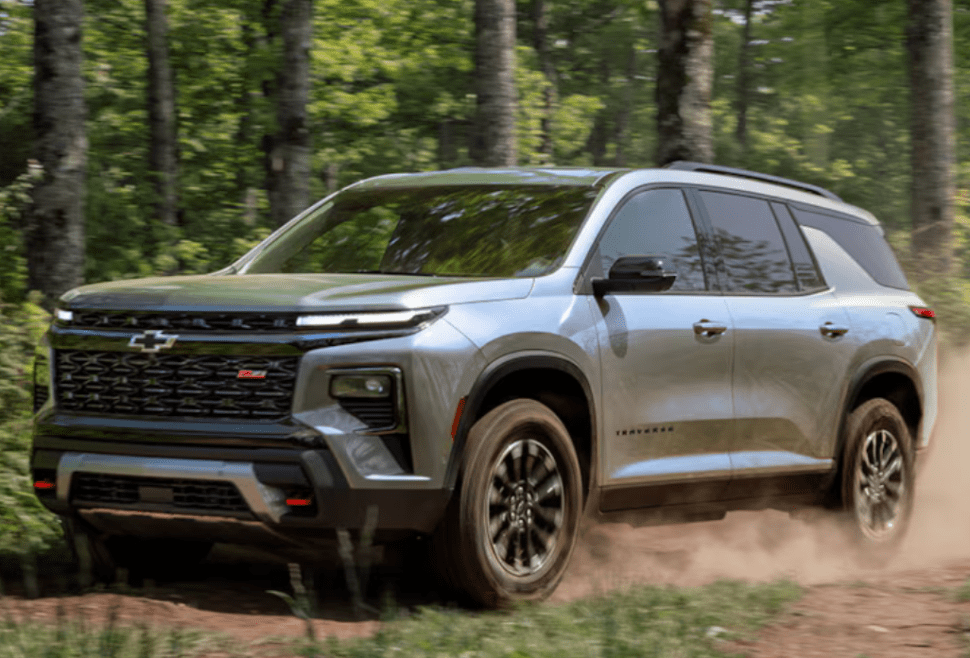
Chevrolet Traverse SUV driving quickly on a dirt trail in a wooded area, kicking up dust behind the wheels.” width=”970″ height=”658″ data-caption=’The Traverse High Country’s turbocharged 2.5-liter inline four-cylinder engine produces 328 horsepower and 326 lb-ft of torque, numbers that some drivers may find stretched thin in a vehicle weighing more than two tons. <span class=”lazyload media-credit”>Courtesy Chevrolet</span>’>
In the latest Chevrolet Traverse High Country, we’re finally getting a proper, full-size SUV. There’s none of that crossover nonsense in play with its three-row seating for seven (eight if Ozempic gets involved). Even so, the Traverse doesn’t feel as bulky or as heavy as a Lincoln Navigator or a Yukon Denali from behind the wheel. The latter machines get their own zip codes coming off the assembly line—the driver needs an intercom system to call passengers in the rearmost seats. The Traverse, by contrast, is a more reasonably scaled people carrier.
However, its engine is a big bowtie question mark. The powerplant functions up to par, and Chevy has put its capable engineering and reliable build quality into it, but it’s undeniably small for a vehicle in its SUV class. Like the other versions in its trim line, the Traverse High Country has a 2.5-liter, turbocharged inline 4-cylinder heart. While it will put out 328 horsepower and 326 lb-ft of torque with its tied-in 8-speed automatic transmission, those numbers have to serve for a 121-inch wheelbase vehicle weighing more than two tons.
Considering that the High Country AWD is meant as the brawny tough kid in the Traverse family for the off-roading enthusiast, the SUV is also expected to tow an additional 5,000 lbs. As tested, the Chevy seems adequately powered for road, freeway and moderate off-road duty, but there didn’t seem to be much to spare in the acceleration department.
As for engine durability, that all comes down to how this generation of turbochargers stand up as the miles roll along. There’s a number buzzing around gearheads these days as they shop the used car market. Whether it’s a domestic or import consumer make, if the model in play relies on a smaller high compression engine boosted by turbochargers, some experts say watch out for that 100,000-mile mark. That’s when the rubber may (or, in this case, may not) meet the road—when the car buyers discover if their turbocharged power plants hold up with advancing age.
The fossil fuel engines of decades past relied solely on cylinders, pistons, camshafts, etc. The idea of using turbochargers to boost engine power made its way from high performance engines down into consumer cars, allowing engineers to remove cylinders without sacrificing too much horsepower. Fewer cylinders then allowed for smaller overall engine sizes and less weight under the hood, often boosting fuel efficiency.
“Eco” types of all breeds are happy as turbocharged engines promise ecological and economic benefits. Still, those turbochargers are an essential engine component shouldering a lot of the strain of V6s behaving like V8s—and inline 4s driving 4,500 lbs of 2026 Chevrolet Traverse High Country AWD while it tows up to another 2.5 tons. The turbo-boosted engines would sweat a lot less pushing a sporty hatchback or crossover down the road.
Setting concerns over engine size on the back burner for a moment, the overall feature package of the $59,095 Traverse High Country remains competitive with much more expensive vehicles in its class. There’s almost 23 cubic feet of cargo space behind the third row of seats, and an auto-sense power lift gate that knows when you need to load your supplies. Outside are LED headlamps, a chrome luggage rack and high-clearance 22-inch wheels for presumed off-road operation. Interior features include a panoramic sunroof, perforated heated and cooled leather seating, heated steering wheel, a 17.7-inch touchscreen and Bose premium audio.
On the safety side, the driver snuggles down with computer assisted adaptive cruise control, blind zone steering assist, Chevy Safety Assist, collision mitigation and lane keeping assistance to monitor driver alertness. Obviously, those features aid road conditions as the High Country (despite the aforementioned off-roading ambitions) is more of a family truckster than a likely forder of streams, even with its all-wheel-drive.
Piling up all of those features and options inside and out, the Traverse High Country AWD packs most of what European SUVs of similar mass offer with price tags north of $70,000. That added value takes some of the sting out of the engine size concerns.
The driving experience is satisfactory, but there are times when you’ll find yourself longing for a couple of extra cylinders. Regardless, the Traverse handles with ease. In fact, it’s a tribute to how Chevy’s engineers (and those at other automakers putting out full-size SUVs and pickup trucks) implement electronic assisted power steering to make larger machines as easy to drive as cars half their size.
Obviously, the operator must be aware of the additional bulk, but the Traverse turns or parallel parks with no more effort than any other daily drive. And the MPG numbers are attractive for a full-size, non-electrified SUV at 20 city, 24 highway and 21 combined. All tallied, there’s much to recommend in the 2026 Chevrolet Traverse High Country AWD, potentially making it a showroom value. The only ding in its fender is that decision to ride or die with four cylinders in a full-size SUV.
