
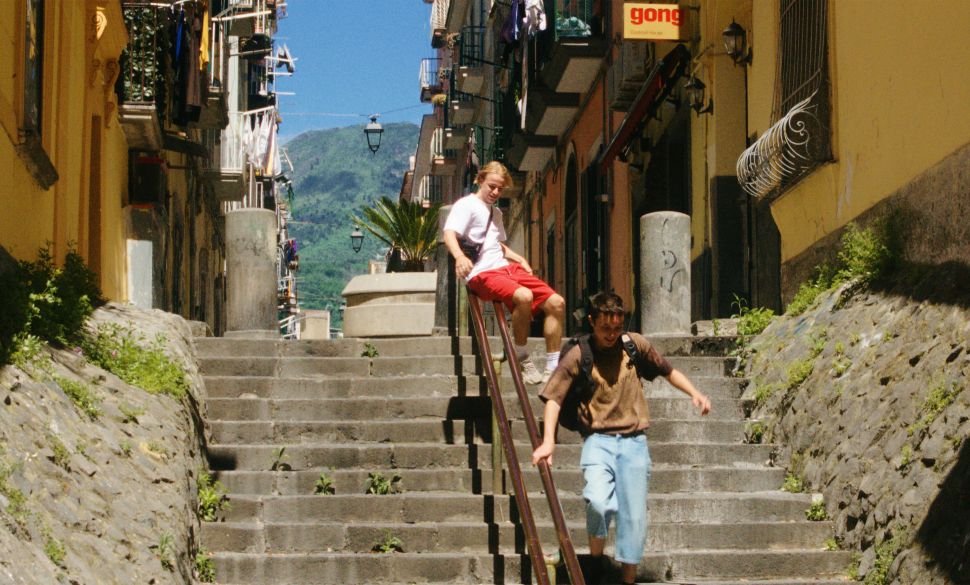
Coming-of-age clashes with oblivion in La Gradiva, a story of French highschoolers visiting the ruins of Pompeii. The Cannes Critics’ Week selection (and Grand Prix winner) marks the feature debut of director/co-writer Marine Atlan, who crafts an enormously affecting tale of volatile youths—played by incredible non-professionals—and their most thorny self-discoveries.
The film is one of homespun naturalism, but Atlan also exhibits immense formal control. The sun streams gently through train compartment windows in an early scene, as young hotshot James (Mitia Capellier-Audat) has sex with Angela (Hadya Fofana), a girl in his class. This hormonally-charged introduction is one of the few moments La Gradiva affords its characters such an up-close intimacy. Before long, it pulls back to reveal the young lovers are being watched by curious onlooker Toni (Colas Quignard), their outwardly masculine queer classmate, who ends up taken with James, but whose dynamic with him grows more curious and complex during their academic pilgrimage. Atlan’s camera, for the most part, mirrors Toni’s feelings of remove by embodying an observational, fly-on-the-wall approach to capturing soulful teenage abandon.
The Italian summer sun obscures and reveals in equal measure, creating lensed hazes at dawn and dusk, while illuminating youthful, intellectual debates during daytime. The same sunrays also light the old family photographs Toni clings to, of his mysterious grandmother in her youth, when she lived in Naples—snapshots in time, not unlike the long-preserved Pompeii. For Toni, a young man cut off from his own lineage, this excursion also presents the chance to learn more about his lost history, and about which details of his tall family tales he often gets wrong.
The movie’s sprawling ensemble is completed by fellow loner Suzanne (Suzanne Gerin), a reserved and bookish girl whose forceful opinions build before exploding, and by the children’s high-strung teacher Madame Mercier (Antonia Buresi, the only veteran actor in the bunch). Rare are the teenage films that meaningfully contrast youthful possibility with dispirited middle age, but Mercier, as the teens’ pessimistic shepherd, finds herself (more often than not) in a position to reflect on her own life’s trajectory while her students await the results of college applications.
LA GRADIVA ★★★1/2 (3.5/4 stars)
Directed by: Marine Atlan
Written by: Marine Atlan, Anne Brouillet
Starring: Colas Quignard, Suzanne Gerin, Mitia Capellier, Antonia Buresi
Running time: 145 min.
On the precipice of adulthood, the movie’s young protagonists are faced with the prospect of mortality for the very first time, as they slowly learn about the volcanic materials (or “gradiva”) and sudden eruptions that encased the ancient victims of Vesuvius. This sense of life lived, but abruptly cut short, makes for a haunting mirror to the teens’ own lives, as Angela faces the reality of being used by James, Suzanne finds uncanny refuge in Toni (a fellow outsider), and their respective emotional explosions begin to mirror volcanic eruptions—especially in the way Atlan traces the fusing of volatile emotional elements. These are teenagers in love, who hate and adore their peers in equal measure (as much as they hate and adore themselves), and whose respective understandings of the world, of art, of politics and of history come into frequent collision.
What is or isn’t, what may or may not constitute a historical offense or modern social faux pas, feels in constant flux, threatening to turn even the most mundane interactions into unpredictable skirmishes. And so, Toni walks on eggshells. This mood especially extends to his dynamic with Mercier, who believes him to have given up on his academic prospects. However, the otherwise conscientious teacher is only so attuned to his sprawling inner life—a world to which we, the audience, have a front-row seat. So when she holds the pages of his hastily-written personal assignment with her fingertips, as though disgusted by it, the impact on his psyche feels monumental.
Like the casts of long-dead Pompeians, Toni is a young man encased in plaster, usually of his own making. However, even the movie’s most expressive teens come across at a similar distance. Atlan and her co-cinematographer Pierre Mazoyer employ long, voyeuristic lenses to make even the audience feel like they’re peering in from the outside, which has the double-edged effect of making each viewer feel like an outcast to a clique, while also creating, around the camera’s subjects, an invisible, self-imposed armor.
That Toni is queer certainly plays into this emotional dynamic. But La Gradiva also treads in a more modern form of queerness, where it’s socially matter-of-fact, but its contours no less strongly shape how characters relate to each other, and themselves. For instance, the question of James’s own sexuality is a mystery the movie doesn’t feel the need to broach, beyond the fact that he might be toying with both Toni and Angela’s emotions, intentionally or otherwise. From the perspective of any nostalgic adult viewer: he’s just a dumb teenager. However, the sense of immediacy and occasion created by Atlan’s camera (and Guillaume Lillo’s free-flowing, conversational editing) imbues each word and action with monumental importance.
This is, for better or worse, the most important trip of these characters’ young lives thus far. So, its most joyous, most melancholy scenes come super-charged with the energy of youthful optimism and adolescent fear, leading to surprisingly heavy outcomes once La Gradiva is all said and done. Atlan may be a mere observer to this drama, but her aesthetic approach is so fine-tuned, so invisible and organic, that the room between the subjects and the camera becomes filled with an unpredictable texture. The image, like the plaster people of Pompeii, becomes a temporal bridge, affording viewers the ability to traverse space and time, until we’re seated alongside these characters, and reminiscing on the most emotionally enormous moments from our own formative years, and the materials that made us.
