
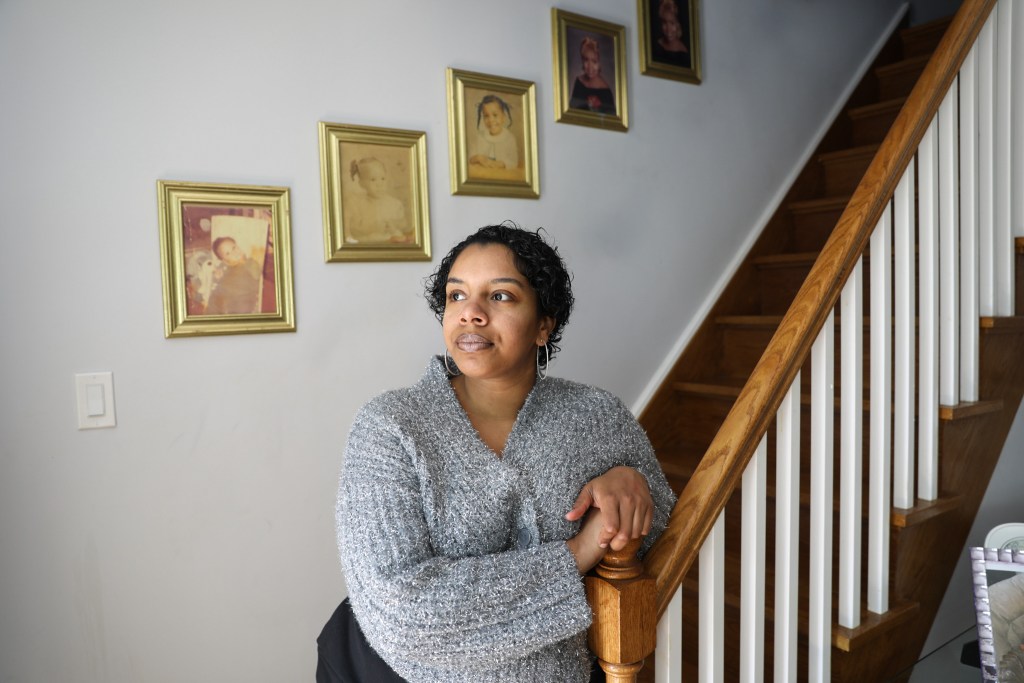
During the last mayor’s term, Sadé Singh was a face of the city’s push to allow more housing across the boroughs. Now, building that housing on her own property may be impossible.
Singh, who lives in St. Albans, Queens, wanted homeowners like herself to be able to build backyard cottages and apartments over garages, in basements and in attics.
But first, the city had to change its zoning rules, which previously forbid those types of structures — known as accessory dwelling units, or ADUs.
During the Adams administration’s push to change those rules, Singh appeared in videos, penned op-eds and lent her image and words to official informational materials about the proposal. She took time off work to accommodate photos and filming, she said.
In August 2024, a car picked her up at her home and drove her to a press conference at City Hall, where she appeared with Mayor Eric Adams and top members of his administration. Standing at a podium in the rotunda, she spoke about how ADUs represented “a lifeline for people like me” thanks to their potential to generate income and create stability.
When the City Council voted to approve the zoning changes, called City of Yes for Housing Opportunity, she got a text from one of the mayor’s communications aides: “Just passed — you now have your ADU!”
Singh was elated.
“I remember thinking, ‘Oh my god, it’s finally about to happen,’” she said.
She hoped to turn her basement into a legal apartment and rent it out, which could help offset the costs she encountered when she became a homeowner. She had shelled out to fix plumbing, the roof and the water heater, among other issues.
But more than a year later, as Mayor Zohran Mamdani succeeded Adams and New York City officially rolled out its program allowing for ADUs, Singh is no closer to building hers than she was before. Even under the newly passed rules, she’s not eligible for most types of ADUs — also sometimes called granny flats or mother-in-law apartments — and her property’s space constraints raise questions about whether she’s able to construct one at all.
“To make someone a promise like that, and to then just kind of take it away from them without any type of explanation, it’s honestly devastating,” Singh said. “It wouldn’t have bothered me so much if they didn’t personally leverage me in their communications and in their campaign.”
Priming the Pipeline
Officials touted the City of Yes as a way to unleash more housing, with ADUs as a particularly promising piece of the plan. There was pushback from many groups across the city, but after zoning reforms passed, developers and homeowners showed significant enthusiasm to start constructing ADUs, as THE CITY previously reported.
Since October 2025, the Department of Buildings has approved permits for more than 30 projects for either existing homes adding an ADU, or new construction that includes an ADU, according to a review of data.
Nearly 2,600 New York City homeowners applied to a program called Plus One ADU, which launched in November 2023 and closed in February 2024. It offered financing and technical support for eligible homeowners to build an ADU on their property. So far, more than 3,100 homeowners have applied since Mamdani reopened the program in March, according to the Department of Housing Preservation and Development. The application period remains open through June 12.
From the first intake period, more than 700 were eligible based on zoning, and of those, almost 200 submitted loan applications. So far, there are 20 projects in the pipeline from that group, per HPD.
Singh had applied to the program in the first period, but found her home was not eligible. Still, the Adams administration asked to include her in its public efforts on City of Yes, and she said officials had told her they’d follow up and work with her on the ADU after the zoning changes passed. That didn’t happen, she said.
“I feel very exploited at the situation,” she said. “I can’t tell you the level of disappointment. You’re talking about a life-changing experience.”
A spokesperson for Adams did not respond to requests for comment.
Limited by the Foot
Singh, 31, who works in corporate communications, bought her semi-attached, two-story house with a small backyard in 2020. She lives there with her younger sister, her mom and their two dogs.
After the celebratory text from an Adams aide in December 2024, Singh said she heard nothing from City Hall.
In June 2025, she reconnected with the aide on LinkedIn and realized he’d moved to another job. In the fall, he sent her a link to the press release announcing the application portal for ADUs and shared with her the number of someone she could contact in the Adams administration.
Singh never reached out, as she said she felt jaded by the experience, though she’d still eventually like to build an ADU.
“Being able to have an additional dwelling unit could completely change our lives,” Singh said. “It could allow us to either create housing for someone in our family, or it could also be a financial benefit to us to be able to alleviate some of the financial pressure of having to pay all of what comes with owning a home.”
Some of the limits Singh faces when it comes to building on her property are a matter of a few feet.
Her basement, which is actually a cellar, is not eligible for an apartment conversion: its ceilings aren’t high enough, and it doesn’t rise two feet above the curb line. She doesn’t have a garage or an attic to turn into an ADU.
It might be possible for her to build an attached ADU, but it’s unlikely given her space constraints.
An attached ADU can occupy only a third of her already quite small backyard, and be no more than 250 square feet. In the city’s collection of pre-approved ADU designs, the smallest option is 280 square feet.
“Going down even further, I think, would be a challenge,” said Basar Girit, partner at SITU, the firm behind that design. The ADU would need to comply with codes that require minimum sizes for habitable space.
And Singh couldn’t build a backyard granny flat, separate from her main house. That’s because her home is just barely outside an area that allows for them — missing it by a handful of blocks because of a last-minute carveout.
Broadly, City of Yes allows for detached backyard ADUs within a half a mile radius from most mass transit stations, though, in some select areas, the radius shrinks to just a quarter mile — including 13 Long Island Railroad stations in eastern Queens and four Metro-North stations in The Bronx.
Councilmember Nantasha Williams, who represents Singh’s neighborhood, said she pushed to limit that radius to restrict where ADUs could be built in response to community concerns about lack of infrastructure to support more neighbors.
So even though Singh’s home is within half a mile of the Locust Manor LIRR stop, she’s about three blocks beyond the quarter-mile zone where detached ADUs are allowed.
“It’s insane,” Singh said of the zone, which ends in the middle of the park directly across the street from her house.
Joanne Madhère, Williams’ communications director, said in an email that the Council member understands Singh’s disappointment, but the changes with the zones were meant to “strike a balance between expanding housing opportunities and protecting neighborhood conditions and capacity.”
City Hall is not currently working to change the ADU eligibility rules in City of Yes.
Singh is far from the only homeowner who can’t build a detached backyard ADU. Of the 702 homeowners found to be eligible for Plus One ADU in the first round of the city’s financing program, 196 of them live outside a transit zone and therefore cannot construct a backyard cottage, according to HPD.
Wil Fisher, principal at the ADU consulting firm Unit Two Development, said he frequently encounters New Yorkers who also live outside the correct area for a detached ADU — or aren’t eligible because they live in a flood-prone area.
“We’ve spoken with dozens of homeowners who were excited to build ADUs and disappointed to learn that their zoning districts made them ineligible,” he said.
Singh has also heard from neighbors in the same boat — and she said, to her, that shows the need to expand City of Yes.
“It’s a great start, but how do we evolve that to make it more inclusive? Because my situation is probably more duplicative than people realize,” she said. “It’s being marketed and promoted as like it’s for everyone, but there are actually so many limitations to actually being a part of it.”
Our nonprofit newsroom relies on donations from readers to sustain our local reporting and keep it free for all New Yorkers. Donate to THE CITY today.
The post City Hall Made Her the Face of a Housing Solution. Now She’s All But Cut Out. appeared first on The City Reporter.
