
A new generation of collectors is thinking collaboratively and finding ways to expand their impact beyond simple ownership. Among them is Annie Taylor, a born-and-raised New Yorker with an unwavering passion for art. In addition to helping with her own family’s foundation, she serves as an active trustee of the Bronx Museum, where she sits on the Acquisitions Committee. She’s also on the Advisory Board and Contemporary Art Committee of the Brooklyn Museum and is co-chair of the Metropolitan Museum of Art’s Apollo Circle. Observer sat down with Taylor to learn more about how her journey into the contemporary art scene started, how she ended up playing such an active role in New York’s contemporary art community and how she sees that role evolving as she continues to engage with today’s fast-shifting art world landscape.
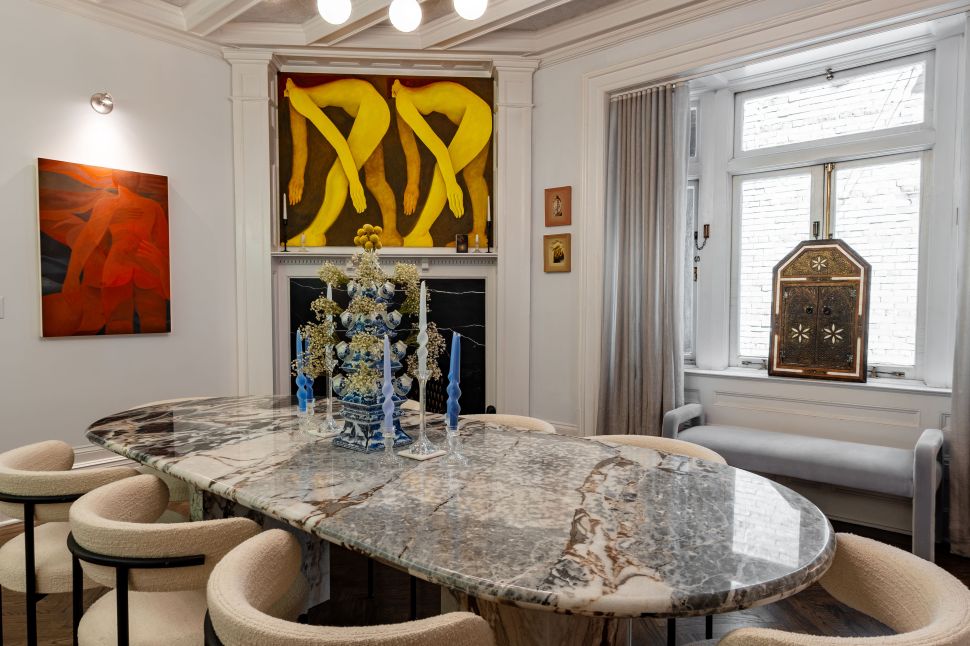
The works hanging in her Upper West Side apartment tell the story of how she crafted her own path and how her collection has been shaped by an unapologetically personal taste, along with the encounters and relationships that have marked the way. The collection on display reflects both her personality and her attitude toward the world and her surroundings.
As she walks us through elegantly decorated, never-overhung rooms, two main threads become obvious: her predilection for representations of feminine forces of regeneration, care and solidarity, and her attention to the vitality of the natural world and the organic processes of matter. “My collection is always about companionship, duality, two figures together and feminine solidarity. It reflects the values I hold in my life,” Taylor acknowledged. “The thing I care about most is my relationships: with people, with my husband, with my family. To have artwork like this around me is very special.”
While most of the pieces Taylor has collected are by women artists, this seems to stem from her being drawn to those who share similar concerns and sensibilities, rather than from a rigid collecting strategy. The pattern emerged organically through her instincts and emotional response to each work. Gender and diversity matter to her, but her first test remains immediate resonance: whether she feels drawn to the artist, the presentation and the world a work proposes.
Taylor did not come from a family of art collectors; she had to carve out a place for herself in the art world. “They had artwork on the walls, but it was all inherited. My mom is definitely getting into it because of me,” Taylor candidly said. Yet her mother often took her to the Met after school. “That was really how I developed an immense appreciation for art. It made me realize that art is enjoyable to live with every day.”
Taylor studied art history and business at Tulane after abandoning economics, then worked at Phillips, Doyle and Scope and in art logistics before stepping back to work for a tech platform. It was while working in the arts that she began buying pieces, though initially without a clear goal or intention.
The work that shifted her from buying to collecting was a small sculpture by Caio Marcolini, which she acquired at the 1-54 art fair from Gallery Nosco and which now hangs above the door of her office. She was already familiar with the artist’s work and the gallery, so she felt confident enough to act. “He was there again with the same gallery at 1-54 a few years ago, so I walked into the booth and thought, this is hour one of the VIP opening; I can get something here. I want this. I like this work. I remember this artist. I like this gallery, and it is a good program,” she recalled. The gallery’s owner told her that all the works in the booth had already sold but they had one left in the closet. She took it as a confirmation of her intuition and acquired it immediately. “I took it home to my previous apartment and hung it next to my desk. I would look at it every day,” she said, noting how that made her think about what she wanted around herself and what she wanted to collect. “Through that acquisition, I was already learning something more about myself. I learned that I’m somebody who likes the hunt, likes the game, likes to try hard. I was looking at this tiny piece, this $1,000 piece, every day, and it made me want to work harder, do more and have this thirst for something.”
Taylor now owns close to 60 pieces and thinks of her home and its furnishings as something that should adapt to the art, rather than the other way around. “When I first started collecting, or when I bought the first few pieces before I would have considered myself a collector, it was just to fill a space in my house. Now I think I need a bigger house to fit all of my work.” Smaller pieces are rotated often, while larger pieces remain as anchors. She is also thinking about future commissions, including a possible ceiling project made from canvases that could move with her to another home. She recently bought five iterations of Duyi Han’s wallpaper from his presentation at Art Basel Paris with Bank Gallery, and may re-wallpaper her entrance or bedroom with it. “I love the wallpaper so much. In my next home, I want to have every wall covered. I think it creates a magical world.”
At the beginning, doors in the New York art world did not automatically open to her—a challenge many young collectors, particularly women, know well. People wanted to know who her parents were, and when they did not recognize their names, she was not immediately of interest. Still, she found her own way in through persistence, community and a network of peers, artists and collectors who supported one another. “It’s much harder, but it’s rewarding to know that I got here through my own will and also with my network. I can only do so much alone,” she said. “Now I have this amazing group of people I can fall back on, look to for advice and who want to see all of us succeed.”
Several pieces came into the collection via personal encounters and unexpected connections. The first paintings she ever collected were acquired over DM, after a Denver gallerist messaged her while she was visiting New York. Personal relationships are central to how Taylor collects today. Her collecting is highly instinctive but not reckless, and for significant purchases she consults a trusted network of collectors and friends to see whether they have either bought the artist’s work or followed their practice closely. “I have a text thread with four other girls, and anytime we buy a work, we send it to the other girls,” she explained. “Most of the time, we end up buying a lot together.”
Taylor identified Danielle Falls as an influential point of reference in her collecting journey. “Danielle has been my greatest sounding board. We have similar tastes, similar budgets and a similar view of how we want to treat these artists and where we want to see their careers go. We’ve never once had a discussion of, ‘Let’s buy this and then sell it in six months.’ That’s never the point.”
You won’t hear her describe her collecting as investment-driven, but she does care about trajectory, community and support. If she emotionally and financially commits to an artist, she wants to help build a broader support system around them. “If I’m going to take a vested interest, a financial interest and an emotional interest in somebody, it’s not something I do lightly. You only have so much time, energy and resources. I want that to be a strong choice, and I want that choice to be affirmed by the people around me. I want my network to also get engaged.” For her, being part of a network is about the collective impact on an artist by working together. “We can all rise together. We can all do this journey together. If you want to go fast, you go alone. But if you want to go far, you go together.”
Taylor often tries to meet artists, speaking with them directly or at least inviting them for coffee when they are in New York. “It’s very important to me that I like the artists themselves, and the world they belong to,” she explained. She points to an acquisition that grew out of her former job in art logistics, when she encountered Stephanie Lucchese, a Brazilian artist who was then Mendes Wood DM’s operations director. When the two connected, Lucchese mentioned that she was also an artist and showed her some work; Taylor found herself genuinely drawn to the pieces. She eventually asked Lucchese to make something at a larger scale, resulting in what was then the artist’s largest work: a piece that stretched wall to wall in her Brooklyn studio. Lucchese did not let her see an image of it until it was completed and installed, making the process less a traditional commission than an invitation: she gave the artist the scale and trusted her to respond.
Over time, Taylor’s support for artists has extended beyond acquisition. Some of her closest friends are artists, and she tries to find ways to elevate them. “‘Can I bring you a collector? Can I bring you somebody who might be interested in getting involved or donating work?’ It’s all about who you know, but it’s also about community and companionship,” she acknowledged. She also began donating her connections’ works to museums to help secure them a place in history in real time. For instance, she donated a work by rising Mexican artist Hilda Palafox to the Bronx Museum and helped facilitate a donation of Duyi Han’s furniture to the Brooklyn Museum, among other efforts. “These are things I think about when I’m collecting and investing: how can I also help further this artist’s career? If I’m going to get behind you, I want to really get behind you.”
Philanthropy has since become as important to her as collecting, and she has embraced her role on museum boards as practically a second job. “Upholding these cultural pillars in New York is exceptionally important to me. Without the institutions, the galleries, the music, the culinary scene, New York would just be this finance hellscape. This is not a livable city without these things we get to indulge in,” she reflected. “If I can spend a portion of my life and my energy upholding at least one part of that, I feel like I’m doing a service to this city that’s given me so much.” She also sees this as a social responsibility. “If I choose to have children, I have to show them that giving back is important. It matters. It can’t always be self-serving. You have to care about your community.”
Each institution serves a different role in her life. The Met represents the institution she grew up aspiring toward, shaped by childhood visits with her mother. The Brooklyn Museum opened a community of deeply engaged supporters. And the Bronx Museum holds a special place in her heart because it was the first museum in which she became deeply involved and because of its vital role in the Bronx community.
When Taylor first joined the Bronx Museum’s acquisitions committee, she felt intimidated and unsure whether she was worthy of being involved. “I went to that first meeting, and I don’t think I said a single word. I just sat there and looked around, thinking, ‘Who is this group of people? What do they care about? What is this museum going to be like? What is this group going to be like?’” Yet she left thinking that she had something worthy to contribute. “Just because I’m one of the younger people in the group doesn’t mean I don’t have great ideas. I was resonating with what everyone else was saying. So I decided that at the next meeting, I would come with an artist I wanted to propose, a presentation, notes and things I wanted to say. I wanted to do my very best to ingratiate myself with all these other women who were actively participating in the group and see what I could get out of it. My appreciation of what was in front of me made me feel like I could give more.”
Taylor is now also considering creating a residency or foundation, potentially focused on production, sculpture and female sculptors, after observing how difficult it is for artists to produce ambitious work without major institutional or financial backing.
When asked about her biggest regret, Taylor mentions passing on a work at Liste three years ago in Basel with Margot Samel. Now, to keep pace, she tries to attend as many art fairs as possible, or at least most of them. She goes to openings every single week, but she also finds many artists she likes on Instagram. “Then I’ll see they have a show opening downtown in two weeks, and I’ll go see the work in person. And, of course, my network is very helpful.” She’s also bought a few works at auction but tries to avoid it because the format can make her too impulsive. More generally, she is not chasing blue-chip names; she wants people to be impressed by the quality and specificity of what she owns, not by the obviousness of a Picasso.
Like many young collectors, Taylor buys fluidly across categories beyond art, though she considers vintage clothing her only other collecting practice. To her, dressing is a form of daily self-curation: a way to express confidence, individuality and values. At almost 32, as an independent woman with a thoughtful and genuine sense of who she is, she wants to be sure that her choices, from what she wears to the artist she supports, align with the person she wants to be and the things she stands for.
