
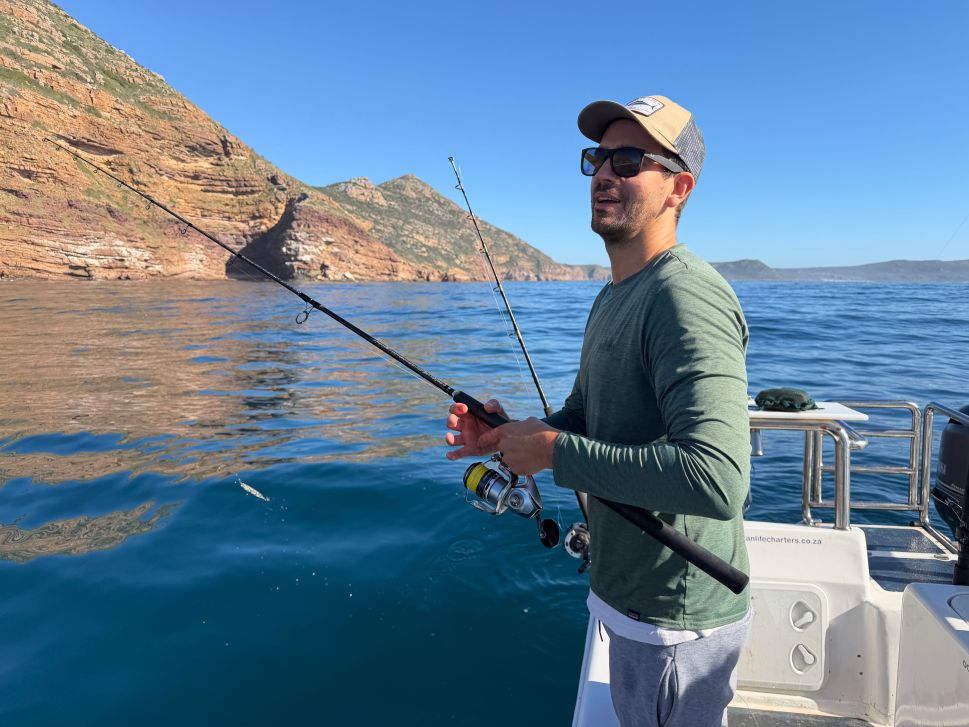
Our boat has only just arrived at Cape Point, on the far southern point of South Africa’s Cape Peninsula, when one of the fishing lines begins to pull. It’s a sunny day at the end of April, the beginning of autumn in this part of the world, and it’s yellowtail season. We are on one of many small boats circling in hopes that the fish will bite. As it turns out, today is a particularly good day on the sea.
I’m fishing with Ryan Cole, executive chef at Cape Town’s Salsify at The Roundhouse, and his brother, Donovan, a commercial fisherman who runs Ocean Life Charters and supplies a lot of the seafood served at Salsify. They’ve been fishing here since they were kids—their father, Roy, was also a commercial fisherman—but the excitement of landing a catch is still palpable. As soon as one line is reeled in, another begins to pull. After less than an hour, there are 17 enormous yellowtail lying on the boat’s deck. Another 10, at least, were thrown back because they were too small.
For an amateur angler like myself, it feels like good luck, especially since some of the other boats aren’t so prosperous. “It isn’t luck,” Cole explains later that day, back in Salsify’s dining room. “You need to be able to read the signs and the conditions. That, for me, is the magic and the romance of fishing. And that’s what cooking is, too. You need to be able to see the signs. It becomes an extension of who you are. Donovan and I have been like this on the water, but I can feel it in the kitchen, too.”
Cole, now 37, grew up in Cape Town in a self-described “poor” family. His most vivid early memories are driving from his parents’ house in the back of his dad’s old van with his crew, hauling their fishing boat behind them. He was six the first time he went out on the boat, and he still goes fishing as often as possible.
“A lot of the commercial guys are out today [fishing], who have their own boats, learned to fish with my dad,” he says. “He’s like a living legend. I watched my dad toil and slave away to craft a living and provide for his family. I knew you had to work fucking hard. For me, the ocean has always been where food is from.”
The fish we catch that morning in Cape Point can’t be sold (it has to be fished under a commercial license to do so), but it will be doled out to friends and family or donated to a local retirement home. Cole does, however, serve his brother’s catch at Salsify, paying a premium for first pick. When I dined at the restaurant a few days earlier, the yellowtail was presented raw and accompanied by coconut and mebos, a South African dried apricot. Later, Cole served kingklip, a white fish, with dressed prenia, a local succulent, and confit leek. But it isn’t just the sea that inspires Cole. Local ingredients like prenia and num num, a South African fruit, appear on the menu alongside more well-known ones.
“I spend my life outside,” Cole says. “When we’re not out at sea, I’m looking at landscapes and what’s around me. I’ve got a naturally inquisitive mind, so when I walk the dogs, I naturally veer off the path, and I’m like, ‘Fuck, what is that? Is this edible?’ I’m always looking for sources of inspiration. That’s how I got into foraging.”
All Cole ever wanted to do was become a chef. He remembers helping the lunch lady at school make sandwiches instead of joining the other kids on the playground when he was only four years old. In high school, he spent a week working in a hotel kitchen as his first apprenticeship, and was flummoxed when the chef asked him to fetch rocket—the British term for arugula.
“It was a whole new world because there were so many things we didn’t grow up with,” he remembers. “We never had Parmesan or mozzarella. For me, cheese was orange. It was all a big discovery.”
After high school, the members of his mom’s church sponsored Cole for a practical apprenticeship, which served as a substitute for a more rigid culinary school experience. Despite admittedly struggling with authority, he was hungry to learn anything he could. “My attitude was, ‘I’m going to force myself to learn, and I’m going to be really good at this, and then I’m going to take your job,’” Cole remembers.
At 21, he bought a one-way ticket to London—his first-ever flight. “I went with two suitcases,” he says. “One had my chef’s uniform and my knives. The other one had summer clothes. I had one hoodie. I landed in London in the middle of April, and it was freezing. I didn’t have a job, but I knew that I wanted to work at a place like The Square.”
His first gig was at Lawson Place, where he was put through the wringer before landing at The Square with chef Phil Howard. It surpassed his expectations. “That was its golden era, because they were trying to push for three Michelin stars at that time,” Cole notes. “So it was on everyone’s lips. It was just crazy the amount of talent that was in that kitchen over those three or four years. Phil’s approach is so restrained with beautiful ingredients, beautiful cooking, no fluff.”
Cole moved back to Cape Town in 2015 and eventually became head chef at The Test Kitchen, South Africa’s top restaurant at the time, under Luke Dale-Roberts. In 2018, he and Dale-Roberts had the opportunity to take over the restaurant space at The Roundhouse, a hillside historic building on the edge of Table Mountain in Camps Bay. The Roundhouse has a complicated past, rooted in the country’s tumultuous colonial history—it was an 18th-century guardhouse for the Dutch East India Company and later a British hunting lodge.
The building itself inspired the restaurant’s name. Cole dubbed it Salsify, after a root vegetable he first encountered at The Square.
“It’s a beautiful vegetable,” he says. “The most incredible thing. It’s like an ‘aha moment’ when you cook it and eat it—like the world stops. The first time we walked in here, I said to Luke, ‘This place is like salsify. It’s sandy and gritty and disgusting, but if you peeled it back, you could get something really beautiful out of it.’”
Salsify at The Roundhouse opened in October 2018. The initial team consisted of only six people, including Nina du Toit, whom Cole met at The Test Kitchen. She’s now Cole’s romantic partner as well as the restaurant’s head chef. “We’ve been together since we opened Salsify, so I’ll never forget our anniversary,” Cole jokes.
Initially, there wasn’t much of a vision for Salsify’s menu. It began as an à la carte offering for lunch and dinner, but soon evolved into a tasting menu. Now, it’s a 10-course chef’s tasting menu, priced at approximately $130 per person.
“Because I came from running The Test Kitchen, which was not my restaurant, I had to actively not cook what I would intuitively cook there,” Cole says. “So it was like untraining and retraining. I had to develop a completely new style. And I was still pretty young at the time, so I was still trying to figure out what I was trying to say with food.”
Cole admits he still isn’t completely sure what he wants to say with food. He likes to put the focus on his ingredients and to pay homage to his home country, as well as the building and location of Salsify. The food is South African because he is South African, but other than that, he doesn’t know what defines the food here.
“South Africa also doesn’t have much of a culinary identity,” Cole says. “With it being such a melting pot of so many different cultures, there isn’t one voice. I think we’re still very much developing it. But because we’re in a national park and in this historic building, I feel like we have to tell the story of where we are. It’s our responsibility to dig deep into South African culture and look past the obvious.”
An example is the Karoo lamb dish, a take on a South African “Seven Colours” meal. It’s traditionally served for lunch on Sundays and often includes meat, rice, vegetables and slaw. It seemed like an obvious thing to do, but Cole wanted to celebrate the local heritage and the communal feeling the meal generates. Salsify’s version includes lamb, rice and vegetable purees, as well as a lamb rib skewer on the side.
“The lamb rib is based off of Donovan’s favorite way to eat lamb,” Cole says. “You cook it for five hours and get too drunk to know that it’s still on the fire and forget about it. It’s these kinds of playful interactions that contribute to the main course. Our service has a high level of detail, but I wanted to be approachable. The first time I ate in a fine-dining restaurant, which was The Square, it was the worst experience in the world. You feel like an imposter. I don’t want people to feel like that here.”
For Cole, it’s important to continue to reinvent Salsify. He changes out the décor in one of the dining rooms on a regular basis—it’s currently adorned with hundreds of elegantly folded old menus—and the menu is always evolving. He discovers a new ingredient almost weekly. Everything on the menu is sourced in Africa, including the caviar, which comes from Madagascar. Cole works with local farms, like Meuse Farm, which grows ingredients specifically for his menus. He’s always trying to do something new or something better. Since Salsify became independent from Dale-Roberts’ restaurant group in 2021, Cole has been the sole creative voice and can do whatever he wants.
“We need to challenge ourselves because it’s human nature to want to do the same thing over and over,” Cole says. “But that equals death. It’s very difficult to constantly put yourself under that and through that, but at the same time, it forces you to go, ‘Well, fuck it.’ Today, I want to go sideways. Tomorrow, I want to walk backwards. And we can do it. Nobody is telling us we can’t.”
Along with Salsify, Cole now helms Coy, a more casual, African-inspired restaurant in Cape Town’s V&A Waterfront, and Cabo Beach Club. He also runs the adjacent The Lawns at the Roundhouse, a beer and pizza garden. During the busy summer season, this means managing up to 500 employees across the four restaurants. But Cole isn’t daunted by the logistics. He wants to keep refining, keep improving and keep making his teams happy.
“I want everyone who works for me to do well, and I want the restaurants to do well,” he says. “This idea of ‘the best’ doesn’t exist. I want us to be everyone’s favorite in everything we do. I just want people to be like, ‘Fuck, I love that place so much.’ I want this to last, and I want this to be sustainable, and I want us to push as far as we can with what we have and see where it takes us. Because I don’t know what the end looks like.”
When we visit Meuse Farm, Cole and Du Toit showcase a traditional braai, a process of cooking over a wood fire. It’s not, as I’m told multiple times, the same thing as a barbecue. Cole cooks a whole yellowtail, caught by Donovan earlier in the week. After rotating it on the fire, Cole does almost nothing to it, instead presenting the fillets with lemon zest and salt. More yellowtail is sliced and served raw with some of the farm’s herbs and Salsify’s own hot sauce. Prenia reappears in a salad with charred broccoli. It’s a simpler version of Cole’s food, but it exemplifies his curiosity about what’s possible.
“This is one of the most beautiful places in the world,” Cole says. “For me, Cape Town is paradise. Salsify is a story of our journey of discovery of where we are. I want it to be an expression of South Africa.”
By showcasing the country’s bounty, an unexpected array of textures and flavors, Cole is doing just that. As it turns out, he is completely clear on what he wants his food to say.
