
The World Cup Final is coming to the New York region, but the real spectacle was never going to be confined to the stadium. For one month, the tournament turns the city into a moving festival of national identity, hospitality economics, fashion peacocking, neighborhood ritual and logistical brinkmanship, all layered atop the usual New York performance of trying to appear blithely effortless while visibly overheating.
The first serious New York pitch for a World Cup final happened in a Midtown steakhouse in 2009, when a delegation of civic boosters gathered around a long table at Smith & Wollensky and set about convincing FIFA that the region could stage the largest sporting event on earth without collapsing into its customary tri-state psychodrama. Sixteen years later, the final arrives at MetLife on July 19. The tournament runs from June 11 through July 19, with 48 teams, 104 matches and eight games at the venue, temporarily—and not especially convincingly—rechristened “New York New Jersey Stadium.” FIFA got the tournament and New York got the atmosphere. Those are different products, and only one of them requires a ticket.
Ahead, a version that survived a summer’s worth of vetting. The inside-the-stadium math is brutal and quickly dispatched: Official hospitality packages run from four figures into the high five, and the most expensive tier in the entire tournament is being sold right here. The far more rewarding month happens everywhere else, on rooftops, behind the unmarked doors of members’ clubs, along the immigrant corridors that have always treated a match as a community event and out in the beach towns where the watch party is practically a native art form. Here’s what you can look forward to.
Celebrating the World Cup Like a NYC Local
The Stadium-Side Arms Race: What You’re Actually Buying
Nobody needs convincing that the stadium is the center of gravity. The real question is how much humiliation your expense account can absorb to sit inside it. On Location handles FIFA’s official hospitality packages, and the escalation is swift. The Pavilion is the threshold tier, a shared lounge and upgraded seat for people unwilling to spend halftime pressed against a beer line beside a dude painted entirely in Dutch orange. Champions Club and Trophy Lounge move into private entrances, plated service and stemware optimistic enough to survive extra time. Pitchside Lounge gets truly absurd in the best possible way: field-level couches a few yards off the touchline, close enough to hear tactical instructions ricochet between accents. The MetLife Venue Series, covering all eight regional matches plus the final, starts around $8,275 per person and climbs beyond $68,000. Single-match suites begin near $43,000, while full boxes veer into six-figure territory more commonly associated with art fairs and discreet tax jurisdictions. None of it includes parking, because there is no general parking at MetLife on match days. The shuttle from Port Authority is effectively the only civilized option, and even that requires a ticket. FIFA, naturally, has monetized scarcity with the efficiency of a luxury conglomerate.
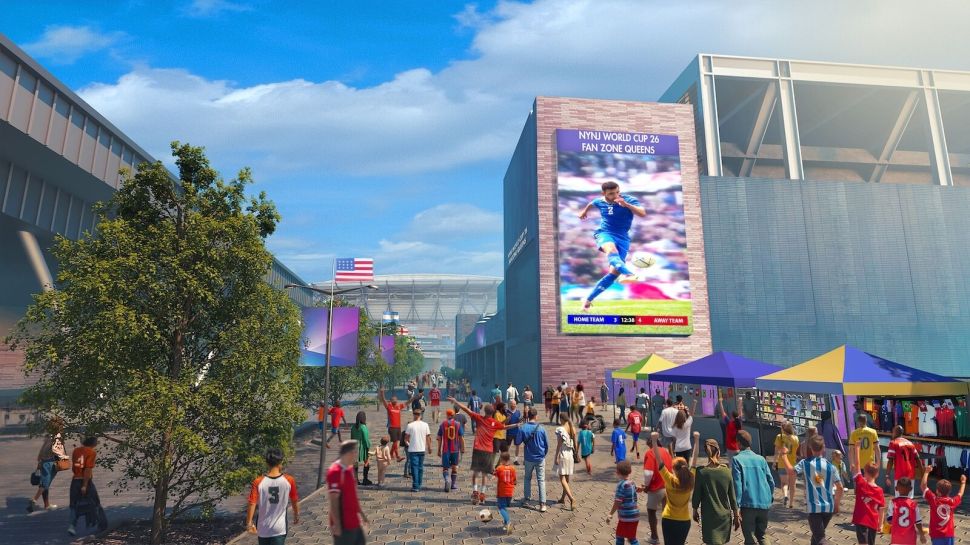
The Fan Zone Queens.
The Fan Zone Queens
The Hotels Doing the Most
New York hotels have approached the tournament the way fashion houses approach Cannes, with varying degrees of admiration and awe. The Peninsula New York abandoned both immediately. Its World Cup package includes two suites, five nights, chauffeured transfers, private shopping appointments and in-room viewing setups. The rate for July 14 through 19 is up to $500,000 for two guests, which places it somewhere between oligarch wedding logistics and sovereign-wealth off-site retreat. More egalitarian—ironic for a members’ club—is Soho House Meatpacking, which is hosting opening-week screenings, rotating menus tied to competing nations and a final-weekend takeover centered around a still-unannounced performer. Members can reserve private screening rooms for hosted dinners, where the real tournament economy emerges, away from branded fan zones and activation jargon. At the more survivable end of the market, Moxy’s “Summer of Soccer” package bundles welcome cocktails, daily credits and transportation to matches for travelers who would rather spend money on the city than on imported marble bathrooms.
The Peninsula Hotel.
The Peninsula Hotel
The Restaurants Cooking by Country
For six weeks, New York’s restaurant scene will reorganize itself around flags, kickoff times and national anxiety. Along Roosevelt Avenue, taquerías will rearrange entire dining rooms around El Tri fixtures with greater operational competence than most consulting firms. A few places warrant reservations well in advance. Cuerno, Enrique Olvera and Oriol Mendívil’s Mexican chophouse near Rockefeller Center is the obvious table and the correct one, its position one block from the Telemundo Fan Village, meaning the city’s largest official gathering effectively spills onto the sidewalk outside. In Long Island City, Beija Flor has operated for more than a decade as New York’s unofficial Brazilian clubhouse, fueled by caipirinhas, samba and watch parties calibrated directly to the scoreline. Nearby, Point Brazil is the deeper cut: Bahian sisters Elzi and Erli Botelho Ribeiro have been serving feijoada beneath Globo broadcasts since 2008, while tables debate defensive shape with parliamentary seriousness. For Argentina, the center remains Boca Juniors in Elmhurst, where devotion to the Buenos Aires club borders on municipal governance. Match days dissolve into parrillada smoke, drum lines and Messi-level catharsis before halftime even arrives.
Cuerno New York.
Cuerno New York
The Bars That Earn Their Place
Most bars suddenly calling themselves soccer bars this summer are participating in a seasonal identity crisis, but two places genuinely matter. Football Factory at Legends on West 33rd Street remains the city’s foundational institution, a basement-level cathedral to televised football with more than 100 matches shown weekly and upwards of 30 supporters’ clubs cycling through the room. Founder Jack Keane more or less built modern New York soccer culture at Nevada Smith’s before transplanting it here. Smithfield Hall on West 25th Street is the city’s only purpose-built soccer bar, outfitted with 26 indoor screens and another eight across a heated terrace. The place brands itself as “the home of football in New York City,” which would normally sound insufferable if it were not substantially true. Both venues also serve as hubs for the St. George’s Society of New York’s official England and Scotland watch series, a surprisingly civilized arrangement from a charitable organization founded in 1770. Humans will invent centuries-old institutions for almost anything except fixing Penn Station.
Smithfield Hall NYC.
Smithfield Hall NYC
Queens Will Host the Real Tournament
For all the money circling Manhattan, the emotional center of this thing will be Queens, as it always is. The borough is the most globally diverse county in the United States, and for six weeks, it effectively becomes a set of embassy annexes with table service. The Mexico corridor spans from Sunnyside through Jackson Heights, where the taquerías along Roosevelt Avenue will outperform every branded FIFA activation in volume, atmosphere and food by a margin that isn’t close. Senegal matches—France on June 16 and Norway on June 22, both at MetLife—will send celebrations spilling through Little Senegal on 116th Street and stretches of the South Bronx long after the official programming has cut the lights. On any diaspora night, arrive before kickoff and let the vibe of the block, rather than the reservation, set the agenda.
MetLife Stadium.
Myron Mott/Unsplash
The Beer Gardens and Dance Parties
The schedule was practically drawn up for a New York July: kickoffs at 3, 4, 5, 6 and 8 p.m. push the whole tournament onto terraces and into gardens. Bohemian Hall & Beer Garden in Astoria, run by the Bohemian Citizens’ Benevolent Society since 1910, remains the category leader and one of the last places in the city where mass sports viewing still feels old-school communal—Czech pilsners in heavy mugs, schnitzels at picnic tables, Croatia supporters growing louder by the half. Over at Sports Illustrated Stadium in Harrison, the Jersey Fan Hub pairs a 60-foot pitch-level screen with a concert series that turns match days into dance parties: DJ Snake and Justice for France-Senegal on June 16, Kygo with Kaleo for Norway-Senegal on June 22. And Governor Hochul’s temporary loosening of State Liquor Authority outdoor-service rules matters more than it sounds—bars can expand into adjacent space for the duration, effectively granting the city permission to behave Mediterranean for six weeks. Overdue, frankly.
Bohemian Hall.
Clayton Cotterell
The Rooftops Worth the Elevator
A steamy July kickoff at 4 p.m. rewards altitude and airflow, and a handful of roofs sit at the right intersection of sightline, scene and screen. The Ides at Wythe Hotel and Westlight atop The William Vale both deliver Williamsburg’s best skyline-and-screen overlap without tipping into sports-bar chaos. The Hoxton Williamsburg rooftop runs a looser, lower-key version of the same. Magic Hour at Moxy Times Square is the most explicitly programmed of the Marriott “Summer of Soccer” properties and the only true Midtown roof that’s gone all in. For the Italy fixtures, Eataly’s Birreria—both the World Trade Center location and the Flatiron original—installs screens for major tournaments and is the closest the city comes to Milan during the group stage. None of these requires a stadium ticket, and all of them improve considerably once the late-afternoon light hits the glass.
Westlight The William Vale Rooftop.
The William Vale
The Free Map and the Westchester Loophole
Liberty State Park is off—the Fan Festival there was scrapped in February—but the official footprint is sprawling and, in places, free. The Telemundo Fan Village at Rockefeller Center runs July 6 through 19 as the Manhattan flagship: the ice rink becomes a temporary pitch with large-format screens, the Channel Gardens become a “Champions’ Garden” honoring the eight nations that have ever lifted the trophy, and Top of the Rock has been designated the official NYNJ Viewpoint with priority entry to the Hyundai-presented “Legacies of Champions” exhibition. The Fan Zone Queens at the Billie Jean King National Tennis Center runs June 17 through 28, with 10,000 capacity, $10 admission and the best food of any official zone by virtue of geography alone. Brooklyn Bridge Park hosts a fan zone on select dates, with the most photogenic free skyline in the city as a backdrop. And Governor Hochul has booked two free state-run viewings: Stony Brook on June 12 for the U.S. opener, and Kensico Dam Plaza in Westchester for the final itself. The Kensico event is the way to go for any household north of the city that wants the communal version of the day without the drive south or the price of a couch at MetLife.
FIFA NYNJ World Cup 26 and Telemundo Fan Village.
FIFA
