
You get home, flick your lights on, run your air conditioner, charge your phone. As of this month, there’s a chance the electricity you’re using is generated from dams in Quebec, Canada, and arrived at your apartment via a line that snakes more than 330 miles long.
A massive transmission line called the Champlain Hudson Power Express began a contract with New York state to carry 1,250 megawatts of electricity from hydropower to the city — enough to power about a million homes, and around a fifth of the city’s electricity needs.
“This is a really exciting milestone because it is the largest transmission project contracted in the whole state in the last 50 years,” said Louise Yeung, New York City’s chief climate officer. “That’s a huge game changer.”
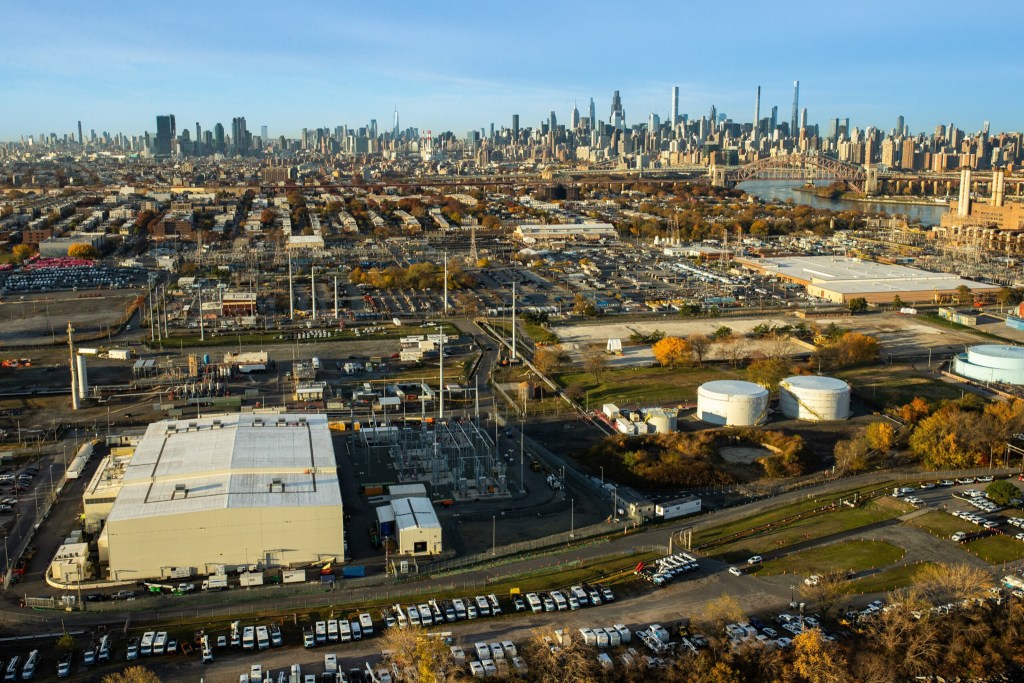
The Power Express — which is backed by Canadian public utility company Hydro-Québec and the Blackstone Group-owned Transmission Developers Inc. — is essentially an extension cord that runs beneath the ground, rivers and city streets. The line makes its way to a converter station in Astoria, Queens, and then goes another 3.5 miles south to the Rainey Substation, just across from Roosevelt Island, before the power travels across the city.
The transmission line took about 15 years to go from concept to completion, at a cost of roughly $8 billion, according to Pete Rose, director of stakeholder relations at Hydro-Québec.
A map shows the route for a renewable energy transmission line running from Canada to New York City. Credit: Courtesy of Champlain Hudson Power Express
It brings a significant influx of cleaner energy to the city’s electric grid, which is mostly powered by fossil fuels. The project also eases some concerns about possible blackouts and brownouts in the summer, when demand for electricity spikes.
Fossil fuels have generated the vast majority of New York City’s electricity since the gas power plants replaced Indian Point, the nuclear plant that provided zero-emissions power and that closed under Gov. Andrew Cuomo. The Champlain Hudson Power Express replaces about half of the power from Indian Point.
“On a summer day when they’re banging their air conditioners, and we’re all sweating to the pavement of the city, they can know this line increased clean energy usage,” said Brad Winer, director of transmission project development at Con Ed.
The planet-warming greenhouse gas emissions this project will displace “is equivalent to removing half of the cars from New York City’s roads annually,” Rose from Hydro-Québec said.
That additional power from the transmission line helps avoid running fossil fuel-powered peaker plants, which are more expensive and can harm the local air quality in the city. Those plants run when demand for power soars in the summer, as New Yorkers blast their ACs.
“The biggest, clearest, most immediate win in the near term is going to be cleaner air,” said Chris Casey, an attorney with the Natural Resources Defense Council. “Having those peakers run less will mean less soot and smog in those communities. The health benefits will be profound.”
Plus, more power available to New York City thanks to the Champlain Hudson Power Express makes for a more dependable grid.
NYISO, the state grid operator, has warned of power shortfalls in times of rising demand, mainly because new power sources aren’t coming online as fast as old sources are taken offline, although power from the Champlain Hudson Power Express and the forthcoming Empire Wind offshore wind project push reliability concerns off for several years.
The 25-year Champlain Hudson Power Express contract lends some predictability to power prices, and can help suppress the costs of wholesale electricity, whose prices fluctuate with supply and demand.
“We’ve seen this winter the volatility of fossil fuel prices because of wars abroad and also because of the cold snap, and so having a reliable source of clean energy that is powering our city is not only better for the planet, it’s also better for long-term affordability,” Yeung said.
Ratepayers across the state will pay about $1.65 more per month on their energy bills in 2027, according to the state Department of Public Service.
New York City will purchase up to $6 billion in renewable energy credits associated with the transmission line to offset the carbon emissions from the running of municipal operations. Under a local law, city government must slash its emissions 50% by 2030.
The Power Express’ development was not without controversy. Opponents decried the costs, and condemned the project’s effects on some indigenous tribes in Canada.
Our nonprofit newsroom relies on donations from readers to sustain our local reporting and keep it free for all New Yorkers. Donate to THE CITY today.
The post New Yorkers, Electricity Will Now Come to You From Dams in Canada appeared first on The City Reporter.
