
Like no other time in history, art has been on the move. Fairs keep artworks traveling from one country to another, but that’s just dealer inventory. Larger museums, usually in major metro areas, have also taken to making long-term loans of objects they have kept in storage to smaller, often more rural institutions. There’s the National Gallery of Art’s “Across the Nation” program and, more recently, the Smithsonian Institution’s Hirshhorn Museum and Sculpture Garden—in conjunction with the Art Bridges Foundation—announced a three- to five-year loan program called “50 for 50” that will place artworks in art museums in all 50 states and Puerto Rico.
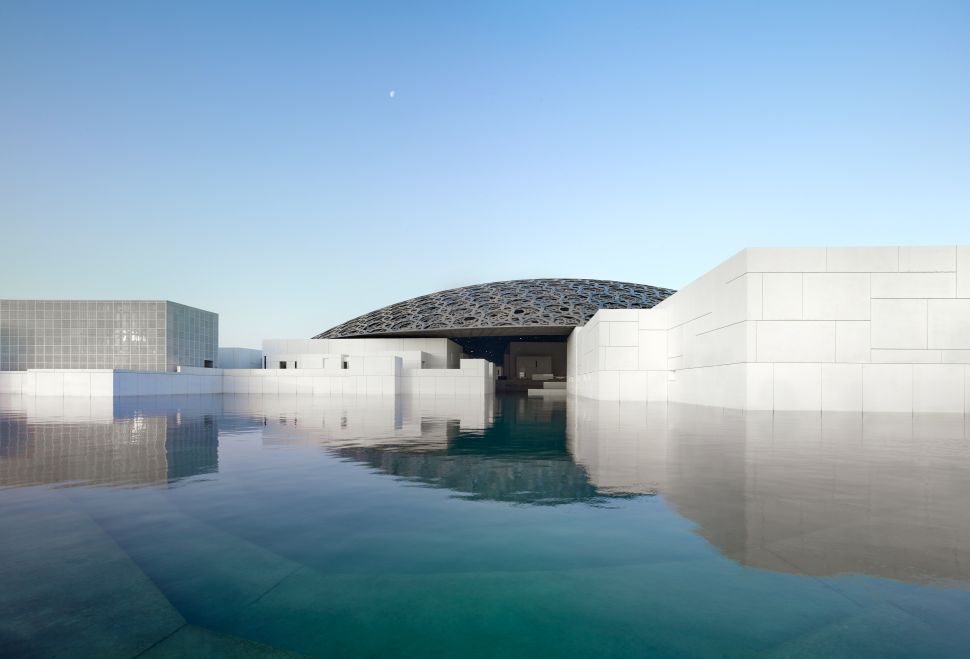
Then there are the museum outposts. The Guggenheim in New York City and the Centre Pompidou in Paris plan to open branches in Abu Dhabi, United Arab Emirates and Seoul, South Korea, respectively. The former institution led the way with its satellite museum in Bilbao, Spain, which opened in 1997, and the outpost at Deutsche Bank in Berlin that same year. This was followed by the Louvre inaugurating a branch in Abu Dhabi in 2017. In 2028, MoMA will launch what it’s calling a “partnership” with Hong Kong’s M+.
“These are not just cultural investments—they are instruments of economic strategy and soft power,” Maria Elena Gutierrez, founder and president of Chora Group, an advisory firm that works with museums on strategy, governance and financial sustainability, told Observer. “Cities like Abu Dhabi, Seoul and Bilbao enter into structured partnerships with globally recognized institutions, leveraging the brand, collections and curatorial authority of names like the Louvre, Pompidou and Guggenheim to accelerate their position on the global cultural stage.”
And these cities are actually paying. Abu Dhabi licensed the use of the Louvre brand for 20 years at a cost of €700 million to the French state, while Pompidou Hanwha in Seoul is paying France €20 million in a four-year deal. As government entities, the Louvre and Pompidou museums are obligated to make these arrangements public, while the privately owned Guggenheim and Museum of Modern Art are not, and both declined requests for more information about the deals.
Not all museum outpost plans have happy endings, however. Earlier this year, the Pompidou canceled plans to build a satellite museum in Jersey City, New Jersey, after the mayor announced that the city had a $255 million deficit, making any payments to the French museum unlikely. But Jersey City had already paid $20 million in consultant fees and another $4.5 million to the Centre Pompidou for licensing and branding rights before the faucet went dry.
Besides appealing to Western travelers, Gutierrez speculated that cities in countries such as the U.A.E. and China—which have a less relaxed attitude toward political dissidence and social freedoms than the U.S. and Europe—view these museum outposts as “opportunities to experiment in neutral spaces. In Abu Dhabi, how do men and women occupy the same space, for instance. I think they are looking ahead to a post-oil economy and using art and culture to help their societies transition.”
On the other side are Western museums looking at their own futures. “Museums are struggling to make a case for themselves, with declining attendance, rising costs and shrinking support,” Maxwell Anderson, former director of the Whitney and current president of Souls Grown Deep Foundation, told Observer. “These outposts are intended to attract resources and audiences.” He added that “expansions are, for the most part, ill-advised unless governments are ready to shoulder the cost.”
Different institutions have different reasons for setting up or licensing an outpost. “I think it is important to understand that different partnerships have different motivations,” said Stephan Jost, director of the Art Gallery of Ontario and former president of the Association of Art Museum Directors. “It is clear that the French State is very sophisticated in using cultural power and partnerships to strengthen their global standing. This has real economic benefits for Paris. That is very different from the Guggenheim, which is a private organization that leverages its brand, expertise and culture to create destinations in places like the U.A.E.”
Guggenheim Bilbao is probably best known for its Frank Gehry-designed building rather than the artwork inside of it, which Gutierrez said is to be expected. “What’s inside are not always masterpieces”—in part because the directors of these museums don’t want to remove artworks that their home visitors pay to see, and partly because some outposts are located in regions of potential geopolitical instability. “You have to protect against acts of war,” she said, adding that Western museums usually “offer two or three recognizable works of art” in these outposts.
Artworks featuring nudity or political opposition are not likely to be exhibited in these partner institutions, Anderson said. “Outposts in locales with no guarantees of free speech are inherently limited in what they will put forward,” and institutions such as the Guggenheim, Louvre, MoMA and Pompidou are likely to self-censor rather than face actual censorship.
When contacted by Observer, neither the Museum of Modern Art nor the Guggenheim would comment on the artworks they plan to exhibit in Hong Kong and Abu Dhabi, and the Centre Pompidou was similarly tight-lipped. However, according to Julie Narbey, the Parisian museum’s general manager, the outpost’s opening exhibition, titled “The Cubists: Inventing Modern Vision,” will “feature 92 works from Centre Pompidou’s modern collections. These include masterpieces that are very frequently on display, as well as works that are shown less often.” She added that “Centre Pompidou exhibitions are organized with curatorial independence.”
Of course, not all outposts are power plays, and some last longer than others—often for reasons of money. The Whitney museum, for instance, had a satellite branch at the Altria Group’s Manhattan headquarters from 1983 to 2008, which closed when Altria moved elsewhere and phased out its charitable arts donations. In the decade prior, from 1973 to 1983, the museum operated a satellite at 55 Water Street, a building owned by Harold Uris, who gave the museum a lease for $1 a year. The Whitney has also had branches at Maiden Lane, Equitable Tower and in Stamford, Connecticut.
The Deutsche Guggenheim in Berlin, which opened at Deutsche Bank in 1997, closed in 2013. The Los Angeles Museum of Contemporary Art operated the Pacific Design Center for 20 years, closing it in 2019, while the Museum of Contemporary Art San Diego opened a downtown branch in 2007, which it sold two years ago. In 2024, Fotografiska, a Swedish-based network of photography museums, closed its Gramercy Park outpost in Manhattan after five years, claiming to be searching for a new site that has yet to be found. In 2021, the San Francisco Museum of Modern Art closed its Fort Mason Artists Gallery as part of Covid-related budget cuts. On the other hand, the Museum of Modern Art acquired an existing art space in 2000—the P.S.1 Contemporary Art Center in Queens—that it continues to use to host more experimental exhibitions to this day.
