
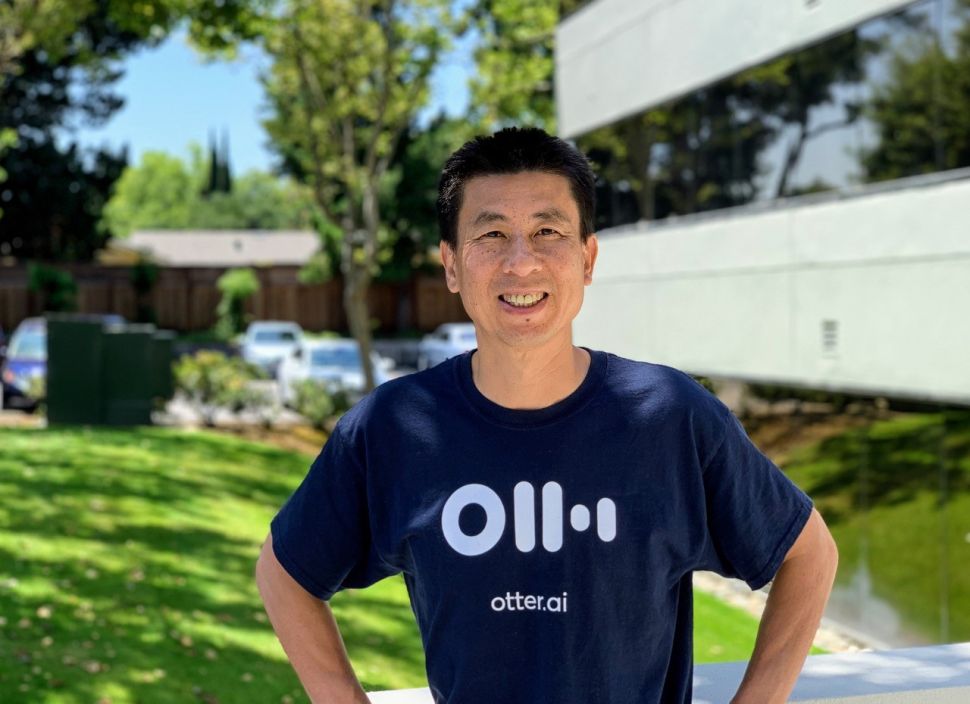
When Sam Liang co-founded Otter.ai in 2016, A.I. was not yet a household buzzword. In the years since, however, the transcription and notes-taking platform has evolved alongside the technology that powers it. Today, its built-in conversational knowledge engine helps users make sense of their business and personal lives by drawing on their own database of meeting recordings. Liang envisions a future where typing—even to a chatbot—becomes largely obsolete.
“When people use chatbots like ChatGPT or Claude, one of the biggest problems is context,” Liang told Observer. “It takes a lot of effort to write a good prompt and provide all the context, but when you bring A.I. into the conversation, it has all the context.”
Used by 86 percent of Fortune 500 companies, Otter surpassed $100 million in annual recurring revenue last year. The company raised $73 million in venture funding in its first five years and exceeded 35 million users late last year. It combines external integrations—such as Google Workspace and Anthropic’s Claude—with internal innovations like agentic chat, which can pull data and complete tasks. Even large banks with strict compliance requirements are in discussions with Otter about incorporating the technology into their workflows, Liang said.
Otter has managed to compete with Big Tech firms like Microsoft and Google. While Microsoft Teams’ note-taking features and Gemini for Google Workspace benefit from being native to their ecosystems, Otter differentiates itself by working across platforms, including Zoom, Google Meet, Microsoft Teams, and even in-person meetings via its mobile app.
Whether college students are trying to understand lectures, recruiters are analyzing candidates, or CEOs are reviewing meetings they missed, A.I. agents alone are not enough to solve productivity challenges, Liang said. Instead, he argues that access to full contextual data from past meetings enables agents to execute tasks more effectively.
Observer spoke with Liang about the state of A.I. in voice communication, competing with tech giants, and why personal meeting avatars are Otter’s next frontier.
The following conversation has been edited for length and clarity.
Otter started out primarily as a transcriber and note-taker. When did it become clear that you needed to shift to understanding and acting on conversation? And how did you tackle that shift in a way that was different from the pathways we’re seeing at big tech competitors?
This has always been our vision from day one, but it took us several years to make the transcription and meeting notes work well. With large language models and new agentic technologies, it makes the knowledge engine possible.
There’s another aspect to why we’re making faster progress on the knowledge engine now. It’s the mindset change. It’s the desire to look for A.I. solutions to transform how people work. We’re still in the early innings, but it’s starting to change.
Business or personal, it does seem to require that mindset shift to make the most of A.I. I actually have a smart fridge at home, so I don’t have to add anything by hand to my shopping list anymore, but it took me a while to get used to it. Now, as you mature in this evolution you’ve described, how do you measure success against giants like Microsoft and Google, who admittedly have a broader purview, but whose ambitions increasingly overlap with yours?
When you build something new, you always face competition from large tech. Google, Zoom, Microsoft, their biggest advantage is their distribution channel. They have penetration in enterprises already, so it’s easy for them to bundle something, even for free.
But this can be their biggest disadvantage. Because it’s so easy for them to bundle things, they don’t really have a strong motivation to build the best product. Microsoft is not known to build new innovative products. They’re known to copy others. For us, with the conversational knowledge engine concept, I don’t see them working on that right now.
My prediction is that they don’t care about what we do until we reach $1 billion in revenue. Microsoft copied Slack, but they didn’t do it until they were big already. Salesforce acquired Slack when it was valued at $27.7 billion, so we still have many years before Microsoft really pays attention.
You mentioned that A.I. benefits from as much context as possible. For business and personal use, some context is very sensitive. How do you balance the productivity benefits of voice data with privacy concerns inside and outside of an organization’s walls?
There is a common security model already. In Google, Microsoft and Notion, you can control who has access to any content. We created a similar structure in Otter. You can create private Otter channels, but there’s some content that could be public to anyone in the company.
A lot of enterprises have information silos, which slow people down. Sales teams don’t necessarily know what marketing or product teams are doing, and vice versa. If you share more information between teams, you can accelerate workflows.
From a similar lens, the question of authenticity is increasingly relevant. Video A.I., for example, is facing a lot of questions around authenticity. Outside of the obvious issues with deepfakes, do you see those concerns emerging in A.I.-enabled voice technology, or do they take a different shape?
I believe voice communication is actually more authentic, especially if you meet someone in person. Still, if it’s written by A.I., it doesn’t mean it’s not authentic. It can still come from authentic human ideas.
Voice communication is actually more likely to be authentic because you’re speaking out of your own mind in real time. In the future, we can build an avatar that can speak just like you, but hopefully that avatar is actually using your own brain dump to talk, so it’s still mostly authentic.
Do you have any plans to tackle the personal meeting avatar in the future?
Yeah, we do plan to do that, but there definitely are still a lot of challenges to make it work really well. We built an avatar for me already. A Bloomberg reporter interviewed my avatar in a live event. It went reasonably well, and eventually, I see avatars for busy professionals to represent them in some meetings.
And in that regard, what are you hearing from your users and industry peers about the risks associated with that kind of technology? How are they thinking about it?
Of course, one risk is fraud. There have already been some cases of people using a clone of a relative to scam people into sending money, so it’s how you better detect that and warn people. There are risks for any new technology.
Looking to the future, what do you think is the next frontier for voice communication in concert with A.I., and how do you see Otter shaping it, especially alongside big tech and these A.I. giants?
I think more and more enterprises will adopt the conversation knowledge engine. You put all the meetings on this system and use it to drive both human and agent workflows, making enterprises way more productive. There’s always competition from Big Tech, but I’m confident that we can innovate way faster.
