
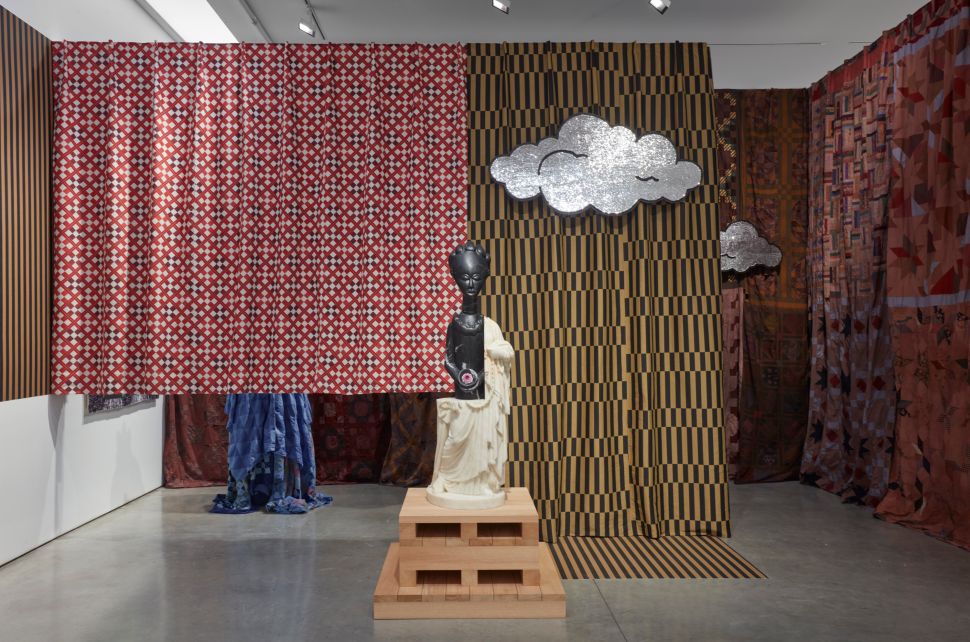
Operating at the intersections of African diasporic history, spirituality, mythology and popular culture, artist Sanford Biggers has long applied strategies of appropriation and transformation to engage creatively and semiotically with systems of power, race and historical narration. For his latest exhibition at Marianne Boesky, Biggers went all in, staging an immersive, psychedelic choreography articulated through quilt-based two-dimensional works, layered canvases and eclectic sculptural assemblages drawing from multiple iconographies and cultures. In an early walkthrough, just as he was finishing installing the show, Biggers described the exhibition as both a return to immersive installation-making and an expansion of concerns that have shaped his practice for years: “I wanted to create an atmosphere here that felt less like walking into a white cube with artwork and more like entering a full enveloping environment— a world where things change scale and have their own context.” He conceived the gallery space as a stage, where the exhibition unfolds fluidly like a play in three or four acts. “As you walk in, it sets the stage for a journey. The viewer becomes part of the unfolding story,” he adds.
“THE GIFT OF TONGUES“
Artist: Sanford Biggers
Venue: Marianne Boesky Gallery
Address: 507 West 24th Street, New York
Runs through: June 13, 2026
The gallery has become an intricate theatrical labyrinth and Gesamtkunstwerk of strategically placed curtains and false walls, where new works from his Codex, Chimera and Shimmer series emerge like fragmented vignettes, inviting visitors to move through a tangled web of historical assumptions and slippery symbols—a patchwork of mutable archetypes that remains perpetually open to reinterpretation. Here, Biggers operates through a deliberately hybrid practice that combines painting, sculpture, textiles, video, performance, sound and archival material, creating collisions between materials, histories and symbolic systems that layer African diasporic traditions with American popular culture, Buddhism, jazz improvisation and postminimalist abstraction.
“The Gift of Tongues” is a fluid, idiosyncratic and multimedia crossing of histories and creative symbolic expressions, all seemingly converging in a simultaneously imaginative and spiritual pull toward transcendence beyond earthly, time-bound reality. Symbols and signifiers from different cultures slip fluidly into the space, embracing multiple meanings and readings, enriched at each passage and altered again through the cultural transmission and exchange that have built our global symbolic vocabulary.
“Each work relies on the history embedded in these materials, especially the quilts, but the titles also suggest narratives,” he notes, pointing to the large quilts that serve as both diaphragm and enveloping narrative structure in the show. “I’m interested in how quilts can function almost like scenery or backdrops,” he says.
The quilt, that quintessential vernacular object, has long proven to be rich ground for what Biggers calls “material storytelling.” His quilting work sheds new light on his long-standing concerns—racial experience, American violence, Buddhism and art history—and reveals inner dimensions of his personal journey. Biggers made his first two quilted works in 2009, installing them at the Mother Bethel African Methodist Episcopal Church in Philadelphia. On each, he transposed the locations of the Underground Railroad’s churches and safe houses from a historical map, marked them as stars in a constellation and connected them with charcoal and oil stick. The central reference is to a theory holding that people along the Underground Railroad shared crucial information in code through quilts hanging from safe houses and other passageways. Scholars have found little proof of this, but for Biggers the very fact of popular knowledge, even when apocryphal, has value in itself: “It is more important that history endure.”
This is, however, the first time Biggers has stretched some of these works like paintings. “They’re all comprised of actual ancient quilts that I combine and paint on,” he explains, noting how he has lately been blurring the colors of the quilts so the geometric structures become softer and less hard-edged. “Over the years, my relationship to quilts has gone through different phases: first creating depth within the patterns, then a more graphic phase, and now I’m interested in narrative and pictorial space—objects existing within settings that remain open-ended.” This can be clearly seen in works like We Build Our Temples for Tomorrow (2026).
From this process, he also began hand-marbling paper as a nod to painting traditions, then painting directly onto fabric and drawing with oil stick. The resulting two-dimensional works, such as The Wind Whispers Mary (2026), are mixed-media, collage-like compositions dense with both materiality and symbolism. “A lot of this came out of the pandemic, when I was working without a team and spending more time on individual pieces,” Biggers says, addressing the rich experimentation in both techniques and materials involved in these new works. “The process became much more instinctive and physical.”
His art-making process begins with one intention, but the work evolves over several days. He is less interested in fixed symbolism than in the creative exploration of symbologies that can emerge through sourcing, assembling and dialectically combining different elements and cultural references. “I’m constantly absorbing influences: The Tibetan Book of the Dead, tarot cards, concert posters from the 1960s. There’s definitely a psychedelic quality there,” he acknowledges, noting how meanings emerge through accumulation. Most decisions are ultimately guided by the material itself, with fabrics, colors and marks added in response to what each composition seems to require spatially or emotionally.
In one of the most richly stratified unstretched quilts, Lodestar (2026), Biggers incorporates Japanese woodblock prints, gold leaf and ukiyo-e traditions. “The gold entered the work as a way of flattening the embroidery and stitching. I think about these pieces in increasingly pictorial terms: horizon lines, spatial relationships, atmosphere.”
Biggers arely throws anything away: “I accumulate materials over years, until they suggest what they want to become.” His process is shaped by this long-term accumulation, with fabrics, textures and colors gradually revealing their potential over time until they find their perfect moment to be reactivated. He approaches each quilt as an individual, responding to its geometry, texture and color structure to determine which forms, interventions or narratives might emerge from it.
Questions of camouflage, visibility and disappearance also play a central role in this latest show. “I realized I could make the figure disappear into it. That idea of fluidity, culturally and visually, became important,” he says. Exploring tensions between legibility and illegibility, black totemic figures emerge from the fabric itself or, at times, dissolve into the backdrop through the accumulation of material additions and painterly gestures, as in Hush Harbor (Hillside Desolate), where two mysterious black silhouettes are embraced and enveloped within an abstract vortex, suspended in an idyllic landscape assembled from different quilts, each with its own motifs, colors and stories.
In this continuous exercise of collaging and stitching together fragments of different visual and symbolic narratives, it is the labor itself—the act of making and its temporal dimension—that truly matters to Biggers. “The repetitive process becomes meditative; eventually you stop consciously thinking, and your hands continue through muscle memory while your mind drifts elsewhere. That relationship between labor, repetition, and imagination feels very powerful.”
His Chimera sculptures work in a similar spirit, combining seemingly paradoxical, eclectic assemblages of fragments of white archetypal classical art—statements of Western canons of beauty—with elements drawn from the equally rich cultural traditions of African and Black communities. In To Repair or Repeat (2026), Biggers combines classical drapery and a distinct contrapposto stance with the bust of a Ghanaian Obaapa figure. In Once Upon a Second Thought (2026), he recreates in New York a site-specific installation first developed during a 2018 fellowship at the American Academy in Rome, wrapping a copy of a fragmented Roman marble from the Academy’s collection in the patchworked hallmark of Americana. By hacking the fixed monumentality of the classical tradition and hybridizing these forms with quilts and mask elements long dismissed as merely vernacular or ethnographic artifacts, Biggers challenges long-sustained power dynamics between cultures and their embedded aesthetic assumptions. In this continuous exercise of appropriation and remediation, he acknowledges the complex origins of the forms he reinterprets while envisioning a future ethnography that questions historical narratives and embraces the natural fluidity, multiplicity and pluriperspectivism that define so much of today’s global culture.
Moving through the environmentally expansive theatrical structure, almost concealed within walls and curtains, one encounters a sculpture that sits atop a pedestal—as if on an altar—before a psychedelic stretched quilt. Draped in textiles and with its face painted in colorful geometric patterns identical to the quilt hanging behind it, Narcissus (2026) both appears and disappears within this kaleidoscopic, almost hypnotic mise en abyme, becoming an auratic presence: a powerful, energetic and spiritual nucleus of the show.
Nearby, one of Biggers’s clouds appears—made of sequins applied entirely by hand in another exercise of meditation through making, one that allows the mind to drift free of the physical act. “The mind just starts wandering,” Biggers says, describing the process. “The labor is meditation, losing consciousness. It’s so repetitive that, at some point, you’re no longer even thinking about it. Your hands are working from muscle memory while your mind is able to monitor, create and imagine.” He first used clouds in graffiti work in Los Angeles in the 1990s; here, these nebulous forms are shaped and reshaped by air currents as they move across the sky, slippery and open to multiple meanings, their atmospheric significance shifting with each subsequent invocation.
In a separate room, Biggers stages three smaller black-masked sculptures, totemic figures that stand against the alluring black shadows of two Black men behind them. Titled Stand (2026), the work suggests a historical continuum—the endurance of these symbols and the spirituality and ancestral wisdom they represent, all of which remain at the heart of vibrant Black culture. Biggers describes them as “power objects,” emphasizing the importance of the interplay between scale, perspective and positioning as something that evokes our relation to the ethereal, as much as to our ancestral path, as it casts shadows or light into our futures.
The entire show is an initiatic journey and a temple celebrating the different spiritual and symbolic expressions of a shared human desire for transcendence—a quest for something beyond our earthly experience of time, given form through a shared polyglot vocabulary of enduring archetypal elements that have hybridized across centuries.
That search, in fact, returned throughout our conversation. “Spiritually, I’m thinking about antiquity, ritual, and synchronicity,” he explains. “Some people are surprised when futurism comes up in relation to my work, but even my earliest works in New York involved mandala forms.” Within this hybrid, synchronic spiritual imagery, different references coexist in a single multilayered lexicon, producing what Biggers describes as simultaneous relationships between past and future, between individual and universal. His patchwork of symbols remains open to endless possibilities and interpretations, hinting at something universal that unites humanity beyond race, gender and time.
