
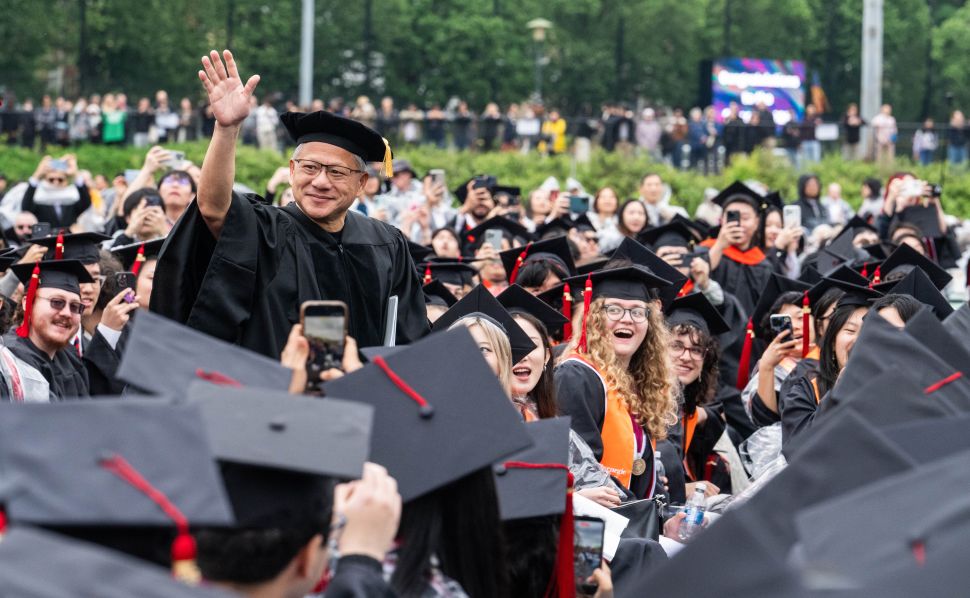
In recent weeks, a slate of today’s most prominent tech figures—Nvidia CEO Jensen Huang, AMD CEO Lisa Su, former Google CEO Eric Schmidt, among others—took the podium at university commencements to address an anxious Class of 2026, the first cohort to spend their entire college years alongside generative A.I. tools. (ChatGPT was launched in November 2022, during their freshman year.) Across campuses, the industry leaders behind those podiums delivered a broadly similar message: embrace A.I., but learn to master it. How that message landed, however, depended less on what was said than on who said it—and, perhaps, where it was said.
The starkest contrast played out between Schmidt at the University of Arizona and Huang at Carnegie Mellon. While Schmidt’s buoyant optimism about A.I. drew loud jeers and boos throughout his speech, Huang’s similarly upbeat message was met with quiet reverence.
Further south, at Middle Tennessee State University, Scott Borchetta, founder of Big Machine Label Group (which famously launched Taylor Swift), also faced pushback when he told graduates to “deal with it” while discussing A.I.’s disruption of the creative industries.
Meanwhile, at Grand Valley State University in Michigan, Apple co-founder Steve Wozniak earned sustained applause with a line that wittily flipped the narrative: “You all have A.I.—actual intelligence.”
Those polarized reactions were not the result of any single speech. If you listen closely to what they said, the text of those prepared remarks was highly similar. What differed was the tone of the delivery and the audience hearing it. If there was a pattern, students at elite institutions appeared more receptive to pro–A.I. messaging than their peers at public universities. Huang spoke at a school widely considered one of the birthplaces of A.I. (where researchers created the first A.I. computer program in the 1950s.) Last week, his rival (and distant relative), AMD’s Lisa Su, gave a commencement speech at her alma mater, MIT, where she was also warmly celebrated.
Of course, just as important was the person behind the podium. Commencement speeches, especially at alma maters, are among the rare moments when tech CEOs drop their corporate armor and offer something resembling personal advice. But they’re also an unforgiving referendum on reputation. Huang and Su, who are actively building the infrastructure powering the A.I. boom, are seen as shaping the future in tangible ways while taking real business risks. Schmidt, by contrast, has long been seen as an out-of-touch capitalist and the poster child for an older, unfeeling era of Big Tech. His awkwardly rushed, occasionally tone-deaf delivery in Arizona only amplified that perception.
The rapid evolution of A.I. tools over the past three to four years has reshaped how students choose majors and think about careers. While overall unemployment in the U.S. remains relatively low, entry-level hiring has severely contracted. (Blame remote work, too, because employers are reluctant to hire fresh graduates on remote teams due to training challenges.) According to a recent Federal Reserve survey, the unemployment rate for college graduates aged 22 to 27 climbed to 5.7 percent, reaching its highest level since 2014, excluding the pandemic years.
Against that backdrop, the advice from tech leaders converges on a simple theme: expect disruption, and adapt.
“My career started at the beginning of the PC revolution. Your career starts at the beginning of the A.I. revolution. I cannot imagine a more exciting time to begin your life’s work,” Huang said. “A.I. is not likely to replace you, but someone using A.I. better than you might.”
“Technology itself does not decide what the future looks like. The best people do,” Su echoed. “It needs people who know what to use it for—people with purpose, judgment, and courage; people who look at a hard problem and say: this matters, and we can figure it out.”
And, stripped of the snark that greeted it in Arizona, Schmidt’s core message was not so different: A.I. “will touch every profession, every classroom, every hospital, every laboratory, every person, and every relationship.” But, he added, it only becomes useful if people do the work to understand it. “I think the key thing is we need, as humans, to retain the sort of sense that hard work, going through the difficulty of learning things, is worthwhile and it pays off, and that’s how you really improve yourself,” he said.
