
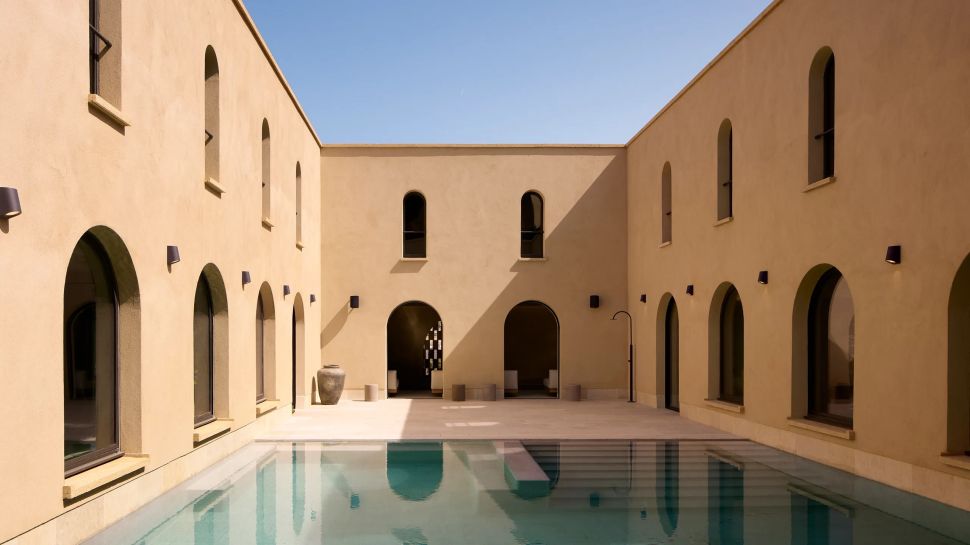
You have probably already decided where you are going this summer, or at least told yourself you have. The flights to the same islands are booked, the villa someone’s cousin swears by is half-paid, and the group chat has once again deadlocked over whether to do Ibiza for the third summer running. This is the moment when the plan quietly hardens into last year’s. So consider this your permission slip to defect. The hotels opening across Europe this year are not in the places your feed keeps serving you, and they are pointedly not the ones a certain prestige drama has already turned into a six-month waitlist.
They are 40 miles off the Norwegian coast, where the sun forgets to set and the granite comes straight out of the sea. They are in Comporta’s pine and rice country, in a Maltese village no one can find without a postcode, on a Capri lane above the scrum the day-trippers never bother to climb past. A few were somebody’s house first and still behave like it, from a baroness’s folly to a palazzo that a family spent five years coaxing back to life. What unites them is harder to book than a sea view: the sense that the building could exist nowhere else. It’s the standard Olga Polizzi has spent three decades chasing across Rocco Forte hotels. “If you’re in Munich, you should wake up and feel as if you’re in Munich; if you’re in Sicily, wake up and feel as if you’re in Sicily,” she tells Observer. The hotels that flunk that test could be airlifted between continents unnoticed. The ones below could not.
Not one of these is angling to be the trophy already clogging your saved folder. They are the trip you have not thought of yet—which, this deep into a summer that was supposed to be settled, is the only kind worth taking. Fourteen of them, below.
The Best New European Hotel Openings for Summer 2026
Île de Bendor, 83150 Bandol, France
Paul Ricard, the pastis magnate, bought this scrap of Mediterranean rock off Bandol in 1950 and spent decades indulging a private Provençal fantasy on it, museum of wine and spirits included. The private island floats a seven-minute boat ride from the Riviera, yet runs on some entirely separate clock, an arithmetic Zannier has always grasped more shrewdly than the competition. Because Ricard built it to please nobody but himself, it never carried the stink of a development, and as a hotel it delivers something close to extinct along this coast: an island answering to one mind, too self-assured to bellow about it across a marina jammed with charter yachts.
Zannier Île de Bendor.
Zannier Hotels
7 Arundel Street, London, WC2R 3DA, United Kingdom
Nick Jones built Soho House into a membership empire across three continents, then handed back the keys in 2022, and the obvious question was what a man like that does for an encore. Saint Clement is the answer. It occupies a hushed stretch of Arundel Street between the Strand and the river, a few doors from his old 180 House flagship and directly above the Corner Shop 180 deli he opened last June. The new venture, Jones & Co., fills it with 90 bedrooms, 15 loft apartments for the longer-stay crowd, a rooftop restaurant and a gym. There is no membership, no application and no one to decide you are not quite right for the room, which, from the man who spent two decades monetizing the velvet rope, is the genuine plot twist.
Saint Clement.
Saint Clement
Leoforos Vasilissis Sofias 46, 11528 Athens, Greece
Athens gets 48 hours and an Acropolis selfie before everyone bolts for the ferry, and the Conrad exists to sabotage that itinerary. It opened 63 years to the day after Jacqueline Kennedy turned up for the Hilton Athens debut in 1963, on a stretch of Vasilissis Sofias that has hosted the city’s social machinery ever since. Hilton stripped the modernist landmark by Emmanuel Vourekas and his collaborators down to its frame, sparing the Yiannis Moralis façade reliefs, a Cubist frieze of Greek myth too good to demolish. The reborn version trades bulk for breathing room: 278 rooms where 506 once crammed in, the upper floors carved into residences, plus the largest outdoor pool in Athens and nine places to eat and drink.
Conrad Athens The Ilisian.
Conrad Athens The Ilisian
Studiestræde 57, 1554 Copenhagen, Denmark
In 1969, Aase and Jørgen Henrik Hildebrandt bought a Copenhagen building for a car-rental business and stumbled sideways into hospitality, which is a more charming origin than most hotels can claim. More than 50 years on, the family has named its fourth property after the patriarch, and the sentiment is doing real work. Henrik’s keeps 44 rooms on Studiestræde, a vintage shop-filled street near Tivoli Gardens that once marked the old city gate, and the interiors run tactile and dollhouse-precise, all warm wood and deliberately low light. There is a fireplace in the lobby and two bars, plus the pillow menus and blackout drapes the Hildebrandts have spent decades refining across their Ascot, Wide and Hypernym hotels.
Henrik’s Hotel.
Henrik’s Hotel
Via Croce 4, 80073 Capri, Italy
Baroness Barbara Margaretha von Salis Marschlins (better known as Meta von Salis) was a Swiss writer who corresponded with Rilke and Nietzsche, and in 1904, she built herself a Capri house that could not decide whether it was Liberty or Moorish and settled the matter by being both. Crenelated towers, horseshoe arches and cream façades stack above La Piazzetta in Via Croce, architectural indecision that only looks like vision once a century has gone by. Capri has never been short on glamour, only on addresses with a rich backstory, and while the masses funnel through the Piazzetta, photographing each other, the baroness left behind something far more bewitching than anything a brand could invent.
Villa Helios.
Villa Helios
Mononaftis, Agia Pelagia, 715 00 Heraklion, Crete, Greece
Crete spent years as Greece’s reliable second-tier getaway—the island you finally visit once Santorini and Mykonos have worn you out, and the family behind Omicron Hotels has wagered that the reputation is an asset rather than a consolation prize. Tierras Villas, opening this July along the coast at Agia Pelagia near Heraklion, is where that pays off. There are only five villas, each named for one of the five elements and built around it, with the design by Manos Kipritidis holding a hard line: Cretan stone and raw wood, low horizontals that follow the hillside rather than fight it, the Aegean left to do its own work just beyond the terrace.
Tierras Villas.
Tierras Villas
Via dei Bossi 5, 20121 Milan, Italy
Milan times its hotel openings to Salone del Mobile the way other cities time them to nothing in particular, so Casa Laveni surfaced in April, mid-pilgrimage, inside a restored neoclassical palazzo in Brera. The 30 rooms come from developer Bohopo with interiors by Delogu Architecture and Studio Sacchi Architetti, who took the surrealist route of sky-blue palettes and a sense of humor that most Milanese design is far too self-serious to risk. The building once belonged to Giuseppe Laveni, an engineer rather than the architect the early press releases insisted on, and in a city that does not forgive a sloppy attribution, the correction matters.
Casa Laveni.
Kasia Gatkowska
The Carlton, a Rocco Forte Hotel
Via Senato, 5, 20121 Milan, Italy
In a fashion district where Giorgio Armani built his own hotel and Bulgari handed the keys to Antonio Citterio, Rocco Forte made the least obvious move on the block: a family operation, a residential design firm, and roughly $65 million spent making you forget you are in a hotel at all. The Carlton reopened last November in a charmless 1963 building that Olga Polizzi gutted without sentiment. “Hand on heart, this time there wasn’t anything I would have kept,” she says of the Baglioni-era bones, all low ceilings and dark, undersized rooms. The 71 keys now reference Gio Ponti and Milanese sobriety, the wall patterns hand-painted by the San Patrignano workshop.
The Carlton.
Rocco Forte Hotels
147 Triq San Anton, Attard, ATD, 1285, Malta
Christopher and Suzanne Sharp founded The Rug Company, so a five-year restoration of an 18th-century palazzo from these two was never going to skimp on what hangs on the walls or covers the floors. They chose Attard, one of Malta’s quaint “Three Villages” between Mdina and Valletta, which is exactly where a casual visitor would never think to look. The 17 rooms and suites come with two pools and a spa whose hammam, sauna, cold plunge and Moroccan-tiled treatment rooms suggest the Sharps were not interested in half-measures, all overseen by Suzanne Sharp Studio in London.
Casa Bonavita.
Casa Bonavita
Rua de Cedofeita 389, 4050-178 Porto, Portugal
You enter Casa Cedo through a flower shop, which also functions as reception and sells ceramics, coffee and Byredo fragrances, a sequence of small ambushes that tells you the Irish-Italian owners have thought harder about arrival than most hotels think about anything. Behind it wait just eight rooms in a 19th-century townhouse on the main drag of Cedofeita, Porto’s gallery-and-vintage quarter, with interiors by Lisbon’s Quiet Studios and a garden by Toni Sastre.
Casa Cedo.
Casa Cedo
EN 261-1, Muda, 7570-337 Grândola, Portugal
Sublime Sand is founder Gonçalo Pessoa’s expansion of the original Sublime Comporta, three times the footprint and considerably less coy about what it wants to be. The 43 villas come with private pools across 42 acres, and the new dining roster makes the ambitions plain, anchored by a Beefbar and a Davvero imported from Sublime Lisboa, plus a nightclub called Ruína that claims to be Comporta’s first. An Aqua social hub folds in indoor-outdoor pools, a hammam and a cold plunge, while a Forum events space opens onto an amphitheater. Everyone insists on calling it the Hamptons of Portugal, which rather gives away the secret. It is now officially out.
Sublime Comporta.
Sublime Comporta
Agia Irini (Agia Eirini), 844 00 Paros, Greece
Hotel operator Morgans Originals practically invented the boutique hotel in 1984, so its first Greek venture, choosing Paros over the obvious islands, doubles as a tip on the country’s emerging hot spot. The 39 cliffside suites perch above the bay of Agia Irini on the tamer western coast, many with private pools and uninterrupted sightlines to Antiparos and a sunset Mykonos would charge a cover for. Elastic Architects shaped the whitewashed village forms; Berlin’s cult studio Lambs and Lions did the interiors, and the restaurants arrive with real pedigree in Mimi Kakushi and La Cantine du Faubourg.
Luura Cliff.
Luura Cliff
39 Boulevard de la Plage, 33970 Lège-Cap-Ferret, France
A geography note before anything else, since the names trip up everyone: this is Cap Ferret, the pine-and-dune peninsula on the Atlantic near Bordeaux, not Cap Ferrat on the Riviera, and the distinction is the entire personality. While the Riviera spends August bumper to bumper in linen, the peninsula trades on oysters and a near-religious absence of glamour, which is exactly why the Parisian set decamps here to not dress for dinner. Villa Colette is the first five-star hotel that the place has ever had, and also the debut beyond Paris for Laurent Taïeb’s Utopik Collection.
La Villa Colette.
La Villa Colette
Husøy, 8770 Træna, Norway
The Træna archipelago sits 40 miles off the Norwegian mainland, on the Arctic Circle, home to roughly 450 people and a fishing tradition older than the country itself. Ytri, whose name means outermost in Old Norse, opened in April on the island of Husøy with 38 rooms beneath the granite spike of Trænstaven. Architect studio Vardehaugen angled the timber-and-glass building toward the light and the water, and there is a wood-fired sauna and a lounge built specifically for watching the aurora come down. You reach the Relais & Châteaux property by plane and then boat, on the islands’ own schedule, which weeds out anyone whose idea of remote is a resort with a spotty signal.
Ytri Norway.
Ytri Norway
