
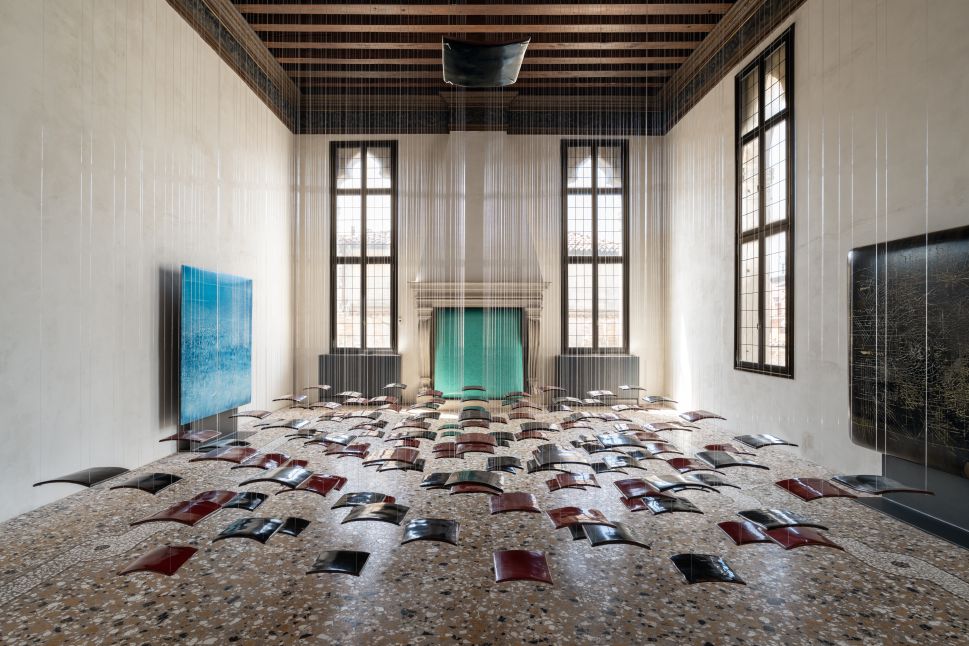
It may be the fluid nature of Venice—the way the city itself makes visible the cyclical rhythm of all things, suspended as it is between decay and regeneration—but alchemy seems to permeate this year’s Biennale and its collateral exhibitions. In one of the most scenographic exhibitions in the city, Chinese artist Su Xiaobai has installed his lacquered three-dimensional works in energetic constellations throughout the magnificent Palazzo Soranzo Van Axel, a 15th-century palace defined by its Gothic style, unusually atmospheric frescoed interiors and a porous, articulated architecture. The exhibition brings together 35 paintings that trace the 77-year-old artist’s three-decade relationship with natural lacquer, from a 2003 work to new paintings made specifically for Venice.
“SU XIAOBAI’S ALCHEMICAL UNIVERSE“
Artist: Su Xiaobai
Venue: Palazzo Soranzo Van Axel, Cannaregio
Open: Daily, except Tuesdays, from 10 a.m. – 6 p.m.
Through: Nov. 22, 2026
Through a meditative practice anchored in ancient traditions and deep spirituality, Su transforms the ancient medium of lacquer into a radiant sculptural language. The resulting layered surfaces are animated by a subtle interplay of light and shadow, as luminescences emerge from within the material itself, inviting the eye into a kind of geological excavation that mirrors the alchemical transformations he enacts.
An official collateral event of the 2026 Venice Biennale, “Su Xiaobai’s Alchemical Universe” is presented by the Su Xiaobai Foundation in collaboration with the Los Angeles County Museum of Art. Speaking ahead of the highly attended opening, Su agreed that there is a form of alchemy in his process. Painting, for him, is about matter and energy. “It’s like the change and improvement of lacquer through mixing it with other materials,” he tells Observer. “I’m always trying to find a new way to utilize this traditional material, lacquer, in a new way.”
Trained at the Central Academy of Fine Arts in Beijing and the Kunstakademie Düsseldorf, Su bridges Chinese literati traditions and postwar European painting, having gradually shifted away from oil paint and Socialist Realist figuration toward a material practice that exists between painting and object. His master first introduced him to lacquer and taught him traditional techniques, but Su progressively transformed and reinvented those methods, bridging Chinese artistic traditions and European modernism.
There is always a dialogue with the material, he explains. “Lacquer is very strong, but I’m always resisting that strength,” he says, noting that his studio resembles a laboratory more than a traditional atelier.
The process is slow by necessity, proceeding through a patient process that involves laying down over 20 layers per painting. That embodied knowledge of lacquer techniques manifests in the layering and stratification, giving the works both chromatic complexity and temporal depth. To further enrich the temporal stratification of their surfaces, Su also folded Fujian’s ruins into the work: roof tiles salvaged from homes demolished to make way for skyscrapers are coated in black or red lacquer, pierced with fine holes at each corner and hung one by one in a suspended installation that appears to float in midair, a testament to a bygone era being rapidly erased by the country’s modernization.
The traces and grids traversing the monochromatic surfaces evoke traditional Chinese painting while suggesting a vital tension between order and disorder, turning these painterly congregations and pigment sedimentations into embodiments of entropy. “The grid creates order and disorder,” Su explains. “I’m trying to conquer disorder and bring order back again with every layer of the painting.” This is also why he refuses to wait for the lacquer to dry completely. He intervenes before it solidifies, disrupting any stable crystallization of gesture into form.
Central to the exhibition is Su’s newest series, Niao Niao, a Chinese poetic phrase embodying sensations of transience and evanescence. Destruction and regeneration are embraced as essential parts of each painting’s transformative cycle. In the alchemy of painting, the solid surface appears to liquefy in the translucency of a crystal, a reflecting water surface or the abysses of the cosmos.
At times the works appear almost magmatic, matter momentarily at rest before shifting again. Every cycle of transformation must pass through destruction to regenerate, and these lacquer paintings evoke matter in perpetual motion across different alchemical states. They seem alive within the space, almost transforming alongside it—living entities evolving through and with their environments, as Su himself acknowledges.
When asked whether the work relates to Daoism or spirituality, Su emphasizes that such meanings are not intentionally imposed but remain deliberately open, allowing viewers to perceive them through their own interpretations and responses. The overall choreography of these quiet, meditative works, floating through the space in constellations, creates a suspension in time that invites contemplation—slowing the viewer down to investigate, appreciate and understand the process and the temporal layers each work embodies.
Through the experimental reinvention of a traditional material—developed through a process of listening to and negotiating with the material itself rather than attempting to control it—Su’s works reveal how painting can become a form of alchemy: an interaction between matter, energy and transformation that evokes, within the very act of creation, the mysteries of the universe.
