
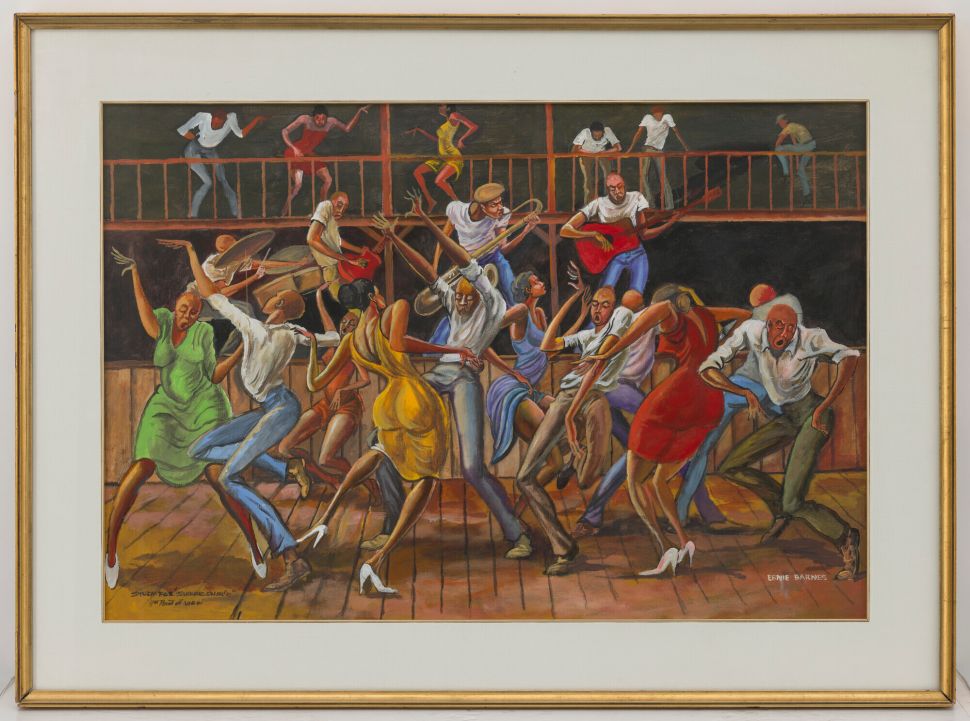
Ernie Barnes study shows a crowded dance floor filled with elongated figures in motion, musicians playing above and dancers twisting across the scene.” width=”970″ height=”722″ data-caption=’Ernie Barnes’s <em>Study of The Sugar Shack (4th Point of View)</em> (1976-81) sold through La Finca Consulting Strategies at Christie’s Post-War and Contemporary Day Sale for $482,600. <span class=”lazyload media-credit”>La Finca Consulting Strategies</span>’>
For the past decade or so, the rhetoric of art as an asset has progressively encouraged collectors to consider it as part of a broader financial portfolio, and they are increasingly looking to play a longer game, tracking the dynamics that elevate the value of individual artworks and entire collections over time, and maximize returns when it comes to selling—often with the help of savvy advisors. Enter La Finca Collection Strategies, seasoned art advisor Dane Jensen’s latest venture designed to address the needs of Baby Boomer collectors and their families as they divest their collections. In brief, the company leverages market data and expertise to identify the best approach for selling art and collectibles ranging from silver to modern and classic design.
Jensen’s key service involves evaluating and filtering available options—reviewing multiple competitive proposals from auction houses, galleries and private sales, then building a comprehensive strategy around the best channel for selling a specific object and maximizing its value. His expertise comes from stints as a top-selling director and art advisor at Gurr Johns, director of contemporary art at Bonhams and director at design gallery Moss and Earl McGrath Gallery in Los Angeles.
What the recent May auctions made abundantly clear is that the market rebound, particularly at the very top end, is largely being led by major consignments from legendary estates and collections as the $120 trillion generational wealth transfer unfolds. “If you really look at what the big story is from the auctions, besides individual records, it’s that the biggest things were actually estates. You can see where this is headed,” Jensen tells Observer.
Over the years, Jensen realized that he was seeing two distinct kinds of clients: “One is buying and building a collection. They’re paying attention to what’s happening at fairs, they’re involved in contemporary art and inevitably involved in the market right now. Then you have another completely different client. They care about different things, they have different priorities and they’re at a different place within the market.” The latter, he says, is a segment that’s expanding quickly, tied to the wealth and value a family accumulates over time. Hence the company name, La Finca, which in Spanish refers to a house or estate, often a country house or luxury rural property. “I think of a home as a container for all of these wonderful things that can be in a collection,” Jensen explains. “The logo is a key, and the key unlocks the value of all of these treasures that are contained within someone’s home.”
Because estate sales can involve many categories beyond modern and contemporary art, Jensen relies on a trusted network of specialists across fields such as watches, jewelry, rugs, design and decorative arts. He gives the example of selling an Indigenous rug collection, for which he consulted a specialist, compared valuations and then determined the best sales venue. The goal, he says, is to give clients a clear sense of value and strategy. “I think there is immense value in understanding how deals are constructed, and in having someone on the inside who takes care of things for you,” Jensen argues.
Trust, he says, is central. Clients who first ask him to sell their modern or contemporary art often return to ask whether he can also handle watches or other property, because they trust his judgment. His process is designed to give sellers multiple options, including auction and private sale possibilities, while helping them understand how deals are structured.
Strategic partnerships can also shape outcomes. Jensen is behind the consignment of four important and rare paintings by Paul Thek—works that have not been shown publicly since the early 1960s and are now featured in Pace Gallery’s exhibition “The Dream of Vanishing,” on through August 14. Selling through Pace, he says, made sense because there is no significant auction market for the artist. “There’s no real private market that is established, but the prices at Pace are very high. They sold a Paul Thek painting last year for $2.8 million, so it became clear that was the place for them, both in terms of scholarship, returns and the length of time they would be offered for sale,” Jensen points out.
Estates especially benefit from an advisor when the collector is no longer present and decisions fall to executors, attorneys or financial advisers who may not know the market. A trust and estates lawyer, for example, may not understand the difference between a single Elvis and a double Elvis by Warhol, how condition affects an estimate, which season is best or where a work should be sold. Auction houses and galleries can be valuable partners, he says, but someone also needs to represent the client’s interest. Auction specialists may have their own institutional needs—they might want a piece to anchor a mid-season sale when the object could perform better two months later. His role is to determine whether a good-looking offer, in both numbers and timing, is actually in the seller’s best interest.
Jensen’s client base today is divided between institutional relationships, such as banks, trusts and estates, and private referrals from older collectors who are downsizing. “I think there are at least two wills where, when they pass, I will be the one to sell their collection because they know they’re going to be taken care of and the best decisions are going to be made for their beneficiaries and their family. That’s a really powerful thing when it happens.”
When asked whether the market can absorb the material emerging from this generational wealth transfer, Jensen answers that the market is now global and that he no longer thinks strictly in regional terms. Asia represents roughly a third of the market, and younger Asian collectors will inevitably acquire some of these works. “The market absorbed all of those major estates that are coming up at auction very well, and it has for some years. Go back to Paul Allen and now with the Newhouse: it has shown that it can absorb these things at the very, very elite end.”
Even in this season’s day sales, things were selling strongly. “Everybody wrote about the evening sales, but I think the day sales were also interesting to analyze: they are often a good barometer, and are really fun,” he says. “There are things in the day sales that are $5 million, and it’s a little more fun to be in the room because people move around, you can see the real action and the real market.” Recently, Jensen facilitated the sale of Ernie Barnes’s Study of The Sugar Shack (4th Point of View) (1976-81), which sold in Christie’s Post-War and Contemporary Day Sale for $482,600, more than doubling its estimate of $100,000-$150,000.
The major evening sales, Jensen argues, show only the edited version of a collection. Inside a house, there may also be silver, glass, classic design and lower-value works that matter deeply to the client. While the highest-value pieces drive most of the return, the lower-value material still requires care, energy and strategy. Most often the right solution for sellers involves international auction houses or galleries, but sometimes it involves local ones.
Valuation and proper appraisals come first. Families often attach value to objects because their parents valued them, but emotional or historical value does not always align with market value. “Sometimes you really need a very good 360-degree view of the market to tell them, ‘I know that your parents paid X for this. This is the market now,’” he says. “‘There are going to be some big wins, and there are going to be things you have to sell for a loss.’” Certain markets, such as silver, he points out, are much smaller than they were 20 or 30 years ago.
Jensen identifies logistics as one of the biggest challenges in estate planning and sales today. “The reason is that when you deal with estates, inevitably you have to control costs, and the cost and complexity of shipping and insurance today are enormous compared to what they used to be. When you’re dealing with artworks that have a certain value, you have to understand what the costs are and embed that into your strategy.” At the high end, decisions come down to risk versus reward. Selling at auction or through a gallery can produce very different outcomes. “If you make the wrong move and something undersells at auction, it could be one or two million, maybe more. You really have to understand not only the estimate but the potential return. You have to look forward in this market.”
When it comes to how new technologies and A.I. are helping make predictions more accurate and facilitate data analysis, Jensen says people have long tried to “Moneyball” the art market, but that data alone cannot determine value. “The reason is that one has to understand the artwork, its condition and the strength of the image. There are things within the valuation of an artwork that data will not tell you,” he says, noting that A.I. cannot determine the elasticity of value or interpret anomalies. He points to The Sugar Shack, which sold for $15 million and lifted the market for Ernie Barnes, while the next-highest sale remained around $2.3 million. That kind of transcendent result, he says, does not necessarily map onto the rest of the market.
“Somebody who is really good at looking at data, but doesn’t understand the art market, is not going to be able to read that data correctly,” he adds, explaining that while he uses data heavily when developing bidding and selling strategies, he hand-selects comparables and removes results that are not relevant.
Another major challenge is that art datasets are often small. For certain artists or movements, there may be only two or three comparable works—or none at all—and even those may not be directly comparable. This is the case with one of the most important collections of Fauve and Die Brücke paintings in the U.S., which Jensen is currently handling and which is valued at around $60 million. Three important paintings by Georges Braque, Maurice de Vlaminck and Alexej von Jawlensky were already consigned and shown at TEFAF New York, all with asking prices in the region of $4,000,000-$7,000,000. Four additional significant paintings by German Expressionist artists Emil Nolde, Gabriele Münter and Karl Schmidt-Rottluff, in the region of $1,000,000-$2,000,000 each, are also currently in Christie’s New York private sale galleries. In both cases, Jensen first identified the best channel and then facilitated the negotiation.
All these options and variables are often difficult for clients to understand. They may own the right artist but not necessarily the right work. Jensen brings up the Warhol market as an example. “The market is very difficult to predict right now. It’s choppy waters. If you’re looking at a risk-reward scenario, if you’re trying to sell a Warhol that has a value of over $2 million, you probably want to go a safer route than a more risk-heavy strategy, but you would only know that if you were in the market.”
Beyond estate-driven sales, Jensen identifies prints and contemporary design as strong market areas. “The print market is very strong right now. It’s an excellent time to bring prints to market.” Design is also gaining traction after a difficult 15-to-20-year stretch, he says, pointing to consistently strong results—most recently Maarten Baas’s Sweeper’s Clock performing well at Christie’s—while postwar design continues to reach remarkable heights. “I think now is a really good time when people are paying much more attention to collectible contemporary design as well,” Jensen says.
This renewed strength in postwar design and prints also reflects a broader acceptance of editions among younger collectors. “Younger collectors are really comfortable with editions. It’s not something where they would rather have a painting, for example.” The market for David Hockney’s iPad drawings is another case in point. “Those are editions, and they sell very well. There are two series, one on Yosemite and another on the English countryside, that are moving very fast,” he points out, noting that some of that momentum reflects Hockney’s market more broadly, but that it also signals a younger audience becoming comfortable with editions and with new methods of making—ones that are not dismissed simply for departing from traditional media. “They’re open to the idea that an iPad drawing is interesting,” he argues. “And I love the fact that Hockney is an artist in his 80s who is still pushing forward.”
