
A man darts around the Roxy Cinema clutching a phone with a photo of an eight-inch penis. The penis has a frightening leftward curve that rockets out like a toucan beak. Some gasp, others giggle; one person looks away, blushing. All we know about this genital organ is that it belongs to a man trying to find love on the kink-curious app Feeld. Tonight, he’s on the receiving end of Catfishing for Love. Definitely not a dating show, sort of an improv set, it’s Ivy Wolk (with some co-stars) seducing men on dating apps for a room of freaks. Soon, deftly extracted by Ivy’s mix of vulnerable, flirtyyyy, filthy texts, we learn this man harbors an early-stage curiosity about scat and was once bestowed with a blumpkin. Feces-stained sexts ensue.
This is how the show goes: Wolk creates a new profile, lies about her age (this character was 19), uploads hot pictures, and writes stuff about how she’s into age play and subbing. The cavalcade of Nice Guys and creeps roll in. These often middle-aged men don’t know they’re being broadcast live, which is the point: They feel comfortable and fearless enough to spill their darkest sexual secrets, which Wolk teases out of them like a demented therapist.
Some might ask, Is this legal? (I don’t know.) Others will scoff at the empty provocation. Wolk is well aware and proud of the repulsive nature of the show; it’s the only kind of comedy she can bear performing. “I’m a very voyeuristic person,” she tells me. “I can’t stand or sit through meandering observational bullshit. I think it’s a waste of an audience’s time to scatter-shot collected notes of shit that you’ve seen and heard that is totally impersonal.” There’s also a sort of vigilante feminism through line: “Typically, what we’re looking for is to expose men with insane rape fetishes that are just loose, walking around the city.”
It’s the next day, and we’re chilling at La Cantine, a French cafe in Bushwick. Passerby twinks blow kisses. “I can’t really go here without getting clocked a billion times. It’s open-air high school,” Wolk moans. “It’s kamikaze, the bombs are raining down.” She currently lives alone in Crown Heights but is about to move further south, away from the Bushwick continuum of hipsters. At one point, someone she met in middle school stops by, informing me that she and Wolk were once victims of the “Xandemic” and the “Fake-Cartdemic” (aka a period when Xanax and fake weed pens proliferated like polio in the late 2010s). “I remember greening out at a house party at 16 on something that was literally neon green in the cartridge,” Wolk groans.
That was when Wolk lived in LA—where she grew up and spent most of her life. Her mom currently works in landscaping, and her dad censored for Jimmy Kimmel Live! She was always quirky, but in the early years, those quirks were confined to the offline world. After getting hooked on the full-immersion weirdness of Miranda Sings and Shane Dawson, and religiously imbibing Portlandia in third grade, Wolk started going to theater camp, and, depending on who you ask, a monster or star was born.
Photo by Francisco Hernandez
Nowadays, Catfishing for Love is just one of Wolk’s “jobs” (another show, Struggle Bus, involves comics making lewd jokes about their private traumas to win the award of Worst Life), along with a grab bag of freelance gigs, such as writing a sex-advice column on Substack. Wolk is somewhere between a DIY artist and face of her generation. As an actress, she’s featured prominently in a slate of buzzed-about indie films, not to mention the Palme d’Or-winning/2024 Best Picture Sean Baker film Anora. Yet she has no publicist and doesn’t plan on hiring one. She makes “really good money” as a result of her various gigs, but the sorry state of the industry means she can’t sell a TV pilot she wrote with a friend and would star in. (It’s a candy-colored, fucked-up show about two actresses in a mutually abusive codependency.)
More shit-girl than it-girl, Wolk has suffered numerous mini-cancellations spawning out of her unquenchable, pathological need to post anything and everything online. Like a platform-era evolution of Chris Kraus’ destructive and cathartic writing in I Love Dick, Wolk conceives of everything flesh and phone as part of her cosmos of work. She has posted and performed so much that it’s hard to generalize her style, but many of her most inflammatory bits rely on self-deprecation. “my pussy could make a rapist retire” and “i was the only girl at the diddy party they all said no to,” go two infamous lines. “did you just put yourself in a mid-off with me girl,” Wolk once wrote to a woman who posted side-by-side photos of herself and Wolk. Across Wolk’s live comedy sets and podcast appearances, what stands out is her ability to puke out elaborate anecdotes that continuously unravel like magic cloth from a sack. She often plays the role of vape-toting weird young sister offering “charity slang lessons” for fossilized millennials.
To Wolk, the internet is a canvas, “an endless opportunity for un-gatekept self-expression.” This means Instagram Stories with thoughtful flecks of criticism comparing Euphoria’s gun-wielding Zendaya plot to the same actress’ role in The Drama. But also random clips asking for help identifying pills next to a razor blade in her bathroom. Spamming Stories is her version of “writing an amazing album of confessional music.” “I see conflict in public, and it feels like my clit has been hooked up to a fucking jumper cable,” went one memorable line during the middle of a twelve-plus Story spree where Wolk riffed about her policy for watching street fights.
Ceaseless discourse about Wolk mirrors the insanity of her output, trapped between “she’s witty genius diva Socrates” and “she’s a grating edgelord.” The latest fight concerns whether Wolk deserves to be called the Gen Z Lena Dunham, another pioneer of let-it-all-hang-out womanhood. While Wolk thinks it’s a reductive comparison, she reveres Dunham. “The debate is quite stupid… I think I’m my own artist, but I love Lena dearly and her work has been so informative. The model that she has built for women like me is really important.”
She and Dunham also share the same mutually toxic relationship with the internet. Whether she’ll be able to convert that gawking into respect for her art, if and when it materializes in the form of her own freaked-up Girls, is yet to be seen. “Last night I was at my comedy show, trying to talk a guy into having a shit fetish, while my friends were at the Cultured Magazine CULT 100 party at the Guggenheim, which I was not invited to and probably never will be, even though I’ve contributed to them a few times and they’ve interviewed me,” she sighs. “Whatever!”
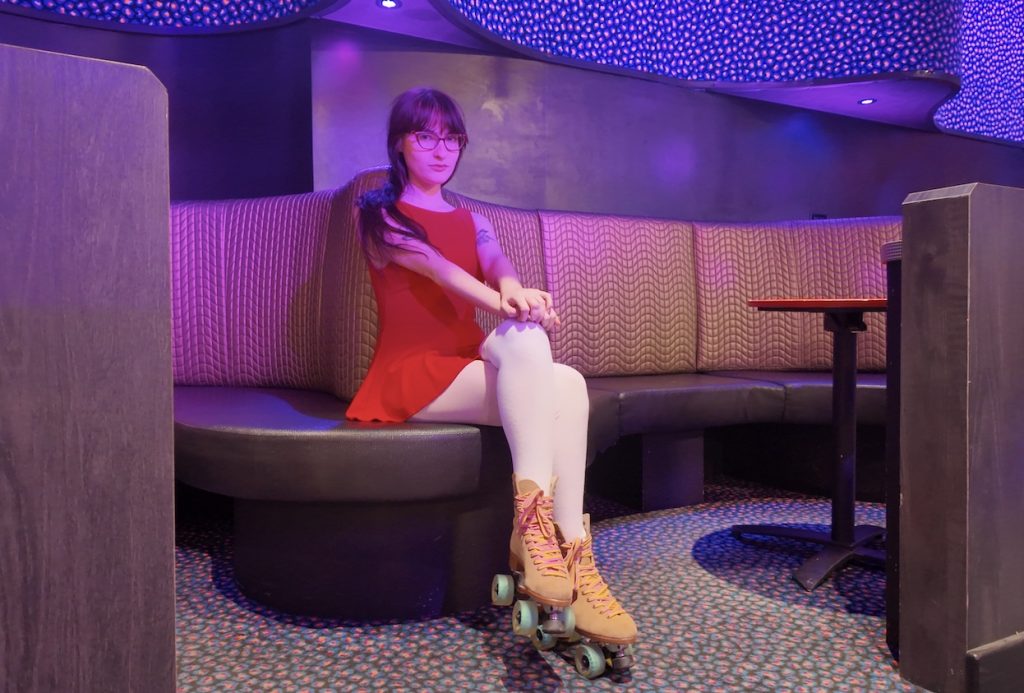
Wearing a rose red dress with arched crimson glasses, Wolk vaguely reminds me of Jimmy Neutron’s Ms. Fowl, especially paired with her nasally voice and habit of speaking like an indignant kid brought in to substitute for some moron adult: No-nonsense and acidic and assured of the lecture she’s delivering (Wolk 101). She flows with a kind of deranged extemporaneous wit, ducking out of and into tangents before returning to the original route of the question. The offhand rawness is what hooks so many young, post-ironic weirdos who are fed up with tidy media-trained influencers and also experience daily life as a 30-tabs-open Adderall scramble.
Photo by Francisco Hernandez
Considering the long arc of Wolk’s career, it’s easy to forget that she’s only 21; it’s also easy to forget, given the detachment with which she speaks about her past, that you’re talking to Wolk and not some professor who has spent ages studying Wolkism. She talks about her need to name-search and create burner Twitter and TikTok accounts to learn what people say about her. “For a lot of people it’s annoying and garish and ugly and nasty how I use the internet, but I don’t really care,” she says matter-of-factly. “I think it’s important to understand why people don’t like you. Understanding the cultural conversation around myself is important for my further study of the phenomenon of what is happening to me.”
The conclusion of Wolk’s research, or at least her current thesis: She isn’t worthy of such derision. “I think people ascribe terms to me—confrontational, abrasive—and it is really as simple as, I am just being myself and however people read it is on them.” Most of the time these days, she’s just at home reading and watching and posting Instagram Stories, alone except for her “insane collection” of celebrity memorabilia. “I really am, like, mad fucking chill. People think I’m crazy as fuck, but I’m just free. I’m not in chains.”
Since she was little, Wolk was fascinated by “women behaving badly,” she says, citing Jodi Arias, a woman from Arizona sentenced to life in prison for killing her boyfriend, which Arias alleged was in self-defense she produced a sketch for her third grade classmates to act out. Wolk was also obsessed with Toddlers & Tiaras, the TLC show that adorned little girls in dresses and “flippers,” or mouth guards that look like straight teeth, with a kind of inchoate sense for its awfulness. Her mom’s iPad contains hundreds of videos of her and her friends roleplaying similar pageants. “At 7, we would wear little slutty outfits; we would wear a bra and panties with a fucking tutu over it,” she recalls. “And we would be gyrating and rubbing ourselves and it was very pornographic. But that was really funny to me, that it was wrong and we are little girls who shouldn’t be doing this, and yet it’s on television for the world to see.”
The perennial role player and ringleader, Wolk would “transcribe television episodes and write my own versions of them from 8, 9 years old, factoring myself in as a character,” and devised a fake game show called Are You a Preteen or Not? that she’d host during lunch at school.
Wolk’s fixation on film and TV LARPing might stem from what she describes as her dad’s “starfucker tendencies.” Together, they’d drive to Beverly Hills or WeHo, and he’d point out reality TV characters behind their sunglasses. Thanks to his job on Kimmel, Wolk met stars like Demi Lovato and Selena Gomez when she was barely above toddler age. But the proximity was just a tease. She grew up “poor,” she says; their family friends were middle-class Hollywood workers. It wasn’t until high school that Wolk met people whose parents “weren’t gaffers or grips [but] actually the movers and shakers, the very famous and very wealthy. I had this feeling of like, damn, my dad would probably kill to be in rooms like this.”
Now Wolk herself is a mover and shaker. While her mom is very proud, her relationship with her dad is a tad strained. “My father, for his own sanity, is not too invested in everything that I’m doing,” she says. “It’s a weird moment where my dad is realizing that I have a certain social capital that he maybe always wanted to have himself. And that is a strange dynamic, where people tell him a lot that they’re fans of my work when they find out he’s my father. There’s a jealousy there maybe, or a worry that my burgeoning fame will somehow embarrass him.”
Wolk is just as vulnerable in real-life as she is online, though “vulnerable” is not the right word: She’s an open book because she doesn’t possess the capacity to not be. She’ll talk about anything: whether divulging so much publicly makes it hard to date (yes), or her experience going through psychosis two years ago (“I was definitely using the internet at that time in a very strange kind of freakshow, lolcow way”) as a result of “drugs, depression, stress, illness, and poverty.” Probably the most “radical” thing about Wolk is her refusal to withhold. And instead of quitting after any particular burst of outrage or cringe viral episode, she kept posting through it, until she reached some kind of Nirvana of invincible shamelessness. Now she’s hanging out with an all-star cast ot gives-no-fucks idols like Courtney Love and Azealia Banks. It is in some ways not too dissimilar from the worst narcissistic, persona-as-performance artist excesses—the Trumps, Kanyes, Claviculars—but twisted into something more productive. Being the most annoying pariah possible encourages others to let their freak flag fly.
“I’m not selling [internet users] a way of life that is capitalistic or harmful,” Wolk elaborates, staring intently. “I’m selling them a way of life for free that’s like, ‘Hey, are you a woman tired of being under the thumb of the world and feeling like all you can do is self-censor because you’re worried about being gauche? What if you lived a life where you were as wacky as you ever wanted to be?’ People have tried to make me regret things that I’ve posted, and I think you can understand that something is not true or good to say anymore without kicking yourself constantly for having said it. I think as long as you’re committed to moving forward and being a more empathetic, curious, understanding person of the world, then that’s all that really matters.”
“What I do on the internet is liberating to me at times,” she adds. “It has also been entrapping and has opened me up to very painful criticism and castigation. But ultimately, from where I’m standing now, it has been a net good. Nobody’s being imprisoned by what I am posting online.”
Wolk’s crusade against shame dates back to when she was a “depressive, strange,” autistic child who once hid in a bathroom for 45 minutes at a middle school party because she thought she’d committed too many faux pas. She was the wackadoodle devil in a City of willowy, chic Angels: “In LA, the expectation for girls from a very young age is to have this detached affect, to be cool and slight and quiet. I always found it strange when I’d go to house shows and nobody would dance when the music was playing. I’d be dancing wildly… it was basically aura farming before that was a thing.” (OC Weekly has a photo of Wolk, age 12, crowd-surfing at a The Garden show.) In high school, she told a therapist she felt like an alien in a human skin suit. “I’m sure a lot of [girls’] quietness came from insecurity, and having to keep up appearances is a crushing thing. But I’ve always lacked the ability to keep up any appearance.”
As she got older and her online infamy swelled under the first handle @fathoodbitch, she started only hanging with people double her age. Fake ID in tow, she “opted out” of the pressures of adolescence, hitting comedy clubs with adults across LA. “My squad senior year of high school was a group of guys aged 25 to 37.” These included comedians like Jay Weingarten, and Grace Freud and April Clark from the duo Girl God, and indie filmmakers like Brandon Wardell; she started grabbing coffee with Sean Baker after cold DMing him a question. Wolk began performing comedy herself at 17 at places like The Elysian in northeast LA. She got a boost from indie filmmaker Eugene Kotlyarenko, who cast Wolk in his 2024 COVID oddity The Code and introduced her to Adam Friedland. The Cum Town alumnus invited Wolk to act as a crazy fangirl in an early episode of The Adam Friedland Show.
This was also around the time Wolk met fellow e-girl Mackenzie Thomas, known for reading her childhood diaries aloud and, recently, surveilling herself 24/7 with cameras. They met at the back of the Club Cafe comedy venue in LA. “She was an unattended child, and I was like, ‘Girl, I recognize you from the internet.’ We hit it off immediately,” Thomas told me over the phone as she walked to Maria-Hernandez Park in Bushwick. Thomas, who’s 27, thinks of Wolk like a little sister—both in terms of how proud she is (“I don’t think anybody could mimic Ivy or copy her because they’re not brave enough. I’m sorry, nobody has the lived experience that she has so young, nobody has this Rolodex of references”) and how terrified she’s been. When they met, Wolk was in the throes of an internet backlash vortex. “She was struggling for a super-long time with public perception,” says Thomas. “It used to really fucking bother her to an extent that scared me, honestly. But over the years, I’ve watched her take control of her narrative.”
Thomas knew Wolk when she was addicted to pills, an era that “almost killed me. I was freaked out, calling her mom,” Wolk says. During another crazed period, Wolk had nowhere else to go and took Thomas’ couch. Thomas has also tried to rein Wolk in at times; Wolk wanted to do something “so fucking funny” recently with Azealia Banks, who’d just had a viral moment where she was taken aback by Judi Jupiter, a 76-year-old interviewer ambushing her with questions. “I think Azealia Banks is in a really bad place and if they hang out and she turns against Ivy, I just don’t really want that for her,” Thomas says. “I just want her to be safe and I want people to be nice to her.”
Wolk has also been there for Thomas, being her rock after a bad breakup. “Sometimes something so fucked up happens to me and I’m just like, ‘The only person in the world I can talk to about this is Ivy.’ … We do call each other crying quite a bit.” Sometimes they’ll just lay in bed and watch Instagram Reels together. They have a group chat with the actress Elsie Fisher called Awesome Girls Reels Club; their latest obsession is Ada Roseberry, a mom in the middle of nowhere. “We find little new lolcows constantly,” Thomas says affectionately.
“I think there’s a true strength in being unfiltered and digitally naked in a way, and Ivy’s really good at that. I don’t think the world was ready for the way she wanted to do that,” Thomas says. “People think she’s racist or nasty, but that’s just not true.” People close to Thomas would scold her for being so tight with Wolk before meeting her and changing tack. ”They’re like, ‘Oh, I was completely wrong.’ It’s a magic trick I’ve performed probably over 20 times. You talk to her for five minutes and you’re like, ‘Oh, this [hate] was the work of some true internet evil.”
Thomas and Wolk moved to New York within the same week; at this point, Wolk was 19 and ready to take comedy seriously. Her first venue was Alligator Lounge. Early on, she became associated with Dimes Square, the hallucination of a downtown New York scene that animated myopic Substack thinkpieces. “I never considered myself part of it—it was people that I would do coke with that lived in Chinatown,” Wolk says now. “I’m quite devoid of a scenester tendency. You’re hard pressed to get me outta the house unless I’m working. The comedy scene is the only social fabric I’ve ever been a part of in my life.”
Compared to LA’s endless reel of weekly shows, Wolk says, “there’s not really much of a free-flowing independent scene here right now.” Every weekly show that existed in NYC when she moved has dissolved into monthly or every-other-month affairs. “It’s a lot harder to do as much standup here if you’re not passed at a mainstream club, like New York Comedy Club or Broadway Comedy Club or The Stand or The Cellar,” she explains. “If you’re an alternative comedian, like I am—Union Hall, The Bell House, Littlefield, they only do produced shows.”
Wolk complains that too many comics nowadays acquiesce to the crowd in an effort to do well. She has no interest in being “submissive to the audience.” That’s another way she justifies Catfishing for Love. “If I’m on the stage, it’s my time to dominate the conversation.”
The state of the comedy scene is also why, despite packing out most rooms (until people start walking out—a badge of honor), she needs other jobs. The side stuff she’s doing mostly aligns with her silver-screen fantasies. Besides the unsold pilot, she and the same friend, Creston Brown, are eight drafts through a Lifetime movie about a femcel who kidnaps a tradwife influencer, “fucks her husband, and raises her children… we’re finally nearing the endpoint where they’re getting ready in the next six months to film it and put it on television.”
Brown’s known Wolk for years and watched as she slowly evolved from IG Reel apparition to professional writer. “People like Ivy are trying to push the boundaries and get things made even though the system is rewarding the most mediocre content right now,” he says. “At the end of the day, I admire that she’s a humanist. She loves people. She’s just obsessed with understanding people. She’s like Johnathan Demme or Mark Twain or Joan Rivers or Robin Williams. You love people, you love humanity and all the weird things that people do.”
Her friends seem like they’d die for her. They predict that she’s about to take over. Brown says it’s “fucking crazy” she isn’t on SNL. “You could say whatever about Zendaya, about these A-list stars, but I feel like there’s no young actress that’s being talked about more than Ivy Wolk. Ask anyone and they’ve heard of her,” he argues, which is admirably passionate but hyperbolic (ask 10 people in a place not named Bushwick and the hit rate will quiver). Thomas wants to see Wolk “play Elizabeth Taylor. I wanna see her play Princess Diana. I wanna see her play Carrie Bradshaw. I wanna see her play a mailman. I wanna see her do everything. That’s why people are obsessed with her: put her anywhere and it’s everything, you know? There’s few people in the world so able to grab reality and cut through it at the same time.”
Photo by Francisco Hernandez
For now, Wolk will play someone who is “crying, screaming, being assaulted, and tortured” in a Ryan Murphy thriller show coming this August on FX. She doesn’t have anything new in the works with Baker yet, but they talk constantly. “He and his wife Sammy came to see my solo show last month and that was really special,” she says. “I trust that man with my life.”
Lately, Wolk has been entertained by a new crop of Ivy Wolk archive accounts that dredge up stuff she can’t remember from when she was 14. This has actually happened a lot; after posting so feverishly, and through psychotic periods where she had little control over what she was doing, the internet knows more about her than she does. While she’s never been attacked in real-life for something offensive she’s said online, she’ll have people come up to her like, “‘Dude, that beef stew saga from two years ago.’ And I’m like, ‘What are you talking about?’” The spirit of Ivy Wolk has diffused across her followers; even if she doesn’t have a TV show yet, she’s influencing how young people speak online and deploy things like Instagram Create Mode for out-of-pocket observations and ramble-art. “In the coming decade,” she augurs, “we will see a lot of Ivy Wolk sons, daughters, NB children.”
All her posts now, she says, are “motivated and artful and add to the larger lore project of me. I could argue for any post from the fucking depths of my soul.” She has an unkillable, maybe foolish faith in the internet despite everything that would make a sane person a doomer: the snark Reddits, the hate campaigns, the misogyny. “My use of the internet makes me a better, more empathetic, smarter person. I always feel good about my use of the internet,” she says. She’s being honest: The internet gave her everything. She is the internet, an always-unraveling avatar for the data dump. “Posting online does not scare me whatsoever,” she declares. “It’s so second-nature. To me, posting on my phone is joy. It is freedom.”
Going home that night, hour after we met, on the way back from a wedding, I checked Wolk’s Instagram. She’d just posted a dozen more stories.
The post Who’s Afraid of Ivy Wolk? appeared first on BKMAG.
