
The last book by the late New Yorker art critic Peter Schjeldahl, The Art of Dying (2024), begins with a bang. Told that he is dying of cancer, Schjeldahl has a unique reaction: he organizes a trip to Madrid, for the sole purpose of spending a significant amount of time at the Prado. After you think about it for a while, it begins to make sense. There you will find the richest collection of paintings by Francisco de Zurbarán, Diego Velázquez, Francisco Goya and El Greco. It’s relatable to anyone whose greatest pleasure in life is looking at stuff, though personally, I wouldn’t have brought Steve Martin on the trip. He’s too funny; it would be a distraction.
With “Zurbarán” at the National Gallery in London, you don’t need to go to Madrid to luxuriate in the works of this master. The exhibition represents the first major show the U.K. has ever given Zurbarán (1598-1664), and features more than 40 paintings, drawn from the Prado, the Louvre, the Art Institute of Chicago, the Thyssen-Bornemisza, the Cleveland Museum, the Norton Simon and the Gallery’s own holdings. The show spans a career that ran from Seville—then one of the richest cities in Europe, its port wired directly into the trade of the Americas—through a brief, prestigious stint painting for Philip IV in Madrid.
“Zurbarán“
Artist: Francisco de Zurbarán
Venue: The National Gallery, London
Address: Trafalgar Square, London WC2N 5DN
Through: Aug. 23, 2026
This last bit produced one of the weirder—we can say “more unique”—works in the show. Hercules and Cerberus (1634) emerged from an invitation that Zurbarán received to help decorate the Buen Retiro, Philip IV’s new pleasure palace in Madrid. This work turned out to be his only royal commission, his only classical subject and his only significant engagement with the male nude. Amid all the scenes of Spanish battle and portraits of the royal family, this painting feels particularly raw. Hercules’ every muscle is on display as he hauls the three-headed hellhound up out of the underworld on a rope, his club at the ready—the labor was to drag the beast out alive, not to kill it. And look how it smolders, the deep blacks shot through with the fiery orange of the underworld behind him. He’s absorbed the hard, naturalistic style of Caravaggio’s followers into something more direct and more strange. An outlier in the oeuvre, and yet unmistakably his. Even at a royal palace, this means a Hercules who is effortful rather than cocky.
Fashion must be central to any exhibition staged these days, and there’s a room at London’s National Gallery that makes the case for Zurbarán as Spain’s first fashion designer. Saint Casilda (c. 1635) would be a good example of this. In a background that might as well be theoretical, she is like one of those overly elaborate cakes from a televised baking competition, a toothsome tower of silk, taffeta and brocade. Her dress is elaborate enough to be a tapestry, and the coloring is outré. This was almost a trend of the era, with the preacher Bernardino de Villegas complaining that such saints were “dressed so profanely” that they read less like figures from heaven than “ladies of the world.” It’s possible he was just jealous of her lovely red skirt.
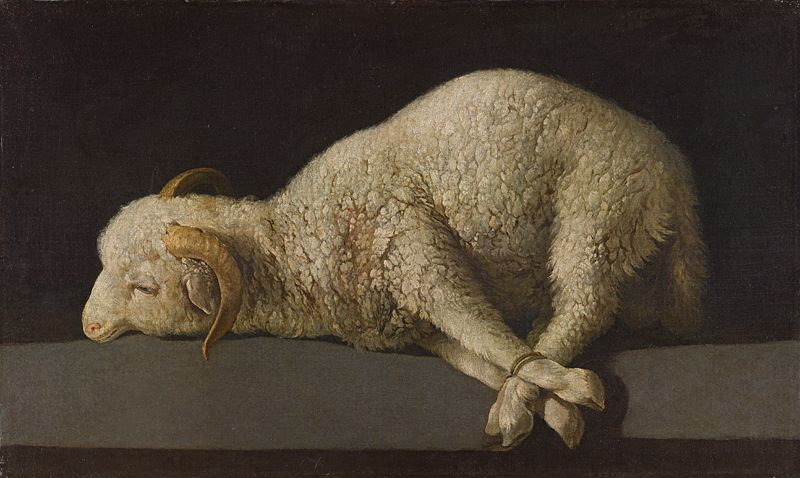
The Agnus Dei (1635-40) gathers up everything else in the room. You can lose yourself in the details of the work—the tangled and snowy fleece of the lamb rendered so realistically, but like a mountain, the shadows on its curved horns so subtle, is its face being blasted with divine light?—that you may not even notice that this lamb is about to be slaughtered. Zurbarán looked life square in the face, and saw in it all its beauty and viscerality.
