
This story is part of the Pride edition of Summer & THE CITY, our weekly newsletter made to help you enjoy — and survive — the hottest time in the five boroughs. Sign up here.
Joel Pipitone filled a penis-shaped glove with yellow Vitaminwater and slipped it into their pants in the basement dressing room at Brooklyn Art Haus on a recent Wednesday night.
Then they adjusted its position in their crotch, jumping up and down to make sure it’d stay put until its reveal in the opening sequence of their clown show upstairs.
“When people say they’re packing, that’s what they mean,” Pipitone said, before whispering to themself: “Maybe I need to fill it up with a little more liquid.”
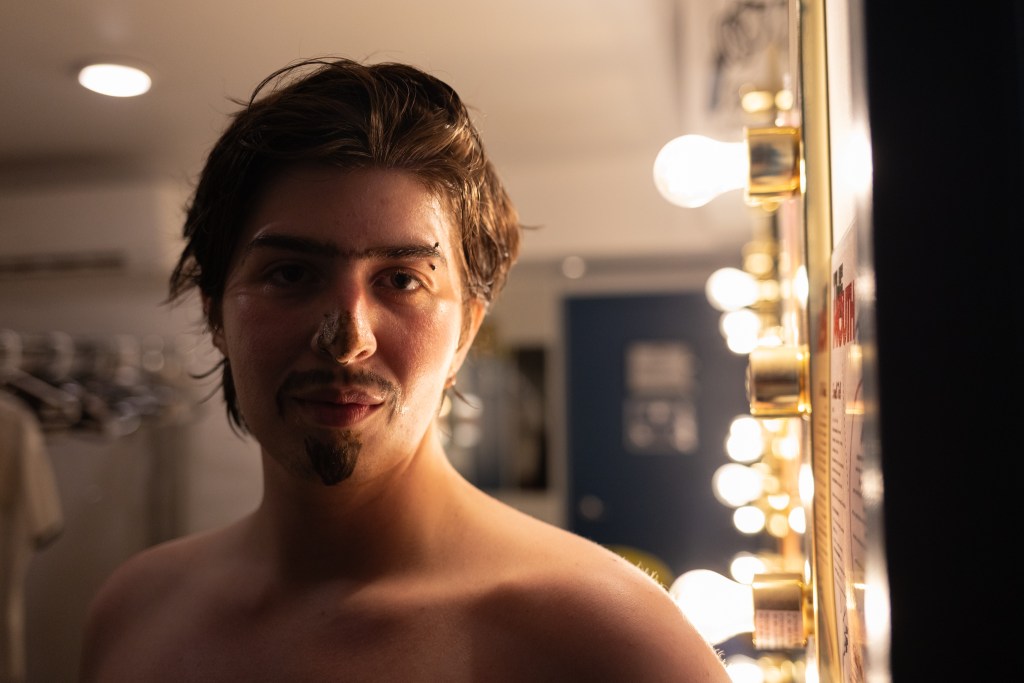
Pipitone, 25, turned to a mirror moments later. With black eyeliner, they filled in a mustache and goatee on their face — building upon facial hair that’s begun to grow since they started testosterone therapy about a year ago.
Joel Pipitone filled a penis-shaped glove with yellow liquid before a clown performance at Brooklyn Art Haus, June 4, 2026. Credit: Haidee Chu/The City Reporter
“He’s sort of a boomer masculinity coach who teaches men how to be real men — but it’s played as myself as a trans-masc person,” Pipitone said, explaining their clown character for the night: Mike Mike Diablo.
“So for me, it’s also about, what are these things we don’t say about gender — that’s so in the culture and that are so funny — that I can mock?” they added. “It’s laughing at the absurdity of gender performance while also exploring the very deep vulnerability of what it means to, I think, be queer in a world that is so defined by gender.”
Those themes are increasingly resonating outside of traditional clowning circles, according to experienced New York clowns, as political and economic tensions have risen across the country — pushing younger people, queer people and people of color further towards the margins.
But more people, they say, are also simply discovering the joys of clowning.
Pipitone teaches a monthly queer clown and movement workshop in Brooklyn. They said they’ve noticed a growing interest in the art among the local queer community as the city’s clown scene burgeoned in recent years. Its popularity has matched a broader uptick in clownery in many places, including the mega-hip Los Angeles clown scene — especially after a publicity boost from clown and “Heated Rivalry” star Connor Storrie this year.
Joel Pipitone performs a “masculinity lessons” clown show in Williamsburg, Brooklyn, June 4, 2026. Credit: Ben Fractenberg/The City Reporter
“Every queer friend group is funny. Everyone is doing a bit. Everyone’s a comedian,” Pipitone said. “Even with other types of performers, they’re getting drawn towards clown to build their skills.”
Suz Murray soon stomped down the stairs in their teal-colored boots, clinking and clanking their way into the dressing room with a rattling metal tool box in hand. A thick layer of white face paint masked their natural eyebrows, which were slicked up using a glue stick and toothbrush and replaced with an exaggerated, drawn-in arch.
Murray, 40, was clowning as Kachonk — a surrealist, robotesque worker surviving under capitalism — to open for Pipitone’s solo show on that warm June evening. Pink eyeliner on their waterline gave Kachonk’s face a hollow, exhausted cast, while a furry thong tucked between their leotard and another pair of panties bulged up their crotch.
Suz Murray performs as Kachonk at Brooklyn Art Haus in Williamsburg, June 4, 2026. Credit: Ben Fractenberg/The City Reporter
“I’ll literally take this out in 10 minutes,” Murray said, referring to their 10-minute opening performance. “But now when I don’t wear it, I feel so weird.”
“It’s so good!” Pipitone exclaimed. “Can I take a photo?”
Pipitone approached for the picture and the two exchanged hugs. They met last summer, Murray recalled, at a monthly queer clown show entitled “Fool Around the Block” in Bushwick. Now, a year later, they were about to perform together for the first time.
Queer clown performers Suz Murray, left, and Joel Pipitone take a selfie backstage at Brooklyn Art Haus in Williamsburg, June 4, 2026. Credit: Haidee Chu/The City Reporter
“Oh, life is so joyous,” Pipitone said.
Murray squealed: “Thank you for having me on!”
“Dude, thank you for being on the show,” Pipitone responded. “Every masculinity coach needs a nonbinary it/its friend to show them what’s up.”
‘You Have to Tell the Truth’
As founder of the Brooklyn Comedy Collective’s clown program, Tallie Medel has witnessed clowning become more popular among queer New Yorkers.
“A lot of people claim their gender or queerness in class because they can’t lie anymore,” said Medel, 40, Pipitone’s teacher and neighbor, who played a supporting role as Joy’s girlfriend in the Oscar-winning blockbuster “Everything Everywhere All At Once.”
“It’s really moving — and then there’s a classroom of people who have already loved them and are like, ‘Absolutely, can’t wait to call you what you’ve always wanted to be called. How else can we affirm you?’” they said. “It is the best, dude.”
That reckoning with truth feels almost inevitable in clown class, Medel added, “because we’re examining shame and humanness and also getting into the body and seeing the confidence that comes from people really knowing themselves. You have to tell the truth.”
Medel draws a line from clowning to anti-fascism and humanitarianism: “It’s quite anti-fascist to claim your own body and know that it doesn’t belong to the state or to another person,” they said.
They also connected the art to mercury, the element namesake of the Roman trickster god, which was historically used to make mirrors.
“Clowns are synonymous with mirrors,” Medel explained. “We make ourselves the fool and we set the world free. Our job is to tell the truth and to balance the world by playing with status and power structures — pointing a finger at different aspects of society that need to be laughed at.”
Joel Pipitone takes off their makeup after performing a “masculinity lessons” clown show in Williamsburg, Brooklyn, June 4, 2026. Credit: Ben Fractenberg/The City Reporter
As the clock approached 7:30 p.m. at Brooklyn Art Haus, a theater technician quieted an audience of roughly two dozen people.
“Thank you everyone for coming!” the technician announced to a cheer.
“Happy Pride!” the worker continued, as the roar grew louder. “Alright, coming up to the stage — make some noise for Kachonk!”
Kachonk soon emerged from the back of the theater, behind the four rows of chairs where the audience was seated.
“Morning,” Kachonk said, prompting the showgoers to turn their attention to the back. Kachonk let the silence stretch as the audience stared, unsure whether to respond — until one person finally greeted them and others joined in.
Suz Murray shows their different facial expressions during a clown show at Brooklyn Art Haus in Williamsburg, June 4, 2026. Credit: Ben Fractenberg/The City Reporter
“Morning,” Kachonk reaffirmed, before continuing in a robotic voice: “Time for — work. Time for — commute.”
With rigid limbs, stiff strides and exaggerated effort, Kachonk marched toward the stage.
“Coffeeeeeeeeeeeeeee!” Kachonk shouted once they arrived, taking big gulps before asking a member of the audience to hold their tall thermal mug.
“Boss? Boss?” Kachonk said as they searched for direction from the audience and obeyed their command to do a somersault.
Suz Murray performs as Kachonk at Brooklyn Art Haus in Williamsburg, June 4, 2026. Credit: Ben Fractenberg/The City Reporter
“Clown is inherently very queer,” Murray said after the show. “It’s about following a very guttural impulse, which I feel like if you’re exploring your gender, your sexuality, that’s what it’s all about: Like, what are the other possibilities besides what’s so prescribed?”
Kachonk, specifically, is a commentary about “the grind,” as Murray puts it. “I think for me, it’s not necessarily that jobs are bad, because, you know, it’s more complicated than that. But it’s just like the shit we go through and, like, how it destroys our body.”
The character was not born from frustration with any particular job as much as from pure serendipity, Murray said. Mesmerized by the sounds created by a metal suitcase they had stumbled upon, Murray began to develop Kachonk last October, months after returning to the clown scene following a two-decade hiatus.
“The comedy scene for so long was, like, straight and heteronormative,” Murray said. They were first exposed to clownery as a 16-year-old in high school, they said, and had wanted to continue clowning when they moved to the city in the early 2000s. But they had no luck finding clowns around town — until about a year ago.
“I started working with some people who were clowning, and I was like, ‘Wait, the clowns I have been waiting for!’” Murray said.
“We, the queer clowns, we find each other.”
Clowning as an adult, however, feels different from when they were a teenager.
“I was just getting my bearings of, like, how to be human, too, and going through adolescence. I hadn’t come out as nonbinary, and the clown work I was doing then was very binary-gendered,” explained Murray, whose high school theater teacher gave them the clown name “Ms. Business.”
“And now, it was definitely after going through a gender journey and feeling really self-affirmed that I was able to really dig in,” they said.
‘I Can Be Completely Deranged’
Back on stage at Brooklyn Art Haus, Kachonk prepared the audience for Pipitone as their opening act came to a close: “Are you guys ready for Mike?”
The crowd cheered as another voice emerged: “Hi, it’s me, Mike Mike Diablo.” A projector screen in the backdrop set the agenda for the rest of the night: “Mike Mike Diablo’s Masculinity Lessons.”
“Before class starts,” he continued with a drawl, “I want to say, silence your cellphones — but also use them to take photos of me, especially where I look toned.”
Slowly but energetically, Mike Mike Diablo moved toward the stage — stopping at times to growl at audience members and inviting them to reciprocate. He karate-chopped a piece of paper with the word “matriarchy” on it, before destroying another piece of paper with the words “small penis” on it.
Once on stage, he bit open the medical glove on his crotch to let out the yellow Vitaminwater, before laying down protein powder in a line on the ground and snorted it up his nose. Moments later — crack! — he broke a raw egg on his forehead and let its contents fall into his mouth, before play-vomiting most of it out moments later, egg yolk drooling down his bottom lip.
“What I love about playing this character is I can be so gross, and I can be completely deranged,” Pipitone explained before the show. “I started as a stand-up comedian and I found myself very much, you know, memorizing every joke and punchline. But being a clown is all about stage presence and being inside your body.”
Joel Pipitone has an audience member hold up a sing reading “Patriarchy” at a clown show. Credit: Ben Fractenberg/The City Reporter
Pipitone said they had initially devised Mike Mike Diablo to poke fun at traditionalist, conservative men like Jordan Peterson. “But as I really dug into Mike Mike’s vulnerability and his inherent queerness … and took back those layers, and I was like, ‘Well, gender and these rules — his lessons that he teaches — are so learned and made up.’
“It almost feels so similar in how I’m learning the social ethos of being perceived as a man now, versus the inherent masculinity I’ve always felt in my life,” they continued. “And as I had a show date a little too freshly after top surgery — maybe a month and a half later — I just kind of knew it was important for me and the character to show my top surgery scars. It seemed like another layer of this character.”
Joel Pipitone performs in Brooklyn, June 4, 2026. Credit: Ben Fractenberg/The City Reporter
‘We’re Rewiring the Brain to be Stupider’
Several days passed by before Pipitone gathered a group of roughly a dozen people in a circle at the back of BOYFRIEND Co-op on a Sunday morning in Brooklyn.
“I’d like to say one thing up top,” Pipitone announced as the queer clown and movement workshop commenced. “Which is that even though we’re in the back of a bar in Bushwick, try to suspend your anxiety and fear of being perceived as stupid. That’s why we’re here.
“The goal is to make a fool of yourself,” they continued. “And everyone here is a silly little goose — and I know that — so the class is also just about freeing the inner gay child and just having fun.”
Joel Pipitone leads a queer clown and movement workshop at BOYFRIEND Co-op in Bushwick, June 7, 2026. Credit: Haidee Chu/The City Reporter
For the class’s first exercise, Pipitone instructed the students to go up to a fellow classmate and make a random sound. That second classmate would repeat the sound, before rushing off to another student to make a new sound, and so on and so forth.
“It’s called a sound circle,” Pipitone said. “I’m gonna do that right now. You’re ready?”
“Ah, mama mia,” Pipitone exclaimed, their fingertips bunched together in a pinch as they demonstrated in front of a student. The student repeated it back, then turned to another person, rolling their tongue to let out a high-pitched purr.
One at a time, the students mimicked various sounds. Some let out timid meows. Others let out expressive barks, soliciting laughter.
A second exercise followed, as Pipitone instructed students to walk through the space in random patterns: “And when I say stop, you’re gonna keep going. And when I say go, you’re gonna stop.”
“Can you see what I’m getting at?” Pipitone said after the exercise. “We’re rewiring the brain to be stupider.”
For the third exercise, students were free to be as they wished while pairing up and taking turns practicing clown bits. One student would play director and instruct the other to develop or switch up their character.
Abby To, 30, fell into a brown leather couch in the space in an instant, letting out horrified screams as she rolled around and coiled herself on the couch before slinking onto the floor, face down.
Abby To participates in a clown workshop in Brooklyn. Credit: Haidee Chu/The City Reporter
“Do you act?” To’s partner, Amanda Gordon, asked. “You’re really good!”
When it came to Gordon’s turn, the 26-year-old began to dance and twerk, dropping low to the ground.
“Clown is kind of hot and popular right now,” To, who does improv, said during a break. “What surprised me about clown is you’re just being yourself, whereas in improv you’re building off of someone else. … Here, you’re really leaning in and pulling out what’s stupid and funny about you.
“Also the thing I’ll say is, like, improv is 100% a straight, white male sport,” said To, who is half-white and half Chinese-Indonesian. “It’s just nice to be in a queer space.”
Amanda Gordon participates at a a queer clowning and movement workshop in Brooklyn, June 7, 2026. Credit: Haidee Chu/The City Reporter
Gordon, a stand-up comedian, agreed: “There’s just a different level of comfortability and vulnerability here.”
At the end of the two-hour class, Pipitone gathered the students in a circle again.
“We’re going to make a sort of class soup of what we have learned, so everyone’s a chef of the soup, and we will throw in the ingredients of our choosing,” Pipitone said, prompting the students to participate in a stirring gesture.
“Fun,” one student said, as their hand released the invisible ingredient into the soup.
“Bravery,” another followed.
The rest chimed in one at a time: “Stupidity,” “vulnerability,” “center yourself,” “development,” “eye contact.”
“Alright, let’s try our soup. Does it need anything?” Pipitone asked.
One student smirked with a furtive look, before throwing in the final ingredient: “Mama Mia!”
Our nonprofit newsroom relies on donations from readers to sustain our local reporting and keep it free for all New Yorkers. Donate to THE CITY today.
The post For Queer New Yorkers, Clowning Makes Space to ‘Tell the Truth’ appeared first on The City Reporter.
