
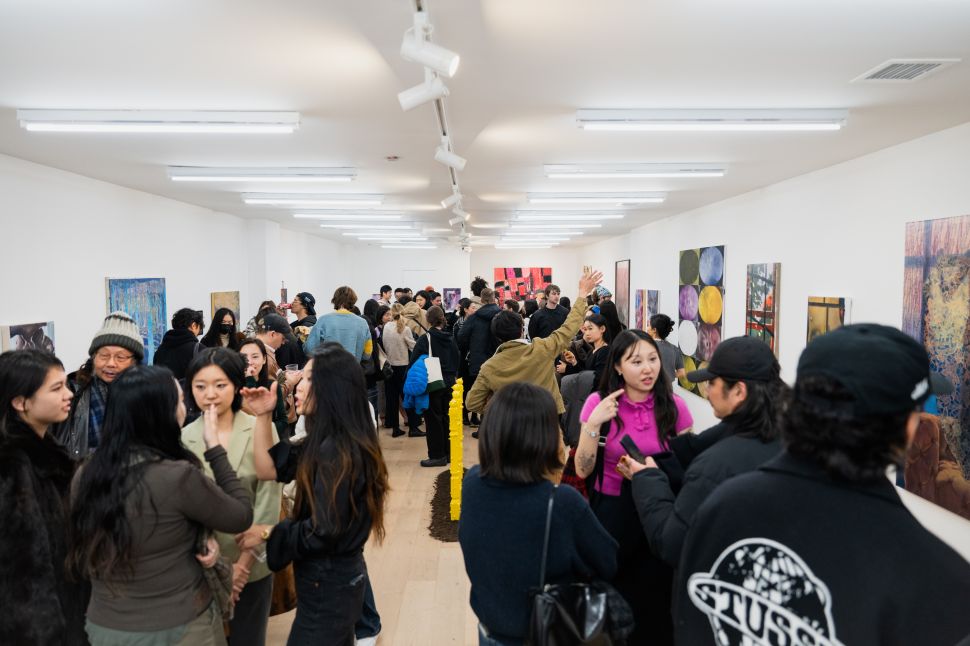
Asian Americans account for only 1 percent of reported cultural engagement, making them the least supported community in New York. Civil Art—an organization that supports AAPI artists, art writers, and cultural professionals—was founded on a desire to change that. Behind it is Korean American artist Ho Jae Kim, who founded Civil Art in the aftermath of the pandemic while pursuing his career as a painter. Since then, he has grown the organization into one with an impact that extends beyond the art world. Between Civil Art’s founding in 2022 and 2025, the organization has raised $755,832 without a development fund, solely through community support. It has created more than 140 opportunities for AAPI creatives and welcomed more than 2,000 visitors to its exhibitions and events. (Of the total funds raised, more than $150,000 was granted to local community organizations working directly with Asian Americans.) And its Community Platform has produced more than 30 online articles, 14 educational events, six exhibitions, four major community activation events and two print publications, creating new spaces for expression, sharing and visibility.
Civil Art grew out of Kim’s conviction that art is not simply visual culture but an extension of humanity, philosophy and communal life. “The way I learned to love art was not just through the visuals, but also through the history of how people really bleed into something, to the point where they build communities, share ideas, and ultimately change how people see the world,” Kim tells Observer as we walk through his Brooklyn studio. “I have always been interested in how art can contribute to society, to the way we feel and the way we think.” This way of thinking about creation informs his own studio practice, which he sees as a contemporary way of revisiting humanism. “Artists do not always have the ability to bridge that encounter with the public.”
From June 18 to 30, Civil Art is hosting “Luminous Path,” a curated selling exhibition at Christie’s, part of an ongoing partnership that began in 2022. Curated by Aleesa Pitchamarn Alexander, Kathy Huang, Peter Kahng, Ho Jae Kim and Carla Shen, the show features artwork by promising and established names from Asia and its diaspora, with pieces that consider the exhibition’s theme in both material and concept.
Kim’s experience as an immigrant has shaped the organization’s mission. While studying at RISD, art history made the world feel limitless, but in the wider world, he encountered a harsher reality: “You almost believed you could do it, that you could change people, but outside of the classroom, it was very different—especially for someone who grew up with financial and family circumstances like mine.” He saw firsthand how difficult it was to access the resources, opportunities and networks needed to build a creative career. “The path to becoming an artist, or pursuing anything in the creative field, is already very difficult. On top of that, for minorities whose histories have been invisible for a long time, there is also a lack of resources and opportunities.”
During COVID, amid hardship for artists and the surge of racism targeting the Asian American community, Kim cold-pitched Christie’s about organizing a fundraising exhibition for Asian American artists and community organizations. Civil Art did not yet exist; he just wanted to find a way to sell art, raise awareness of Asian artists and direct support back to the community. “I knew a few people at Christie’s at the time, so I wrote to them and said, ‘I think this is the time when we can do something for my community through some of the resources and facilities that you have.’ Luckily, that idea was accepted,” he recounts.
The resulting exhibition, “At the Table,” featured around 40 works by Asian American artists and raised more than $200,000, with part of the proceeds going to the artists and part donated to Heart of Dinner, a nonprofit supporting elderly Asian Americans living in poverty. “With this fundraising exhibition format, I realized we could actually give back directly to people in my community who needed support,” says Kim, adding that putting together that first exhibition helped him see that what he had previously understood as his own lack of access was, in fact, a shared experience. The missing piece was not desire or talent, but a platform.
After “At the Table,” he formalized that platform in Civil Art, which he launched with three co-founders: Sarah Han, Matthew Capasso and Rachel Ng. Han brought gallery experience, while Capasso and Ng were working at Christie’s and helped co-produce the first initiative. Today, Kim serves as CEO while maintaining his studio practice. His early co-founders are now part of the board.
The organization is still focused on supporting Asian and Asian American artists but recognizes Asia as a broad, diverse category rather than a single cultural designation. “One of our long-term efforts is to feature the full, diverse spectrum of our community,” Kim is quick to say. “The most important things are visibility, awareness and a community platform, through exhibitions, book publishing, educational and exhibition walkthroughs.”
Rather than operating as a traditional nonprofit that raises and distributes funds, Civil Art is a multilevel community-building ecosystem. “It came from the necessity of sustainability,” he explains. “I literally started this when I had $40 in my pocket.” Through collaborations not just with artists and Christie’s but also businesses such as East West Bank, ELOREA, Ace Hotel, Le Mieux, the Yang Won Sun Foundation and the YS Kim Foundation, among others, Civil Art was able to strategize and build collectively, even when the organization was essentially still an abstract idea. “By myself, I did not have the ability, but in this way, we became a community, an ecosystem, almost an epicenter where many different interdisciplinary fields could come together, share networks, resources, ideas and awareness and grow together.”
In 2026, Civil Art is projected to reach a million-dollar milestone, raised through a combination of individual donations, corporate sponsorships, ticket sales and other initiatives. Corporate sponsors that provide financial or in-kind support can write off contributions, which Kim says is a strong incentive.
Over time, the Civil Art community has expanded, and Kim credits its success in part to the leadership of Han, Capasso, and Ng, along with Robert Dunn, Anne-Laure Lemaitre, Daniel Liu, Soo Lee, Kat Huang, Megan Noh, Ho Joon Kim, Steve Juh and Sam Hyun. Finding mentors has been crucial—one of the best questions someone asked Kim early on was: “Who suffers if Civil Art does not exist?” and his answer “became a pillar, the background for why we wanted to create programming that actually makes a life-changing impact on people’s lives.
Civil Art continues to serve as a community platform that supports public exhibitions, publishing, events and programs that build awareness and allow audiences to encounter Asian American and Pacific Islander artists. It has also branched out into professional pipeline programs, which offer potentially life-changing support for artists and arts workers in the early stages of their careers. “We wanted to go beyond featuring and awareness, and create something that could be a key moment in someone’s journey,” says Kim.
The organization’s first pipeline program is Art House, an emerging artist leadership program for AAPI artists who recently graduated from college. “We tried to be the bridge that helps them assimilate into New York City, while also receiving educational materials, opportunities and community-building that they may not readily have coming out of school,” Kim explains. Workshops are among the most important components of the program; these cover legal issues such as consignment agreements, taxes, budgeting, LLC formation, grant writing, professional email setup, archiving, packing and shipping. “I personally taught some artist toolkits, such as how to start a professional email linked to your website, how to archive work and how to package work so that you can self-ship when necessary. From my personal experience, there are a lot of elements outside of just painting that schools do not teach.” Participants also connect directly with galleries about studio visits and professional opportunities. “They hear from the gallery perspective what they look for when they visit studios and how artists can leverage those studio visits so that they can turn into opportunities.”
The Art House program guarantees participants at least one group exhibition and is now developing an alumni component in which former participants curate exhibitions for other artists, moving from receiving support to creating opportunities for others. Artists are selected through open calls, recommendations and outreach. “We cannot help everyone, so we want to make sure that the people who really want to make it have the resources,” Kim explains.
Civil Art also runs an internship program for emerging writers, curators and arts professionals, with opportunities in programming, development, design, video editing and writing. Because the organization partners with major cultural and corporate entities, interns gain direct experience working on projects with organizations such as Christie’s and Rockefeller Center. Several past participants have gone on to significant roles or further study, including positions at Hauser & Wirth and MASSIMODECARLO.
What has remained constant since Civil Art’s founding is Kim’s desire to create space for Asian American and Pacific Islander artists and to archive their work, while resisting trend-based visibility. Only the structure has evolved, with Civil Art growing to create systems of support capable of changing the course of an artist’s or arts worker’s life. “In the beginning, I hoped Civil Art could be one way for people to access and become aware of the living talents who are really shaping the world,” explains Kim. “What we have learned and grown into is creating a structure that generates real impact, changing people’s lives.”
He sees Civil Art as providing the kind of infrastructure he wishes he had earlier in his own career. Many talented people, he argues, do not leave the field because they lack ambition or ability but because they lack the network, resources or professional support to survive difficult moments. Civil Art aims to intervene before life circumstances place “an expiration date on a person’s dream.”
Looking ahead, Kim hasn’t ruled out Civil Art expanding into other cities, especially those with large Asian American and Pacific Islander communities, such as Los Angeles. “I think we have the formula,” he says. “Art House is replicable in different cities, as long as there are the right leaders who want to support it. That is the long-term vision.” But for now, however, the priority remains sustainability: building enough funding to support a small staff and reduce the operational burden currently carried by Kim and others.
Civil Art’s partnership with Christie’s continues this month with another fundraising exhibition structured as a private sale. It’s the third iteration of the partnership, and this edition will be intergenerational for the first time, with work by artists including Dabin Ahn, Gahee Park, Amanda Phingbodhipakkiya, Maia Cruz Palileo, Melissa Joseph, Hiba Schahbaz and Sung Hwa Kim, many of whom donated their work directly. Kim reached out to many of the artists and worked with a curatorial committee that included Peter Kong, Carla Shen, Aleesa Pitchamarn Alexander and Kathy Kwong to build the roster. Christie’s also helped identify artists through its own network. “It will be a very diverse show,” Kim says. “My hope is to show the expansion and legacy of art history through the lens of living Asian American artists who are really at the forefront of the art market and their careers. We wanted to show that space.”
Because Civil Art is not large enough to organize galas, these exhibitions are key to gathering and activating corporate, philanthropic and community support, following the same model it launched with: half of the proceeds are returned to the artists, and part is donated to a local Asian American nonprofit. Proceeds from this exhibition will be shared with Apex for Youth, a move Kim says is about bridging art and humanity. “That is why the name Civil Art makes sense. I really believe that art is an extension of humanity. We have all the right pieces of the puzzle to do something meaningful. We just need to connect them.”
