
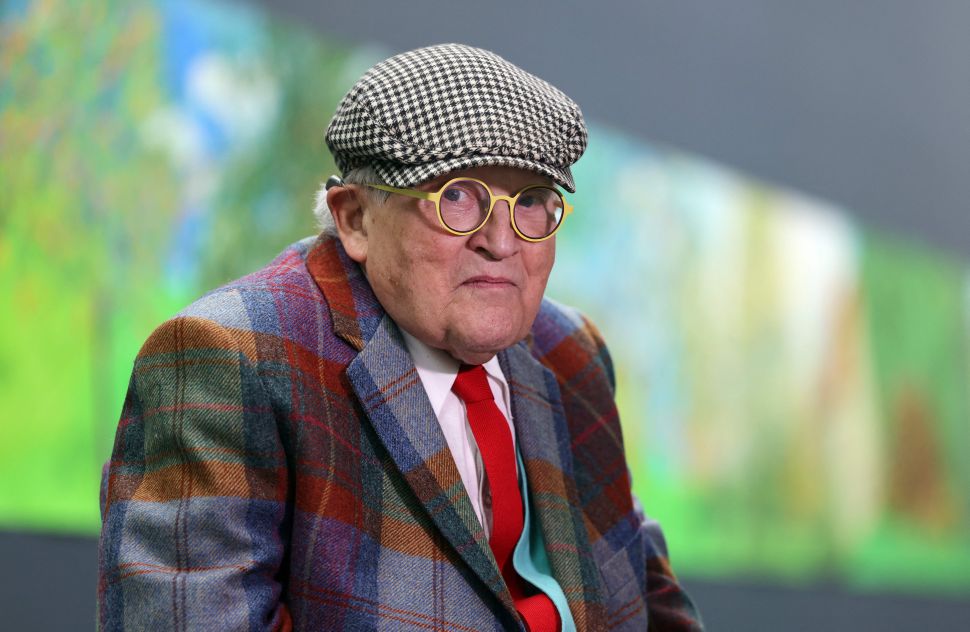
The British have a term for people like David Hockney: national treasure. It’s an informal title reserved for people who achieve success so substantial that their name becomes synonymous with the nation’s identity. When Hockney died last week, both the Prime Minister and the King released statements praising his achievements and contributions to art. Hockney’s most famous paintings depict the swimming pools of California; later works show the changing light of Normandy over the course of a year. Yet he was born in Yorkshire, died in London and never lost his flat Northern accent. There was something else he never lost in his 88 years on earth: his love of looking and using whatever tool felt right to capture what he saw.
Hockney was born in Bradford, an industrial town in the north of England, to a working-class family. His father upholstered prams, and when Hockney started painting street scenes of his native Bradford, he would lug his paints and equipment in one of his dad’s prams. It must have been a funny sight, but Hockney was not one to be embarrassed or snobbish when it came to anything, not least the tools of his trade. He embraced technology wherever it opened new creative possibilities, his curiosity keeping pace with every new development. His works encompass painting, photocopies, Polaroids and iPad drawings. His methods of reproducing the world were not just a means to an end but an inspiration in themselves.
As a student at the Royal College of Art, he was rebellious; he almost didn’t graduate when he refused to fulfill the essay-writing requirement of his degree, arguing that the work should be allowed to speak for itself. Hockney never wanted anyone to speak for him, nor did he want to censor himself in any way. He came out as gay while still a student, at a time when it was illegal to be homosexual in Britain. His signature looks—the blues of Californian water, most clearly—have long been part of queer visual culture. His was not an activist art; there’s no anger or stance, per se, other than an enjoyment of beauty and living how you want. Some of his early works were provocative—a cheeky wink to viewers able to read queer desire between the lines. In Cleaning Teeth, Early Evening (10pm) W11 (1962), two men brush their teeth with Colgate toothpaste, but the positioning of the bodies and the phallic Colgate tubes is unmistakably sexual. A famous work from the year before is less provocative but no less enthralling. We Two Boys Together Clinging at first looks crude, but the longer one looks, the more tender the work becomes. The title of the 1961 painting is borrowed from Walt Whitman’s Leaves of Grass, an example of queer work inspiring later queer work, holding hands through time.
Another important event happened in 1961: Hockney visited America for the first time. Over the next few years, he would create works that came to symbolize the ease, leisure, modernity and loneliness of Californian life. A Bigger Splash from 1967 has entered the visual canon and is as good a representation of the duality of the Golden State—light and water, wealth and decadence, beauty and loneliness—as any work of art in any medium. Its color palette is about as far from the grey skies of Bradford as you can get. Other paintings featuring pools, solitude and Hockney’s lovers are among his most celebrated works. Peter Getting Out of Nick’s Pool similarly plays with light and water but is more clearly erotic. The Peter in question is Peter Schlesinger, Hockney’s lover and muse, and we see him delicately through Hockney’s eyes. Portrait of an Artist (Pool with Two Figures) is a literal painting about looking. This one is set in St. Tropez, France, and depicts Peter again, this time swimming in the pool. (It sold for $90.3 million in 2018, the highest sum paid for a work by a living artist at the time.) Like Joan Didion, Hockney helped shape how we picture California, but also desire and luxury in the second half of the 20th Century: the very word Hockney conjures the tranquil, eerily unreal blue of swimming-pool water.
What other colors does the name Hockney evoke? The iPad greens of the British countryside. The oranges of Salts Mill in Saltaire, a reproduction of which still hangs in my parents’ home. The pink of the roses that match his mother’s skin in My Parents, a painting that shows, as well as any, Hockney’s ability to capture his own feelings about someone by painting them. Later in life, Hockney focused more on landscapes, particularly those of England and France. In 2008, he donated his largest work, Bigger Trees Near Warter, to the Tate in London. He had painted the work the year before in the East Riding of Yorkshire, and the almost luminous greens of the fields in the background are unmistakably Hockney.
During the COVID-19 pandemic, Hockney moved to France. “I’m going to show the French how to paint Normandy,” he joked, never one to resist a provocation. The result was A Year in Normandie, a 90-meter digital frieze created on his iPad. It depicts the seasons over a year, and Hockney clearly enjoyed the opportunity to use a range of colors to capture the changing nature. When I saw the work a few months ago at London’s Serpentine Gallery, I went in half-expecting a gimmick. I ended up walking around the space five times. I felt like I wasn’t seeing Normandy or even time changing, but rather a man’s enthusiasm for capturing the world around him.
Hockney was never interested only in what he saw, but in how seeing worked. He spent much of his career questioning whether conventional perspective or photography really reflected how humans perceive the world. His photographic “joiners,” piecing together multiple photographs to create a single larger image, disrupted our understanding of what a photographic image was and how photography presents reality. The same fascination informed the controversial Hockney-Falco thesis, in which he argued (with American physicist Charles Falco) that Renaissance masters had relied on optical devices, namely the camera obscura, to achieve their realism. For Hockney, technology was never the enemy of art; it was another tool for understanding how we perceive the world.
David Hockney loved many things. He loved color. He loved smoking. He loved fashion. He loved work. He had a rule: “Paint the things you love.” He evidently followed his own advice. In a 2020 letter to Ruth Mackenzie that has circulated widely since his death, he wrote simply: “I love life.” It may be the most fitting epitaph imaginable for an artist who painted what he loved.
