
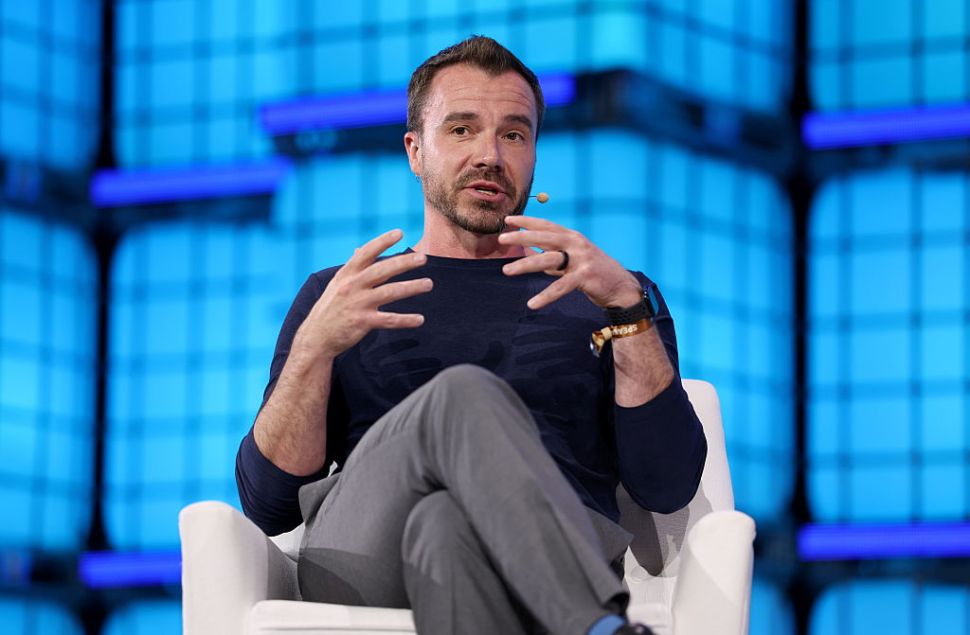
Danny Rensch, Co-founder & Chief Chess Officer, Chess.com, during day two of Web Summit Vancouver 2026 at Vancouver Convention Centre in Vancouver, Canada.” width=”970″ height=”636″ data-caption=’Danny Rensch helped Chess.com grow into a 250 million-member platform spanning subscriptions, creators, coaching and media. <span class=”lazyload media-credit”>Florencia Tan Jun/Web Summit via Sportsfile via Getty Images</span>’>
At Web Summit Vancouver last month, Danny Rensch, co-founder and chief chess officer of Chess.com, asked the audience for a show of hands: Who had seen Untold: Chess Mates, the Netflix documentary about the 2022 Carlsen-Niemann cheating scandal that rocked the professional chess world? Rensch, who was featured prominently in the film, has become one of the most visible figures in chess as the game’s biggest online platform has expanded into media, subscriptions and brand partnerships.
Rensch’s route to co-founding Chess.com was unusual. In 2005, internet entrepreneurs Erik Allebest and Jay Severson bought the Chess.com domain at a bankruptcy auction for their fledgling online chess business. But the company that exists today took shape later, after Rensch joined in 2008 and pushed for a bigger vision involving live video play, coaching and community. “They had a vision for it to be the MySpace of Chess, a smaller vision with many domain names. But I was like, no, no, no, this is the beginning of the future. Chess was made for the digital age, and it’s coming online,” he told Observer on the sidelines of Web Summit.
Today, Chess.com says it has more than 250 million members and generates around $150 million in annual revenue. It hosts more than 10 million chess games every day, and its business now extends well beyond gameplay into coaching, events, creator content and advertising.
That expansion has helped make Rensch a recurring figure in chess media this year. Besides Untold: Chess Mates, the documentary series Grandmasters, in which Rensch also appears, premiered at the Tribeca Film Festival last month. The three-episode series follows modern chess through the lens of Norwegian grandmaster Magnus Carlsen’s attempt to launch a new chess league.
“The story initially focused on the players, but I realized much of the drama was happening outside of them,” Grandmasters director Liz Mandelup told Observer. “Danny has an amazing story. It was almost insane to not include it.”
Last year, Rensch published Dark Squares: How Chess Saved My Life, a memoir that traces how chess shaped his life before and after his formative years in a controlling Arizona collective. The book offers important context for how that experience shaped his worldview and the company he built.
Rensch grew up in a small, financially merged collective in rural Arizona called the Church of Immortal Consciousness, which was run by trance medium Trina Kamp and her husband Steven. He found chess at nine after watching Searching for Bobby Fischer, and he progressed quickly. By age 12, chess had been declared his divine purpose, and he was increasingly and then fully separated from his mother as the collective controlled more of his life.
There’s even a chapter in Dark Squares called “Cults Work,” meant to be read with some irony. Its point is that people can do extraordinary things when they unite around a common goal.
Rensch is careful with the term. “Cults work. Until they don’t,” he writes, and his line for where healthy group energy becomes dangerous is simple. “The moment it tells you it is the only one that has all the answers is the moment it becomes a cult,” he said.
The internet boom in the mid-2000s helped pull him out of that world. Bored and bedridden while recovering from extensive surgeries to repair lost hearing from years of medical neglect living under the cult, Rensch taught himself search engines and SEO. From there, he came to see chess as a product that was naturally suited to the digital age.
Rensch helped Chess.com ride the successive internet waves from live streaming to social media to A.I. In the years leading up to the pandemic, the company invested heavily in courting top creators and influencers, as well as in live-play and cheat-detection systems. As a result, when lockdowns kicked in across the globe, and TV shows like Netflix’s The Queen’s Gambit popularized chess to the masses, traffic and sign-ups soared. “Chess.com captured probably 95 percent of the growth of the chess community,” during that time, writes Rensch in Dark Squares, and there hasn’t been a dropoff.
The company’s recurring-revenue business combines utility and entertainment, using subscriptions to fund features that help players improve while also creating enough content and community to keep them engaged. Most of its revenue comes from roughly 2 million subscribers across three tiers, with more than half on the $119-a-year Diamond plan. Advertising still makes up a relatively small share of the business, but the company is expanding its direct ad sales as it looks to appeal to blue-chip and luxury brands.
Unlike traditional media companies that “gamble” on expensive intellectual property and hope subscribers follow, Rensch said, Chess.com built storytelling on top of an already profitable product. Its media arm, including YouTube and Twitch programming and a creator network, grew out of an ecosystem of players who were already paying for the game. That gives the company a built-in audience and a business model that is grounded in usage rather than speculation.
Rensch sees that structure as one reason Chess.com has stayed aligned with its users in a way his childhood collective never did. “I feel so grateful that we couldn’t even let money be in charge if we wanted to, because the community owned the game,” he said.
His broader point is that communities can act as a check on institutions when they have real agency. In chess, players, creators and fans can move freely across platforms, which keeps Chess.com accountable in a way many companies are not.
And given that IBM Deep Blue beat Gary Kasparov in a game 30 years ago, what business lessons does the chess world offer the rest of us today? “We live in a world where more human beings play chess than ever before,” he told the Web Summit audience. “Human beings do still value the journey more than the destination. There are reasons to be more efficient and productive, but chess has shown that the process of learning and failing while you strive for perfection, knowing you’ll never attain it, is not just B.S. Otherwise, chess would be dead.”
